Chinese Rose Flower
- Chinese
- 月季花
- Pinyin
- Yue Ji Hua
- Latin
- Flos Rosae Chinensis
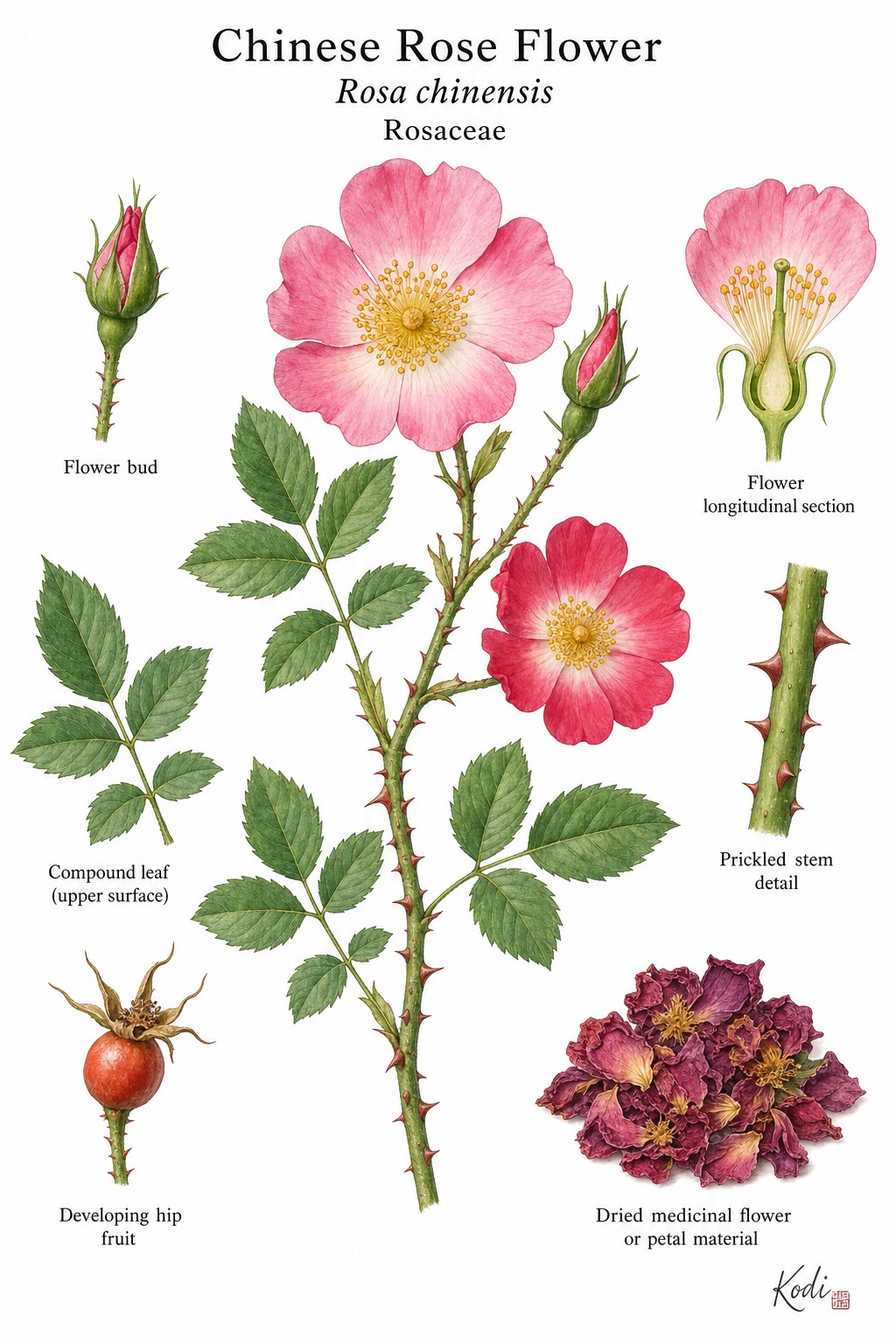
Known in TCM as Yue Ji Hua (月季花), this sweet, warm herb enters the Liver and Kidney. Traditionally, it invigorates blood and regulates menstruation - Yue Ji Hua is used for dysmenorrhea, scanty menses, amenorrhea, and menstrual irregularity when constrained blood and Qi lead to fixed lower-abdominal pain or difficult flow, most often applied for dysmenorrhea, amenorrhea, and menstrual irregularities. Modern research has identified Astragalin among its active constituents.
Part used: Flower
Also Known As
Latin: Flos Rosae Chinensis | Pinyin: Yue Ji Hua | Chinese: 月季花
TCM Properties
- Taste
- sweet
- Temperature
- warm
- Channels
- Liver, Kidney
Traditional Use
Primary Actions
- Invigorates blood and regulates menstruation - Yue Ji Hua is used for dysmenorrhea, scanty menses, amenorrhea, and menstrual irregularity when constrained blood and Qi lead to fixed lower-abdominal pain or difficult flow.
- Reduces swelling and resolves toxicity - beyond gynecology, the flower is traditionally applied for boils, breast-area swelling, scrofula, and early hot suppurative lesions where blood stasis has transformed into heat and swelling.
- Moves Qi within blood-stasis patterns - classical comparison with Mei Gui Hua emphasizes that Yue Ji Hua works more strongly on the blood aspect of stagnation, especially when pain, clots, or traumatic bruising predominate.
- Relieves pain and swelling from traumatic injury - regional use includes bruises, fixed injury pain, and superficial inflammatory swellings treated internally or as a topical preparation.
Secondary Actions
- Yue Ji Hua is often used as the more blood-moving counterpart to Mei Gui Hua: the latter better soothes Liver Qi and harmonizes the middle, while Yue Ji Hua is selected when stasis and swelling are the stronger features.
- Because it is both warm and blood-moving, the flower is typically used for deficient-cold menstruation only when there is a clear stasis component rather than for purely weak, pale, depleted cycles.
Classic Formulas
- Yue Ji Hua with Dang Gui and Dan Shen - classical blood-moving wine or decoction logic for scanty menstruation, amenorrhea, and lower-abdominal stasis pain.
- Yue Ji Hua with Xia Ku Cao, Zhe Bei Mu, and Mu Li - pairing logic preserved in materia medica for neck swellings and scrofula where stasis, phlegm, and heat intertwine.
- Topical Yue Ji Hua poultice - traditional external use for boils, swellings, breast abscess, and early toxic lesions when the goal is to reduce swelling while moving constrained blood.
Classical References
- TCM Wiki describes Yue Ji Hua as sweet and warm, entering the Liver and Kidney channels, with actions of activating blood, regulating menstruation, resolving swelling, and removing toxicity for traumatic injury, sores, boils, dysmenorrhea, and abnormal menstruation.
- American Dragon likewise lists the flower under blood-invigorating herbs and stresses its distinction from Mei Gui Hua: Yue Ji Hua works more strongly on blood stasis, while Mei Gui Hua is more Qi-regulating.
- A traditional herb compendium summary quoted by Birt and Tang attributes to Yue Ji Hua the ability to invigorate blood circulation, relieve swellings, and draw out toxins externally, reinforcing that its skin and abscess uses are not just modern additions.
Modern Research
Active Compounds
- Astragalin (flavonoid glycoside) - a major bioactive constituent isolated from Rosa chinensis flowers and studied for coagulation-related effects
- Gallic acid and gallotannins (phenolic tannins) - abundant astringent phenolics associated with antioxidant and antifungal activity
- Quercetin and kaempferol glycosides (flavonols) - prominent antioxidant flavonoids identified in flower profiling work
- Anthocyanins such as cyanidin- and pelargonidin-based glycosides - pigments that also contribute to antioxidant activity
- Medium-molecular-weight polysaccharides - water-binding components studied for hydration-supportive topical effects
Studied Effects
- A 2017 study found that ethanol extract from Flos Rosae Chinensis inhibited fluconazole-resistant Candida albicans and synergized with fluconazole both in vitro and in vivo, giving direct modern support to the flower's traditional toxin-resolving reputation (PMID 28303159).
- Astragalin isolated from Rosa chinensis flowers showed procoagulant activity in vitro and in vivo, an interesting modern correlate for the flower's lesser-known traditional hemostatic and bleeding-related uses alongside its blood-moving identity (PMID 31906332).
- Rosa chinensis flower cell-culture extract rich in medium-molecular-weight polysaccharides increased aquaporin-3 expression in reconstructed human epidermis, supporting modern topical-hydration and skin-support applications (PMID 31722561).
- Analytical profiling of Rosa chinensis flowers identified hydrolysable tannins, flavonols, and anthocyanins and documented strong radical-scavenging antioxidant activity, suggesting that high phenolic content likely underpins several of the flower's broader pharmacologic effects.
PubMed References
- Antifungal Activity of the Ethanol Extract from Flos Rosae Chinensis with Activity against Fluconazole-Resistant Clinical Candida (2017)
- Evaluation Procoagulant Activity and Mechanism of Astragalin (2020)
- Rosa chinensis in vitro cell cultures: a phytocomplex rich of medium molecular weight polysaccharides with hydrating properties (2019)
Safety & Interactions
Contraindications
- Pregnancy
- Spleen and Stomach deficiency cold with easy diarrhea
- Long-term unsupervised use when blood-moving action is not clearly indicated
Cautions
- Although the flower also contains astringent and procoagulant constituents, its traditional blood-moving use means it should not be treated as a simple bleed-stopping herb in all contexts
- Excessive use may loosen the stool or burden weak digestion in patients with cold or deficient middle-burner patterns
- Distinguish Yue Ji Hua from Mei Gui Hua clinically: they overlap, but Yue Ji Hua is the more blood-focused and potentially less appropriate when only mild Liver-Qi stagnation is present
- MSK page not found - drug interaction data not available from Memorial Sloan Kettering integrative medicine database
Conditions
- Dysmenorrhea Traditional ★★★★☆ JSON
- Amenorrhea Traditional ★★★☆☆ JSON
- Menstrual Irregularities Traditional ★★★☆☆ JSON
- Traumatic Injury Traditional ★★★☆☆ JSON
- Breast Abscess Traditional ★★☆☆☆ JSON
Frequently Asked Questions
What is Chinese Rose Flower used for?
Chinese Rose Flower is traditionally used to Invigorates blood and regulates menstruation - Yue Ji Hua is used for dysmenorrhea, scanty menses, amenorrhea, and menstrual irregularity when constrained blood and Qi lead to fixed lower-abdominal pain or difficult flow., Reduces swelling and resolves toxicity - beyond gynecology, the flower is traditionally applied for boils, breast-area swelling, scrofula, and early hot suppurative lesions where blood stasis has transformed into heat and swelling., Moves Qi within blood-stasis patterns - classical comparison with Mei Gui Hua emphasizes that Yue Ji Hua works more strongly on the blood aspect of stagnation, especially when pain, clots, or traumatic bruising predominate., Relieves pain and swelling from traumatic injury - regional use includes bruises, fixed injury pain, and superficial inflammatory swellings treated internally or as a topical preparation.. Research has investigated its effects on: A 2017 study found that ethanol extract from Flos Rosae Chinensis inhibited fluconazole-resistant Candida albicans and synergized with fluconazole both in vitro and in vivo, giving direct modern support to the flower's traditional toxin-resolving reputation (PMID 28303159).; Astragalin isolated from Rosa chinensis flowers showed procoagulant activity in vitro and in vivo, an interesting modern correlate for the flower's lesser-known traditional hemostatic and bleeding-related uses alongside its blood-moving identity (PMID 31906332)..
What are other names for Chinese Rose Flower?
Chinese Rose Flower is also known as Rosa. In TCM: 月季花 (Yue Ji Hua); Flos Rosae Chinensis.
Is Chinese Rose Flower safe during pregnancy?
Chinese Rose Flower is not recommended during pregnancy.
What are the contraindications for Chinese Rose Flower?
Chinese Rose Flower should not be used in: Pregnancy; Spleen and Stomach deficiency cold with easy diarrhea; Long-term unsupervised use when blood-moving action is not clearly indicated. Consult a qualified healthcare provider before use.