Chinese Magnoliavine Fruit
- Chinese
- 五味子
- Pinyin
- Wu Wei Zi
- Latin
- Fructus Schisandrae
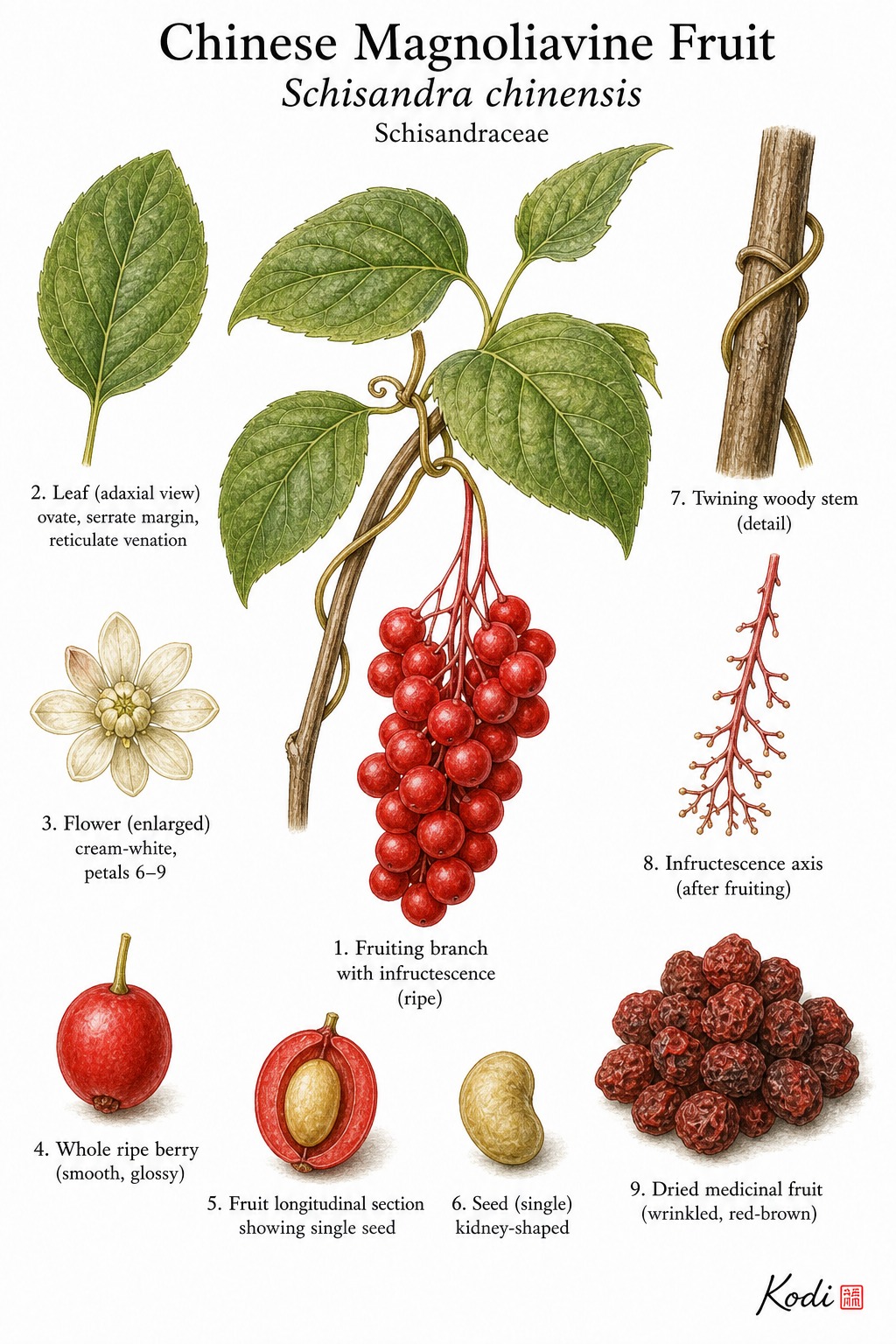
Known in TCM as Wu Wei Zi (五味子), this sour and sweet and bitter and acrid and salty, warm herb enters the Lung, Heart, and Kidney. Traditionally, it restrains Lung Qi and stops chronic cough or wheezing - Wu Wei Zi is classically used when leakage of Lung Qi causes prolonged cough, wheezing, shortness of breath, or weak grasping of breath, especially when Lung and Kidney deficiency coexist, most often applied for cough, wheezing, and spontaneous sweating. Modern research has identified Schisandrin among its active constituents.
Part used: Fruit
Also Known As
Latin: Fructus Schisandrae | Pinyin: Wu Wei Zi | Chinese: 五味子
TCM Properties
- Taste
- sour, sweet, bitter, acrid, salty
- Temperature
- warm
- Channels
- Lung, Heart, Kidney
Traditional Use
Primary Actions
- Restrains Lung Qi and stops chronic cough or wheezing - Wu Wei Zi is classically used when leakage of Lung Qi causes prolonged cough, wheezing, shortness of breath, or weak grasping of breath, especially when Lung and Kidney deficiency coexist.
- Generates fluids and checks leakage of sweat and body fluids - the sour, collecting nature helps contain spontaneous sweating, night sweats, thirst, dry mouth, and Qi-Yin depletion after prolonged illness or summer-heat injury.
- Binds the intestines and stops chronic deficiency-type diarrhea - it is used when long-standing loose stool, early-morning diarrhea, or intestinal leakage reflects deficiency and cold or combined Spleen-Kidney weakness rather than acute damp-heat infection.
- Tonifies the Kidneys and calms the Heart spirit - beyond astringing, Wu Wei Zi nourishes and secures essence while also helping insomnia, palpitations, restlessness, and poor spirit when Heart and Kidney disharmony or Yin depletion are present.
Secondary Actions
- Wu Wei Zi is famous as the 'five-flavor fruit' because classical writers attributed all five tastes to it, which helped give it a reputation for benefiting multiple organ systems at once.
- Processing and species identity matter: Bei Wu Wei Zi from Schisandra chinensis is the tonic-standard medicinal berry, whereas Nan Wu Wei Zi from Schisandra sphenanthera has a different chemistry and is treated separately in modern pharmacopoeia.
Classic Formulas
- Sheng Mai San (生脉散) - the classic three-herb formula with Ren Shen and Mai Men Dong in which Wu Wei Zi restrains leaking Qi and fluids while the companion herbs tonify and moisten.
- Xiao Qing Long Tang (小青龙汤) - Wu Wei Zi plays the crucial 'closing' role in this otherwise strongly dispersing cold-phlegm formula, preventing over-scattering of Lung Qi while cough and wheezing are treated.
- Si Shen Wan (四神丸) - paired with Bu Gu Zhi and other warming astringents for early-morning diarrhea and Spleen-Kidney deficiency leakage.
- Tian Wang Bu Xin Dan (天王补心丹) - used here for its ability to collect Heart Qi and calm the spirit while deeper Yin and Blood deficiency are replenished.
Classical References
- Me and Qi cites Shen Nong Ben Cao Jing in describing Wu Wei Zi as sour and warm, benefiting Qi, treating cough with counterflow and upward Qi, supplementing insufficiency, strengthening Yin, and benefiting male essence.
- The same source emphasizes Wu Wei Zi's classical strategy of 'restraining while nourishing,' which is why it appears in such different settings as chronic cough, diarrhea, sweating, nocturnal emission, and insomnia.
- Sacred Lotus and later materia medica sources consistently place Wu Wei Zi among herbs that astringe and stabilize, while classical commentary preserved by Me and Qi notes its relationships with Rou Cong Rong, Wei Rui, and Wu Tou.
- Identity notes in modern materia medica stress that superior tonic use belongs to northern Wu Wei Zi from Schisandra chinensis, not the southern species often sold under the same general name.
Modern Research
Active Compounds
- Schisandrin and schisandrin B (dibenzocyclooctadiene lignans) - hallmark hepatoprotective and antioxidant lignans from Wu Wei Zi
- Schisandrol A and deoxyschisandrin - major lignans associated with adaptogenic, liver-protective, and metabolic effects
- Gomisin C and gomisin G (lignans) - interaction-relevant constituents known to affect CYP3A enzymes
- Schisantherin A (lignan) - anti-inflammatory constituent highlighted by MSK and preclinical signaling studies
- Lignan-rich Schisandra extract fractions - the clinically important multicomponent profile rather than a single isolated molecule
Studied Effects
- Schisandra chinensis extract ameliorated nonalcoholic fatty liver in preclinical models by inhibiting endoplasmic-reticulum stress, supporting the long traditional association between Wu Wei Zi and liver support (PMID 26972505).
- Lignans from Schisandra chinensis reduced alcohol- and carbon-tetrachloride-induced long-term liver injury and hepatocellular degeneration via endothelin-B-receptor-related mechanisms in experimental models (PMID 32259665).
- Schisandra chinensis lignans suppressed inflammatory mediators regulated by NF-kappaB, AP-1, and IRF3 in LPS-stimulated RAW264.7 cells, giving a mechanistic anti-inflammatory correlate for several traditional uses (PMID 30558163).
- A pharmacokinetic interaction study found that Wu Wei Zi and the schisandrol/schisandrin constituents activated pregnane X receptor signaling and increased warfarin clearance in rats, reinforcing the importance of modern drug-interaction screening with this herb (PMID 16267138).
PubMed References
- Schisandra chinensis extract ameliorates nonalcoholic fatty liver via inhibition of endoplasmic reticulum stress (2016)
- Lignans from Schisandra chinensis ameliorate alcohol and CCl4-induced long-term liver injury and reduce hepatocellular degeneration via blocking ETBR (2020)
- Schisandra Chinensis Lignans Suppresses the Production of Inflammatory Mediators Regulated by NF-kappaB, AP-1, and IRF3 in Lipopolysaccharide-Stimulated RAW264.7 Cells (2018)
- Traditional Chinese medicines Wu Wei Zi (Schisandra chinensis Baill) and Gan Cao (Glycyrrhiza uralensis Fisch) activate pregnane X receptor and increase warfarin clearance in rats (2006)
Safety & Interactions
Contraindications
- Active exterior pathogen when venting and release are still required
- Acute excess Lung heat or acute damp-heat diarrhea
- Marked phlegm-fluid retention that should first be dispersed rather than constrained
Cautions
- The fruit's sour and collecting nature can aggravate acid reflux, gastric sensitivity, or severe peptic-ulcer patterns in susceptible patients
- Pregnancy and breastfeeding use should be practitioner-directed because formal human safety data are limited and the herb has meaningful CYP and transporter effects
- Northern and southern Wu Wei Zi are not interchangeable in all clinical contexts because their lignan profiles differ
- Schisandra can reduce certain liver-enzyme lab values, which may matter when interpreting follow-up testing
Drug Interactions
- CYP1A2, 3A4, and 3A5 substrates … Schisandra lignans can inhibit these CYP enzymes, while long-term use may also induce CYP3A4 and alter substrate exposure (Moderate) Source: Memorial Sloan Kettering
- P-glycoprotein substrates … May inhibit P-gp activity and interfere with the metabolism and transport of susceptible drugs (Moderate) Source: Memorial Sloan Kettering
- Tacrolimus … Coadministration increased blood levels of tacrolimus via effects on P-gp and CYP3A-mediated metabolism (Major) Source: Memorial Sloan Kettering
Classic formulas that use Chinese Magnoliavine Fruit
Herbs are rarely taken alone in Chinese medicine. These formula pages show what this herb does inside a classic prescription and which pattern that prescription is chosen for.
Conditions
Frequently Asked Questions
What is Chinese Magnoliavine Fruit used for?
Chinese Magnoliavine Fruit is traditionally used to Restrains Lung Qi and stops chronic cough or wheezing - Wu Wei Zi is classically used when leakage of Lung Qi causes prolonged cough, wheezing, shortness of breath, or weak grasping of breath, especially when Lung and Kidney deficiency coexist., Generates fluids and checks leakage of sweat and body fluids - the sour, collecting nature helps contain spontaneous sweating, night sweats, thirst, dry mouth, and Qi-Yin depletion after prolonged illness or summer-heat injury., Binds the intestines and stops chronic deficiency-type diarrhea - it is used when long-standing loose stool, early-morning diarrhea, or intestinal leakage reflects deficiency and cold or combined Spleen-Kidney weakness rather than acute damp-heat infection., Tonifies the Kidneys and calms the Heart spirit - beyond astringing, Wu Wei Zi nourishes and secures essence while also helping insomnia, palpitations, restlessness, and poor spirit when Heart and Kidney disharmony or Yin depletion are present.. Research has investigated its effects on: Schisandra chinensis extract ameliorated nonalcoholic fatty liver in preclinical models by inhibiting endoplasmic-reticulum stress, supporting the long traditional association between Wu Wei Zi and liver support (PMID 26972505).; Lignans from Schisandra chinensis reduced alcohol- and carbon-tetrachloride-induced long-term liver injury and hepatocellular degeneration via endothelin-B-receptor-related mechanisms in experimental models (PMID 32259665)..
What are other names for Chinese Magnoliavine Fruit?
Chinese Magnoliavine Fruit is also known as Schisandra. In TCM: 五味子 (Wu Wei Zi); Fructus Schisandrae.
Is Chinese Magnoliavine Fruit safe during pregnancy?
The safety of Chinese Magnoliavine Fruit during pregnancy has not been established. Consult a qualified healthcare provider before use.
What are the contraindications for Chinese Magnoliavine Fruit?
Chinese Magnoliavine Fruit should not be used in: Active exterior pathogen when venting and release are still required; Acute excess Lung heat or acute damp-heat diarrhea; Marked phlegm-fluid retention that should first be dispersed rather than constrained. Consult a qualified healthcare provider before use.
Does Chinese Magnoliavine Fruit interact with any medications?
Chinese Magnoliavine Fruit may interact with: CYP1A2, 3A4, and 3A5 substrates - Schisandra lignans can inhibit these CYP enzymes, while long-term use may also induce CYP3A4 and alter substrate exposure - (Moderate severity); P-glycoprotein substrates - May inhibit P-gp activity and interfere with the metabolism and transport of susceptible drugs - (Moderate severity); Tacrolimus - Coadministration increased blood levels of tacrolimus via effects on P-gp and CYP3A-mediated metabolism - (Major severity). Always inform your healthcare provider of any herbal supplements you are taking.