Chinese Lobelia Herb
- Chinese
- 半边莲
- Pinyin
- Ban Bian Lian
- Latin
- Herba Lobeliae Chinensis
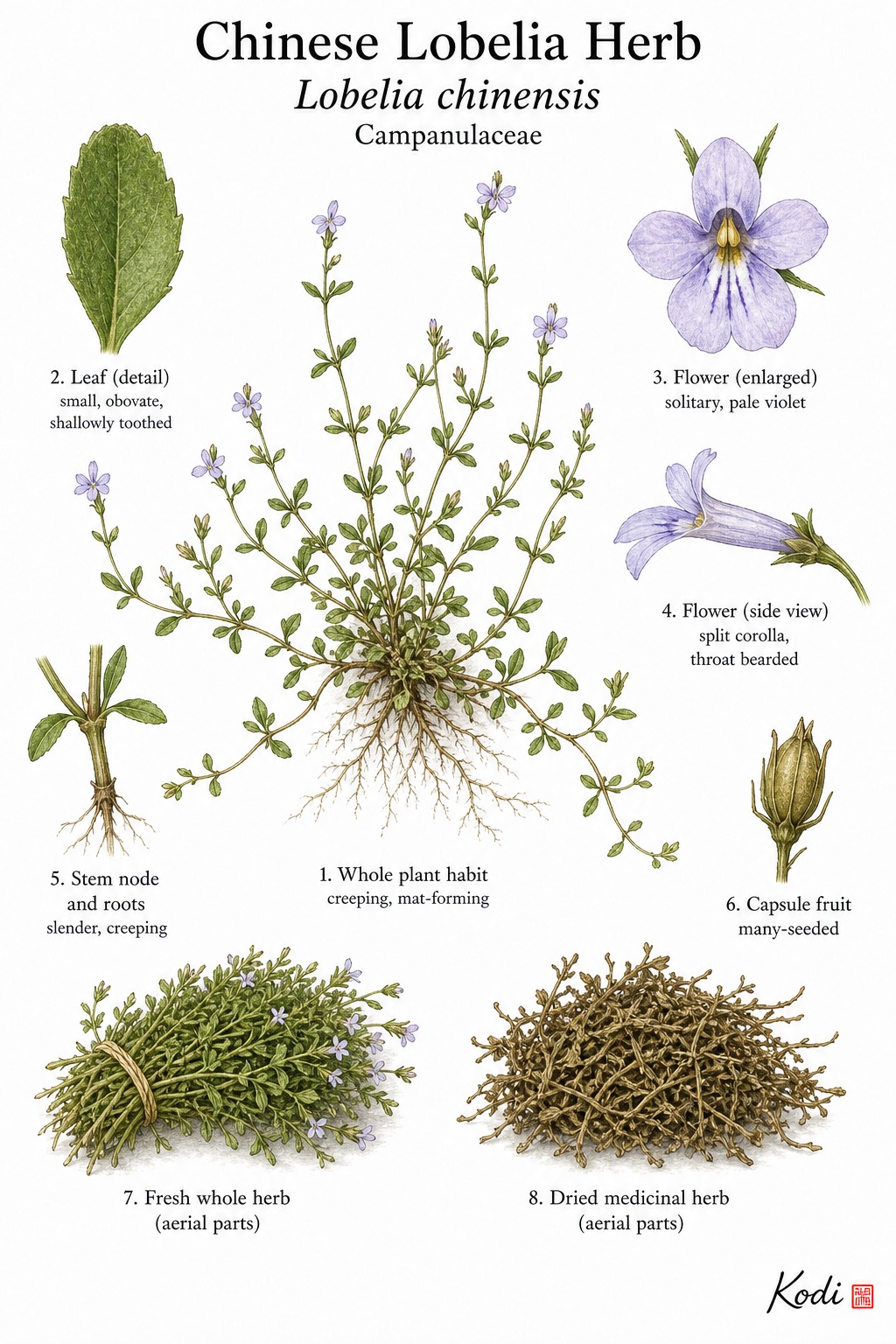
Known in TCM as Ban Bian Lian (半边莲), this sweet and bland, cool herb enters the Heart, Lung, and Small Intestine. Traditionally, it promotes urination and reduces edema - Ban Bian Lian is a fluid-draining herb used for swelling, ascites, dark scanty urine, and damp-water accumulation when toxic heat or damp obstruction prevents the normal movement of fluids, most often applied for edema, snakebite, and abscess. Modern research has identified Diosmetin among its active constituents.
Part used: Whole herb
Also Known As
Latin: Herba Lobeliae Chinensis | Pinyin: Ban Bian Lian | Chinese: 半边莲
TCM Properties
- Taste
- sweet, bland
- Temperature
- cool
- Channels
- Heart, Lung, Small Intestine
Traditional Use
Primary Actions
- Promotes urination and reduces edema - Ban Bian Lian is a fluid-draining herb used for swelling, ascites, dark scanty urine, and damp-water accumulation when toxic heat or damp obstruction prevents the normal movement of fluids.
- Clears heat and resolves toxicity for bites, sores, and inflamed swellings - it is especially valued for snakebite, wasp or bee stings, carbuncle-type lesions, and other hot toxic conditions that can be treated internally and externally.
- Cools and unblocks toxic heat in the channels and flesh - in practice it is used for hot painful throat conditions, inflamed skin eruptions, and damp-toxic disorders where swelling and redness are prominent.
- Pairs with other detoxifying herbs when water retention and toxicity coexist - Ban Bian Lian is often chosen when a case combines edema or ascites with snakebite, suppurative lesions, or damp-toxic masses because it drains as it clears.
Secondary Actions
- This herb is frequently compared with Ban Zhi Lian and Bai Hua She She Cao: Ban Bian Lian is the stronger urination-promoting member of the group, while the others contribute more cooling of damp-heat or blood stasis depending on the pair.
- Fresh juice, crushed topical application, or higher-dose acute use are preserved in older and folk practice for snakebite and stings, which helps explain why the herb has both internal and emergency-style external indications.
Classic Formulas
- Ban Bian Lian with Ban Zhi Lian - a classic toxin-clearing herb pair for snakebite, toxic swellings, and fluid-containing masses in which Ban Bian Lian contributes stronger water-draining action.
- Ban Bian Lian with Bai Hua She She Cao - commonly used when damp-heat toxicity and edema or painful swelling appear together, especially in modern oncology-supportive or severe inflammatory settings.
- Single-herb or fresh-herb snakebite use - older sources specifically describe Ban Bian Lian being taken internally and applied topically for poisonous snakebite and insect stings, reflecting its reputation as a rapid toxin-clearing field herb.
Classical References
- TCM Wiki describes Ban Bian Lian as slightly bitter, sweet, bland, and cold, with actions of clearing heat and removing toxicity while inducing diuresis and relieving edema for sores, ascites, jaundice, and difficult urination.
- Me and Qi classifies Ban Bian Lian among herbs that clear heat and relieve toxicity, emphasizing its dual action of promoting urination and reducing edema while treating toxic heat conditions such as snakebite and inflamed sores.
- American Dragon highlights the longstanding cross-source variation in flavor, temperature, and channel attribution, but consistently preserves the herb's main identity as a stronger diuretic toxin-resolving herb and also records pregnancy as a contraindication.
- IDENTITY NOTE: some older herb pages repeat the idea that Ban Bian Lian contains lobeline, but modern HPLC/Q-TOF profiling of authentic Lobelia chinensis found lobeline absent, so older cross-Lobelia toxicity descriptions should be interpreted carefully.
Modern Research
Active Compounds
- Diosmetin and diosmin (flavonoids) - well-studied constituents tied to anti-inflammatory, skin-barrier, and antioxidant interest
- Apigenin, luteolin, and linarin (flavones and flavone glycosides) - major anti-inflammatory flavonoids identified repeatedly in Lobelia chinensis chemistry studies
- Scoparone and related coumarins - constituents with documented anti-inflammatory screening activity in compound-isolation work
- Lobechine and related alkaloid-lignan hybrid compounds - characteristic Lobelia chinensis metabolites with reported anti-HSV-1 or anti-inflammatory screening activity
- Lobetyolin and related polyacetylenes - non-alkaloid constituents contributing to the broader whole-herb pharmacology
Studied Effects
- A 2011 compound-isolation study identified 46 constituents from Lobelia chinensis and found selected isolates active against HSV-1 replication, superoxide-anion generation, or elastase release, providing direct modern support for the herb's anti-toxic and anti-inflammatory reputation (PMID 21656355).
- Comprehensive HPLC/Q-TOF profiling across multiple authentic batches demonstrated that lobeline is absent from true Lobelia chinensis, an important identity correction because older sources had projected lobeline-centered toxicity assumptions onto Ban Bian Lian (PMID 30544710).
- Lobelia chinensis extract and its constituent diosmetin improved atopic-dermatitis-like skin damage by reinforcing SPINK5/LEKTI-related skin-barrier function and reducing IgE- and IL-4-linked inflammation in a murine model (PMID 35955819).
- A 2021 mechanistic study suggested that Lobeliae Chinensis Herba may help diabetic kidney disease by inhibiting podocyte DPP4 activity, extending Ban Bian Lian research from classic edema use into metabolic and renal signaling pathways (PMID 34950037).
PubMed References
- Chemical constituents from Lobelia chinensis and their anti-virus and anti-inflammatory bioactivities (2011)
- Chemical Profiling of Lobelia chinensis with High-Performance Liquid Chromatography/Quadrupole Time-of-Flight Mass Spectrometry (HPLC/Q-TOF MS) Reveals Absence of Lobeline in the Herb (2018)
- Lobelia chinensis Extract and Its Active Compound, Diosmetin, Improve Atopic Dermatitis by Reinforcing Skin Barrier Function through SPINK5/LEKTI Regulation (2022)
- Inhibition of Podocytes DPP4 Activity Is a Potential Mechanism of Lobeliae Chinensis Herba in Treating Diabetic Kidney Disease (2021)
Safety & Interactions
Contraindications
- Pregnancy
- Edema due to deficiency rather than damp-heat or toxic obstruction
- Pronounced blood deficiency or fragile deficient constitutions easily weakened by draining herbs
Cautions
- Ban Bian Lian can be too draining for patients with weak appetite, chronic loose stool, or deficiency-type swelling without heat or toxin
- Some older sources attribute severe lobeline-style toxicity to this herb, but modern profiling suggests authentic Lobelia chinensis may lack lobeline; concentrated extracts should still be used cautiously and source identity matters
- Fresh-herb and high-dose emergency-style use for bites or stings belongs to supervised traditional practice rather than casual home self-treatment
- MSK page not found - drug interaction data not available from Memorial Sloan Kettering integrative medicine database
Conditions
Frequently Asked Questions
What is Chinese Lobelia Herb used for?
Chinese Lobelia Herb is traditionally used to Promotes urination and reduces edema - Ban Bian Lian is a fluid-draining herb used for swelling, ascites, dark scanty urine, and damp-water accumulation when toxic heat or damp obstruction prevents the normal movement of fluids., Clears heat and resolves toxicity for bites, sores, and inflamed swellings - it is especially valued for snakebite, wasp or bee stings, carbuncle-type lesions, and other hot toxic conditions that can be treated internally and externally., Cools and unblocks toxic heat in the channels and flesh - in practice it is used for hot painful throat conditions, inflamed skin eruptions, and damp-toxic disorders where swelling and redness are prominent., Pairs with other detoxifying herbs when water retention and toxicity coexist - Ban Bian Lian is often chosen when a case combines edema or ascites with snakebite, suppurative lesions, or damp-toxic masses because it drains as it clears.. Research has investigated its effects on: A 2011 compound-isolation study identified 46 constituents from Lobelia chinensis and found selected isolates active against HSV-1 replication, superoxide-anion generation, or elastase release, providing direct modern support for the herb's anti-toxic and anti-inflammatory reputation (PMID 21656355).; Comprehensive HPLC/Q-TOF profiling across multiple authentic batches demonstrated that lobeline is absent from true Lobelia chinensis, an important identity correction because older sources had projected lobeline-centered toxicity assumptions onto Ban Bian Lian (PMID 30544710)..
What are other names for Chinese Lobelia Herb?
Chinese Lobelia Herb is also known as Lobelia. In TCM: 半边莲 (Ban Bian Lian); Herba Lobeliae Chinensis.
Is Chinese Lobelia Herb safe during pregnancy?
Chinese Lobelia Herb is not recommended during pregnancy.
What are the contraindications for Chinese Lobelia Herb?
Chinese Lobelia Herb should not be used in: Pregnancy; Edema due to deficiency rather than damp-heat or toxic obstruction; Pronounced blood deficiency or fragile deficient constitutions easily weakened by draining herbs. Consult a qualified healthcare provider before use.