Chinese Honeylocust Abnormal Fruit
- Chinese
- 猪牙皂
- Pinyin
- Zhu Ya Zao
- Latin
- Gleditsiae Fructus Abnormalis
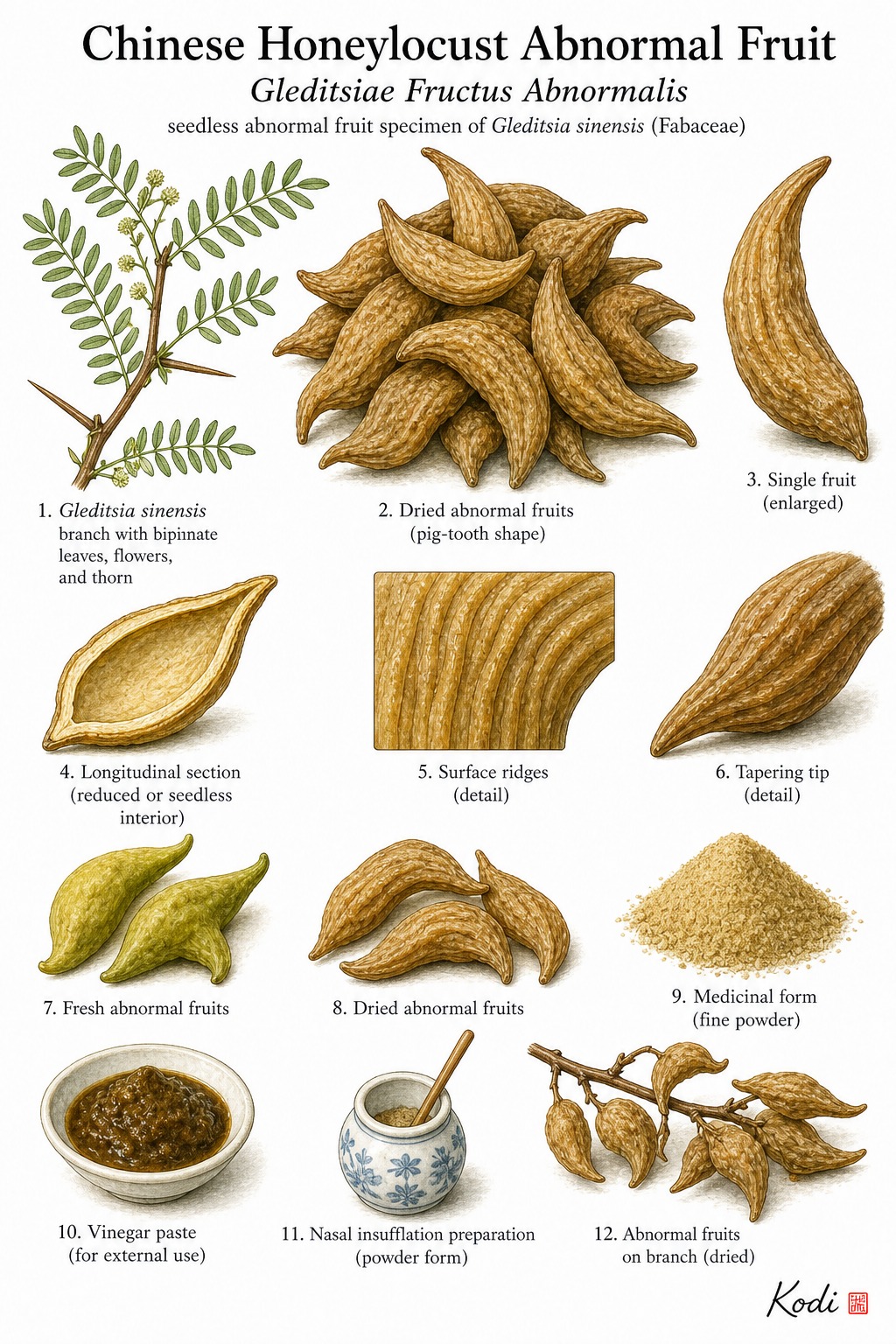
Known in TCM as Zhu Ya Zao (猪牙皂), this acrid and salty, warm herb enters the Lung and Large Intestine. Traditionally, it expels phlegm and opens the orifices - Zhu Ya Zao is one of the harsh emergency herbs for thick, obstructing phlegm that locks the jaw, clouds consciousness, or causes phlegm gurgling in stroke, epilepsy, or other closed excess disorders, most often applied for stroke, epilepsy, and productive cough. Modern research has identified Gleditsioside among its active constituents.
Part used: Fruit
Also Known As
Latin: Gleditsiae Fructus Abnormalis | Pinyin: Zhu Ya Zao | Chinese: 猪牙皂
TCM Properties
- Taste
- acrid, salty
- Temperature
- warm
- Channels
- Lung, Large Intestine
Traditional Use
Primary Actions
- Expels phlegm and opens the orifices - Zhu Ya Zao is one of the harsh emergency herbs for thick, obstructing phlegm that locks the jaw, clouds consciousness, or causes phlegm gurgling in stroke, epilepsy, or other closed excess disorders.
- Forcefully dislodges stubborn turbid phlegm from the chest and throat - when taken internally in tiny doses or used as a nasal powder, it can provoke sneezing or vomiting to break up fixed phlegm that milder transform-phlegm herbs cannot move.
- Dissipates swelling and resolves toxicity - externally it is applied as a powder or vinegar paste for unruptured abscesses, boils, and other swollen lesions that need a sharp penetrating herb to draw the accumulation outward.
- Opens blocked passages above and below - older sources also use it for severe constipation, abdominal fullness, and focal obstruction when its acrid dispersing quality can move stubborn accumulations.
Secondary Actions
- Zhu Ya Zao is the seedless abnormal fruit of the honeylocust tree and is traditionally considered superior to the larger mature pod for dispersing Wind-Phlegm, even though the two share overlapping actions.
- This is usually a powder, pill, or external-application herb rather than a routine decoction substance because the crude saponins are strongly irritating in liquid form.
Classic Formulas
- Tong Guan San (通关散) - nasal insufflation powder using Zhu Ya Zao with Xi Xin, and sometimes Bing Pian, to trigger sneezing and rouse consciousness in acute phlegm obstruction.
- Xi Xian San (稀涎散) - classical pair of Zhu Ya Zao and Ming Fan used to induce vomiting of copious sticky phlegm in acute closed-type phlegm obstruction such as stroke with lockjaw and loss of consciousness.
- Zao Jia Wan (皂荚丸) - Jin Gui Yao Lue formula for cough with upward-rushing Qi and thick turbid phlegm that cannot be expectorated, highlighting the herb's deeper chest-phlegm application.
Classical References
- Me & Qi describes Zhu Ya Zao as warm, acrid, and salty, entering the Lung and Large Intestine channels, with strong actions of expelling phlegm, opening the orifices, reducing swelling, and clearing severe obstruction.
- Ming Yi Bie Lu records that pig-tooth-shaped pods are the superior form and uses them for abdominal fullness, cough with phlegm nodules, and other obstruction patterns, helping explain why the abnormal fruit became the preferred medicinal grade.
- Ben Cao Gang Mu states that blown or guided into the body it opens the upper and lower orifices, while taken internally it treats phlegm wheezing, swelling, fullness, and parasites and topically it disperses swelling and sores.
Modern Research
Active Compounds
- Gleditsioside B and related triterpenoid saponins - the best-known bioactive constituents isolated from the anomalous fruits
- Oleanane-type and echinocystic-acid-related triterpenes - structural families repeatedly reported from Gleditsia sinensis fruit studies
- Saponin-rich fruit fractions - the broad chemical basis for the herb's harsh expectorant, irritant, and experimental antiproliferative effects
- Minor sterols and supportive phenolic constituents - additional components described alongside the dominant fruit saponins
Studied Effects
- Gleditsioside B isolated from the anomalous fruits of Gleditsia sinensis showed anti-angiogenic effects by inhibiting endothelial migration and suppressing MMP-2, FAK, ERK, and PI3K/AKT signaling, providing a direct modern study on the abnormal fruit's triterpenoid saponins (PMID 23026290).
- A 2023 study reported that Gleditsia sinensis aqueous extract attenuated allergic-rhinitis nasal inflammation and reduced MUC5AC production through STAT3 and STAT6 suppression, fitting the herb's traditional respiratory and phlegm-obstruction use even though the experiment was not a classic decoction trial (PMID 36921533).
- A saponin structure-activity study from the anomalous fruits found cytotoxic and apoptosis-inducing activity across multiple tumor cell lines, showing that the fruit's strong penetrating chemistry has measurable bioactivity far beyond its classical emergency-phlegm role (PMID 15386187).
PubMed References
- Gleditsioside B, a triterpene saponin isolated from the anomalous fruits of Gleditsia sinensis Lam., abrogates bFGF-induced endothelial cell migration through preventing the activation of MMP-2 and FAK via inhibiting ERK and PI3K/AKT signaling pathways (2013)
- Gleditsia sinensis Lam. aqueous extract attenuates nasal inflammation in allergic rhinitis by inhibiting MUC5AC production through suppression of the STAT3/STAT6 pathway (2023)
- Structure-activity relationships of saponins from Gleditsia sinensis in cytotoxicity and induction of apoptosis (2004)
Safety & Interactions
Contraindications
- Pregnancy
- Active hemoptysis or hematemesis
- Qi deficiency or Yin deficiency without substantial phlegm obstruction
Cautions
- Zhu Ya Zao is slightly toxic and highly irritating to the nasal, respiratory, and gastrointestinal mucosa if overdosed or prepared casually
- Internal use requires very small doses because overdose can cause intense nausea, vomiting, abdominal pain, and profuse diarrhea
- Use cautiously in bleeding tendency or when combined with drugs that increase bleeding or gastric irritation
Drug Interactions
- Anticoagulant and antiplatelet drugs: theoretical increased bleeding or blood-related risk because irritating saponins may aggravate fragile mucosa and hemolytic effects are reported at high concentrations
- Mucosal-irritant medications such as NSAIDs: concurrent use may increase gastrointestinal irritation
- Sedatives and CNS depressants: theoretical conflict when the herb is used as an acute stimulating orifice-opening intervention
Conditions
- Stroke Traditional ★★★★☆ JSON
- Epilepsy Traditional ★★★☆☆ JSON
- Productive Cough Traditional ★★★☆☆ JSON
- Constipation Traditional ★★☆☆☆ JSON
- Abscess Traditional ★★☆☆☆ JSON
Frequently Asked Questions
What is Chinese Honeylocust Abnormal Fruit used for?
Chinese Honeylocust Abnormal Fruit is traditionally used to Expels phlegm and opens the orifices - Zhu Ya Zao is one of the harsh emergency herbs for thick, obstructing phlegm that locks the jaw, clouds consciousness, or causes phlegm gurgling in stroke, epilepsy, or other closed excess disorders., Forcefully dislodges stubborn turbid phlegm from the chest and throat - when taken internally in tiny doses or used as a nasal powder, it can provoke sneezing or vomiting to break up fixed phlegm that milder transform-phlegm herbs cannot move., Dissipates swelling and resolves toxicity - externally it is applied as a powder or vinegar paste for unruptured abscesses, boils, and other swollen lesions that need a sharp penetrating herb to draw the accumulation outward., Opens blocked passages above and below - older sources also use it for severe constipation, abdominal fullness, and focal obstruction when its acrid dispersing quality can move stubborn accumulations.. Research has investigated its effects on: Gleditsioside B isolated from the anomalous fruits of Gleditsia sinensis showed anti-angiogenic effects by inhibiting endothelial migration and suppressing MMP-2, FAK, ERK, and PI3K/AKT signaling, providing a direct modern study on the abnormal fruit's triterpenoid saponins (PMID 23026290).; A 2023 study reported that Gleditsia sinensis aqueous extract attenuated allergic-rhinitis nasal inflammation and reduced MUC5AC production through STAT3 and STAT6 suppression, fitting the herb's traditional respiratory and phlegm-obstruction use even though the experiment was not a classic decoction trial (PMID 36921533)..
What are other names for Chinese Honeylocust Abnormal Fruit?
Chinese Honeylocust Abnormal Fruit is also known as Gleditsia. In TCM: 猪牙皂 (Zhu Ya Zao); Gleditsiae Fructus Abnormalis.
Is Chinese Honeylocust Abnormal Fruit safe during pregnancy?
Chinese Honeylocust Abnormal Fruit is not recommended during pregnancy.
What are the contraindications for Chinese Honeylocust Abnormal Fruit?
Chinese Honeylocust Abnormal Fruit should not be used in: Pregnancy; Active hemoptysis or hematemesis; Qi deficiency or Yin deficiency without substantial phlegm obstruction. Consult a qualified healthcare provider before use.
Does Chinese Honeylocust Abnormal Fruit interact with any medications?
Chinese Honeylocust Abnormal Fruit may interact with: Anticoagulant and antiplatelet drugs: theoretical increased bleeding or blood-related risk because irritating saponins may aggravate fragile mucosa and hemolytic effects are reported at high concentrations; Mucosal-irritant medications such as NSAIDs: concurrent use may increase gastrointestinal irritation; Sedatives and CNS depressants: theoretical conflict when the herb is used as an acute stimulating orifice-opening intervention. Always inform your healthcare provider of any herbal supplements you are taking.