Chinese Holly Leaf
- Chinese
- 枸骨叶
- Pinyin
- Gou Gu Ye
- Latin
- Ilicis Cornutae Folium
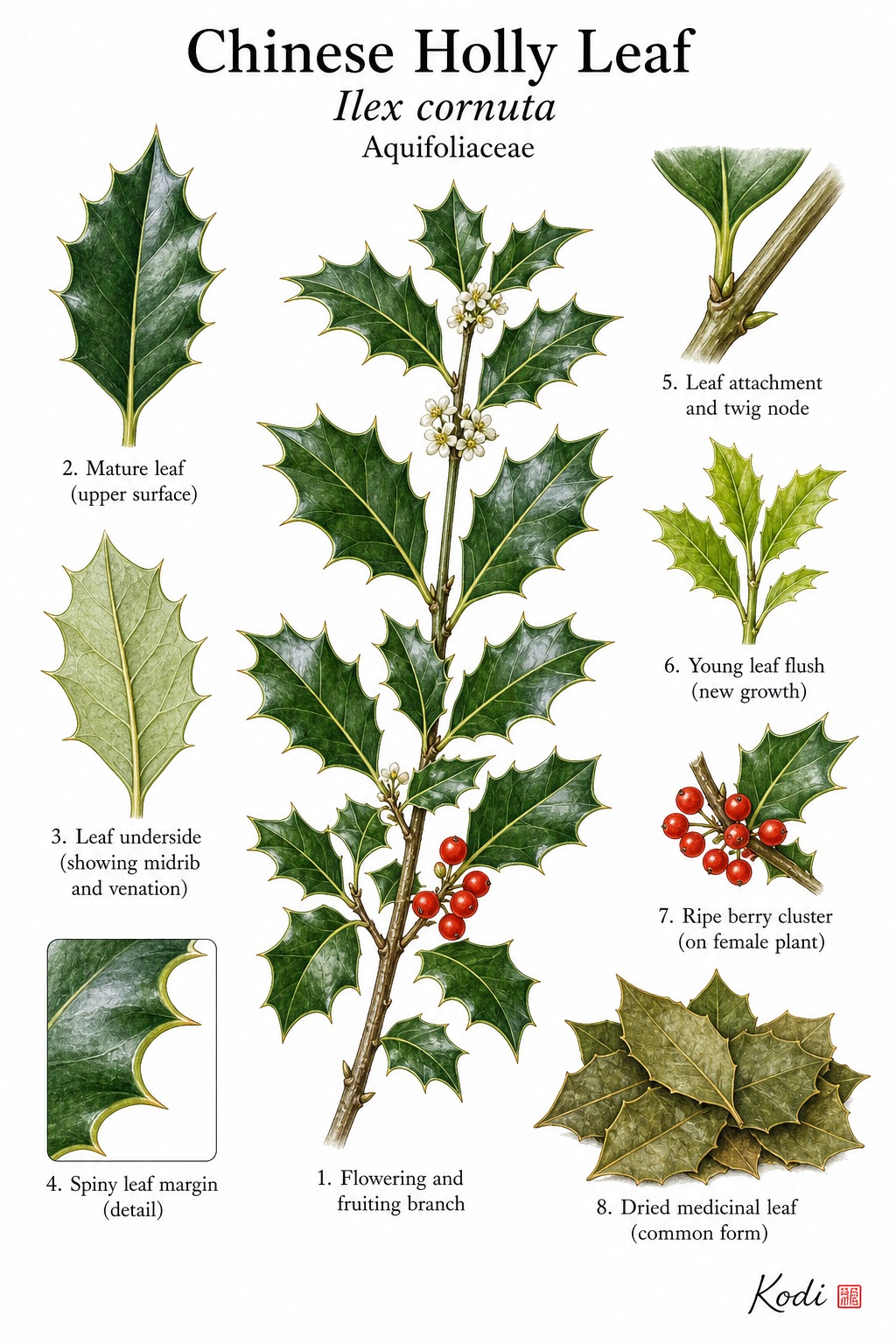
Known in TCM as Gou Gu Ye (枸骨叶), this bitter, cool herb enters the Liver and Kidney. Traditionally, it supplements the Liver and Kidney and supports depletion patterns - Gou Gu Ye is used when chronic weakness shows up as sore low back and knees, weak sinews and bones, dizziness, or tinnitus in a worn-down constitution rather than a robust excess pattern, most often applied for low back pain, rheumatism, and tinnitus. Modern research has identified Ursane-type among its active constituents.
Also Known As
Latin: Ilicis Cornutae Folium | Pinyin: Gou Gu Ye | Chinese: 枸骨叶
TCM Properties
- Taste
- bitter
- Temperature
- cool
- Channels
- Liver, Kidney
Traditional Use
Primary Actions
- Supplements the Liver and Kidney and supports depletion patterns - Gou Gu Ye is used when chronic weakness shows up as sore low back and knees, weak sinews and bones, dizziness, or tinnitus in a worn-down constitution rather than a robust excess pattern.
- Assists consumptive cough and hemoptysis from chronic deficiency - regional materia medica use includes pulmonary-taxation patterns with lingering cough, blood-streaked sputum, or fatigue-related bleeding where deeper depletion and mild deficiency heat are part of the picture.
- Dispels wind-damp and relieves impediment pain - despite its mildly nourishing character, Gou Gu Ye is also used for wind-damp Bi pain, traumatic injury, and aching or numb weakness in the limbs when deficiency and obstruction coexist.
Secondary Actions
- This herb sits in a historical naming tangle because some older sources blurred Gou Gu Ye with Gong Lao Ye; modern pharmacognosy separates them and assigns Gou Gu Ye specifically to the dried leaf of Ilex cornuta.
- Compared with the colder berberine-rich Mahonia leaf sold as Gong Lao Ye, Gou Gu Ye is more centered on Liver-Kidney support and chronic weakness than on draining active Damp-Heat.
Classic Formulas
- Gou Gu Ye with Du Zhong, Xu Duan, or Sang Ji Sheng - common traditional pairing logic for low-back and knee weakness with concurrent Liver-Kidney deficiency and lingering wind-damp aching.
- Gou Gu Ye with Bai Ji or E Jiao - regional deficiency-cough combinations when chronic Lung depletion leads to cough or minor hemoptysis and the treatment goal is to support while limiting further damage.
- Wind-damp injury combinations with Qin Jiao or Ji Xue Teng - used when Bi pain or traumatic injury appears on top of an already depleted constitution.
Classical References
- Hong Kong Baptist University and Zhongyifangji list Gou Gu Ye (枸骨叶) as bitter and cool, identify it as Ilicis Cornutae Folium, and summarize its functions as supplementing the Liver and Kidney, nourishing Qi and Blood, and dispelling wind-damp for cough, hemoptysis, lumbar weakness, and Bi pain.
- TCM Pro likewise records Gou Gu Ye as bitter and cool with Liver and Kidney tropism, reinforcing that the modern herb identity is primarily a Liver-Kidney leaf medicine rather than a Lung-focused heat-clearing leaf.
- Me & Qi's identity note on Gong Lao Ye explains the long-standing confusion between Mahonia leaf and holly leaf, but specifically states that modern pharmacognosy now separates Gou Gu Ye as the holly leaf from Ilex cornuta.
Modern Research
Active Compounds
- Ursane-type triterpenoids and triterpenoid saponins - the dominant modern chemistry repeatedly isolated from Ilex cornuta aerial parts and roots
- Randialic-acid-type triterpenes and related glycosides - representative protective constituents identified in phytochemical work
- Phenolic acids and polyphenol-rich fractions - compounds contributing to antioxidant activity in Ilex cornuta tea and extract studies
- Minor flavonoids and glycosides - supportive constituents likely contributing to broader anti-inflammatory and metabolic effects
Studied Effects
- A 2017 study isolated three new triterpenoids from the aerial parts of Ilex cornuta and found that randialic acid B showed significant cell-protective effects against H2O2-induced cardiomyocyte injury, supporting the plant's reputation as a triterpenoid-rich medicinal Ilex species (PMID 28284425).
- A 2022 experiment reported that Ilex cornuta bark extract promoted fracture healing in mice and appeared to act through adenosine A2A receptor signaling with anti-inflammatory pathway involvement, suggesting broader tissue-repair potential beyond the herb's classical materia medica indications (PMID 35959419).
- Comparative tea-chemistry work found that Ilex cornuta genotypes contain major phenolic constituents with measurable in vitro antioxidant activity, giving a plausible modern correlate for some of the herb's traditional nourishing reputation even though this was not a clinical decoction trial (PMID 19601659).
PubMed References
- Three new triterpenoids isolated from the aerial parts of Ilex cornuta and protective effects against H2O2-induced myocardial cell injury (2017)
- The Extract of Ilex cornuta Bark Promotes Bone Healing by Activating Adenosine A2A Receptor (2022)
- Comparison of major phenolic constituents and in vitro antioxidant activity of diverse Kudingcha genotypes from Ilex kudingcha, Ilex cornuta, and Ligustrum robustum (2009)
Safety & Interactions
Contraindications
- Spleen or Stomach deficiency cold with loose stool or poor appetite
- Predominantly cold Yang-deficiency patterns without heat, dryness, or depletion signs
Cautions
- Historical naming confusion between Gou Gu Ye (Ilex cornuta leaf) and Gong Lao Ye (Mahonia leaf) means source identity should be verified before applying monograph-level safety assumptions
- Because the herb is cool and somewhat bitter, larger doses may aggravate weak digestion or chronic loose stool in sensitive patients
- MSK page not found - drug interaction data not available from Memorial Sloan Kettering integrative medicine database
Conditions
- Low Back Pain Traditional ★★★☆☆ JSON
- Rheumatism Traditional ★★☆☆☆ JSON
- Tinnitus Traditional ★★☆☆☆ JSON
- Hemoptysis Traditional ★★☆☆☆ JSON
- Tuberculosis Traditional ★★☆☆☆ JSON
Frequently Asked Questions
What is Chinese Holly Leaf used for?
Chinese Holly Leaf is traditionally used to Supplements the Liver and Kidney and supports depletion patterns - Gou Gu Ye is used when chronic weakness shows up as sore low back and knees, weak sinews and bones, dizziness, or tinnitus in a worn-down constitution rather than a robust excess pattern., Assists consumptive cough and hemoptysis from chronic deficiency - regional materia medica use includes pulmonary-taxation patterns with lingering cough, blood-streaked sputum, or fatigue-related bleeding where deeper depletion and mild deficiency heat are part of the picture., Dispels wind-damp and relieves impediment pain - despite its mildly nourishing character, Gou Gu Ye is also used for wind-damp Bi pain, traumatic injury, and aching or numb weakness in the limbs when deficiency and obstruction coexist.. Research has investigated its effects on: A 2017 study isolated three new triterpenoids from the aerial parts of Ilex cornuta and found that randialic acid B showed significant cell-protective effects against H2O2-induced cardiomyocyte injury, supporting the plant's reputation as a triterpenoid-rich medicinal Ilex species (PMID 28284425).; A 2022 experiment reported that Ilex cornuta bark extract promoted fracture healing in mice and appeared to act through adenosine A2A receptor signaling with anti-inflammatory pathway involvement, suggesting broader tissue-repair potential beyond the herb's classical materia medica indications (PMID 35959419)..
What are other names for Chinese Holly Leaf?
Chinese Holly Leaf is also known as Ilicis. In TCM: 枸骨叶 (Gou Gu Ye); Ilicis Cornutae Folium.
Is Chinese Holly Leaf safe during pregnancy?
The safety of Chinese Holly Leaf during pregnancy has not been established. Consult a qualified healthcare provider before use.
What are the contraindications for Chinese Holly Leaf?
Chinese Holly Leaf should not be used in: Spleen or Stomach deficiency cold with loose stool or poor appetite; Predominantly cold Yang-deficiency patterns without heat, dryness, or depletion signs. Consult a qualified healthcare provider before use.