Chinese Gall
- Chinese
- 五倍子
- Pinyin
- Wu Bei Zi
- Latin
- Galla Chinensis
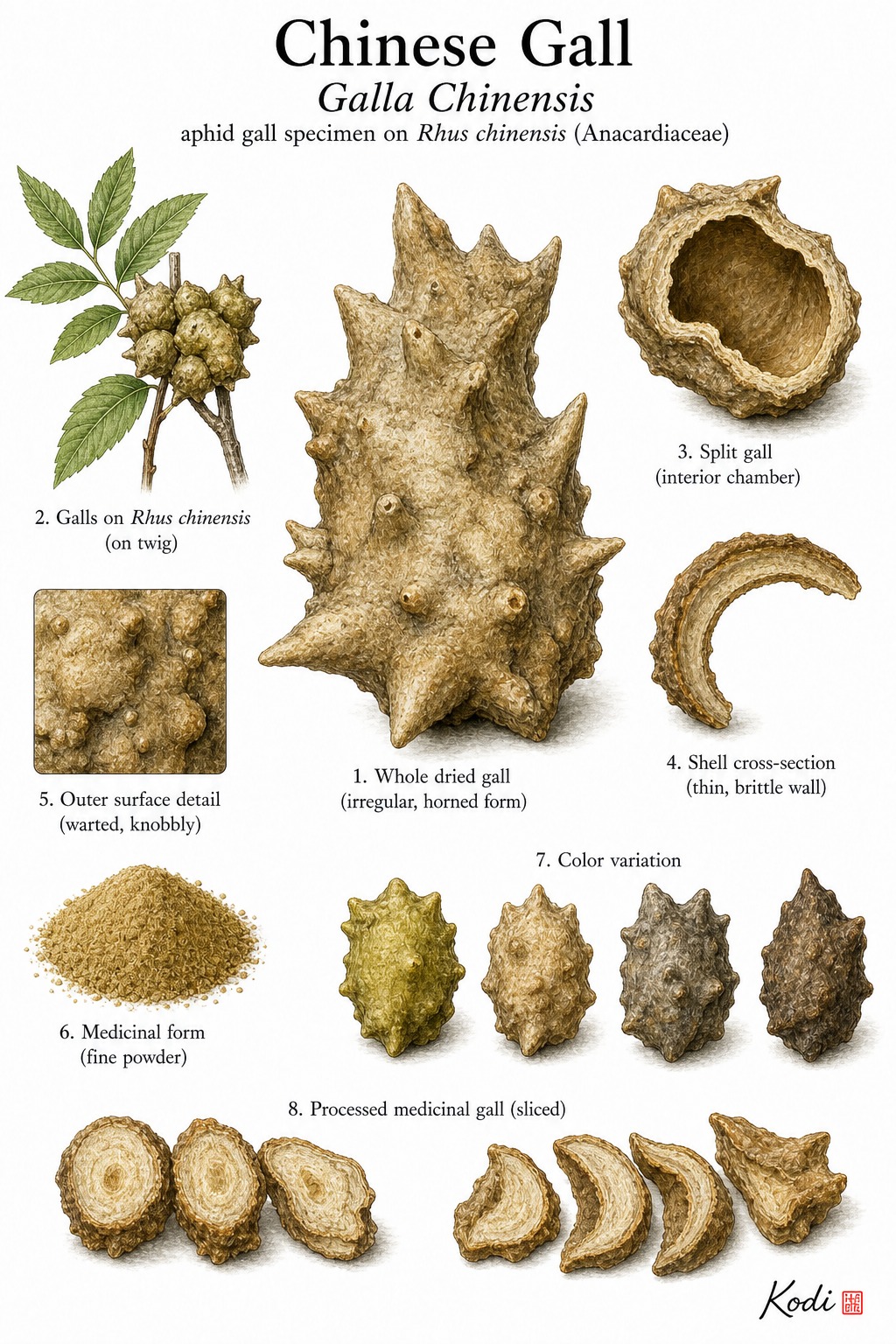
Known in TCM as Wu Bei Zi (五倍子), this sour and salty, cold herb enters the Lung, Large Intestine, and Kidney. Traditionally, it astringes the Lungs and stops chronic cough - Wu Bei Zi is used after the acute pathogen has passed, when lingering deficiency or residual heat leaves the Lungs unable to contain Qi and fluids, causing persistent cough, sweating, or weak breath, most often applied for diarrhea, night sweats, and hemorrhoids. Modern research has identified Tannic among its active constituents.
Also Known As
Latin: Galla Chinensis | Pinyin: Wu Bei Zi | Chinese: 五倍子
TCM Properties
- Taste
- sour, salty
- Temperature
- cold
- Channels
- Lung, Large Intestine, Kidney
Traditional Use
Primary Actions
- Astringes the Lungs and stops chronic cough - Wu Bei Zi is used after the acute pathogen has passed, when lingering deficiency or residual heat leaves the Lungs unable to contain Qi and fluids, causing persistent cough, sweating, or weak breath.
- Binds the intestines and stops chronic diarrhea or dysentery - its powerful astringent action is classically chosen for prolonged loose stools, lingering dysentery, and even rectal prolapse when the bowels have lost their holding function.
- Restrains sweating and secures essence - by tightening leakage, Wu Bei Zi is used for spontaneous sweating, night sweats, involuntary seminal emission, and other disorders of fluids or essence failing to stay contained.
- Stops bleeding and heals sores - whether taken internally for nosebleed, bloody stool, or uterine bleeding, or used externally for wounds, hemorrhoids, and weeping lesions, Wu Bei Zi is valued for its contracting and drying action.
Secondary Actions
- External use is particularly important: powders, washes, and sitz baths are common for hemorrhoids, prolapse, weeping eczema, and slow-to-close tissue damage.
- Processing matters - raw Wu Bei Zi is strongly astringent, while Bai Yao Jian and vinegar-processed forms are used when gentler lung, throat, or intestinal effects are desired.
Classic Formulas
- Gu Chong Tang (固冲汤) - a womb-stabilizing and bleeding-controlling formula in which Wu Bei Zi contributes strong astringency for flooding and spotting with instability.
- Yu Suo Dan (玉锁丹) - classical essence-securing formula pairing Wu Bei Zi with Fu Ling and Long Gu for seminal emission and lower leakage from Kidney insecurity.
- Wu Bei Zi with Ming Fan external wash - traditional hemorrhoid and prolapse method using its strong topical astringent and tissue-tightening action.
Classical References
- Me and Qi describes Wu Bei Zi as a strongly astringent cold herb that restrains the Lungs, binds the intestines, stops sweating, secures essence, stops bleeding, and heals sores.
- The same source cites Ben Cao Gang Mu in describing Wu Bei Zi as able to restrain the Lungs, stop bleeding, transform phlegm, stop thirst, and collect sweat, while also recording the famous navel application for night sweats.
- Sacred Lotus agrees on the core profile of sour, salty, and cold, entering the Lung, Large Intestine, and Kidney channels, and places Wu Bei Zi among the key astringent and stabilizing medicinals.
Modern Research
Active Compounds
- Tannic acid and broader hydrolyzable tannins - the dominant chemical group responsible for the herb's strong astringent and hemostatic reputation
- Gallic acid - a major hydrolysis product and well-studied antimicrobial and antidiarrheal constituent linked to Galla chinensis activity
- Methyl gallate and related galloyl phenolics - supportive polyphenols contributing to antioxidant and antimicrobial effects
- High-polyphenol gallotannin fractions - topical bioactive material relevant to wound-healing and barrier-repair research
Studied Effects
- Galla chinensis and gallic acid inhibited the interaction between E. coli heat-labile enterotoxin and GM1 ganglioside in an antidiarrheal study, giving a modern mechanistic correlate for Wu Bei Zi's longstanding use in diarrhea and dysentery (PMID 16213682).
- A 2025 study of tannic acid identified it as an inhibitor of Streptococcus mutans biofilm formation through glucosyltransferase antagonism, reinforcing the herb's modern relevance in mucosal and oral surface care (PMID 40212388).
- A 2025 rat study reported that tannins from Galla chinensis cream promoted skin wound healing through FAK/PI3K/Akt/mTOR signaling, closely matching the classical topical use of Wu Bei Zi for weeping sores and wound closure (PMID 39929629).
PubMed References
- Anti-diarrheal effect of Galla Chinensis on the Escherichia coli heat-labile enterotoxin and ganglioside interaction (2006)
- Glucosyltransferase activity-based screening identifies tannic acid as an inhibitor of Streptococcus mutans biofilm (2025)
- [Mechanism of tannins from Galla chinensis cream in promoting skin wound healing in rats based on FAK/PI3K/Akt/mTOR signaling pathway] (2025)
Safety & Interactions
Contraindications
- Early-stage cough or diarrhea with unresolved external or internal pathogens
- Constipation or dry stool without leakage pathology
- Use of strong astringency when the therapeutic need is to vent rather than contain
Cautions
- Excessive internal use may cause constipation or gastric irritation because of the herb's very strong contracting tannin content
- Practitioners generally avoid using Wu Bei Zi too early in acute diarrhea or acute cough, since premature astringing can trap the pathogenic factor
- Powdered forms are often preferred for astringent and hemostatic purposes because prolonged boiling can blunt some of the tannin effect
- MSK page not found - drug interaction data not available from Memorial Sloan Kettering integrative medicine database
Conditions
- Diarrhea Traditional ★★★★☆ JSON
- Night Sweats Traditional ★★★☆☆ JSON
- Hemorrhoids Traditional ★★★☆☆ JSON
- Cough Traditional ★★☆☆☆ JSON
Frequently Asked Questions
What is Chinese Gall used for?
Chinese Gall is traditionally used to Astringes the Lungs and stops chronic cough - Wu Bei Zi is used after the acute pathogen has passed, when lingering deficiency or residual heat leaves the Lungs unable to contain Qi and fluids, causing persistent cough, sweating, or weak breath., Binds the intestines and stops chronic diarrhea or dysentery - its powerful astringent action is classically chosen for prolonged loose stools, lingering dysentery, and even rectal prolapse when the bowels have lost their holding function., Restrains sweating and secures essence - by tightening leakage, Wu Bei Zi is used for spontaneous sweating, night sweats, involuntary seminal emission, and other disorders of fluids or essence failing to stay contained., Stops bleeding and heals sores - whether taken internally for nosebleed, bloody stool, or uterine bleeding, or used externally for wounds, hemorrhoids, and weeping lesions, Wu Bei Zi is valued for its contracting and drying action.. Research has investigated its effects on: Galla chinensis and gallic acid inhibited the interaction between E. coli heat-labile enterotoxin and GM1 ganglioside in an antidiarrheal study, giving a modern mechanistic correlate for Wu Bei Zi's longstanding use in diarrhea and dysentery (PMID 16213682).; A 2025 study of tannic acid identified it as an inhibitor of Streptococcus mutans biofilm formation through glucosyltransferase antagonism, reinforcing the herb's modern relevance in mucosal and oral surface care (PMID 40212388)..
What are other names for Chinese Gall?
Chinese Gall is also known as Galla. In TCM: 五倍子 (Wu Bei Zi); Galla Chinensis.
Is Chinese Gall safe during pregnancy?
The safety of Chinese Gall during pregnancy has not been established. Consult a qualified healthcare provider before use.
What are the contraindications for Chinese Gall?
Chinese Gall should not be used in: Early-stage cough or diarrhea with unresolved external or internal pathogens; Constipation or dry stool without leakage pathology; Use of strong astringency when the therapeutic need is to vent rather than contain. Consult a qualified healthcare provider before use.