Chinese Dwarf Cherry Seed
- Chinese
- 郁李仁
- Pinyin
- Yu Li Ren
- Latin
- Pruni Semen
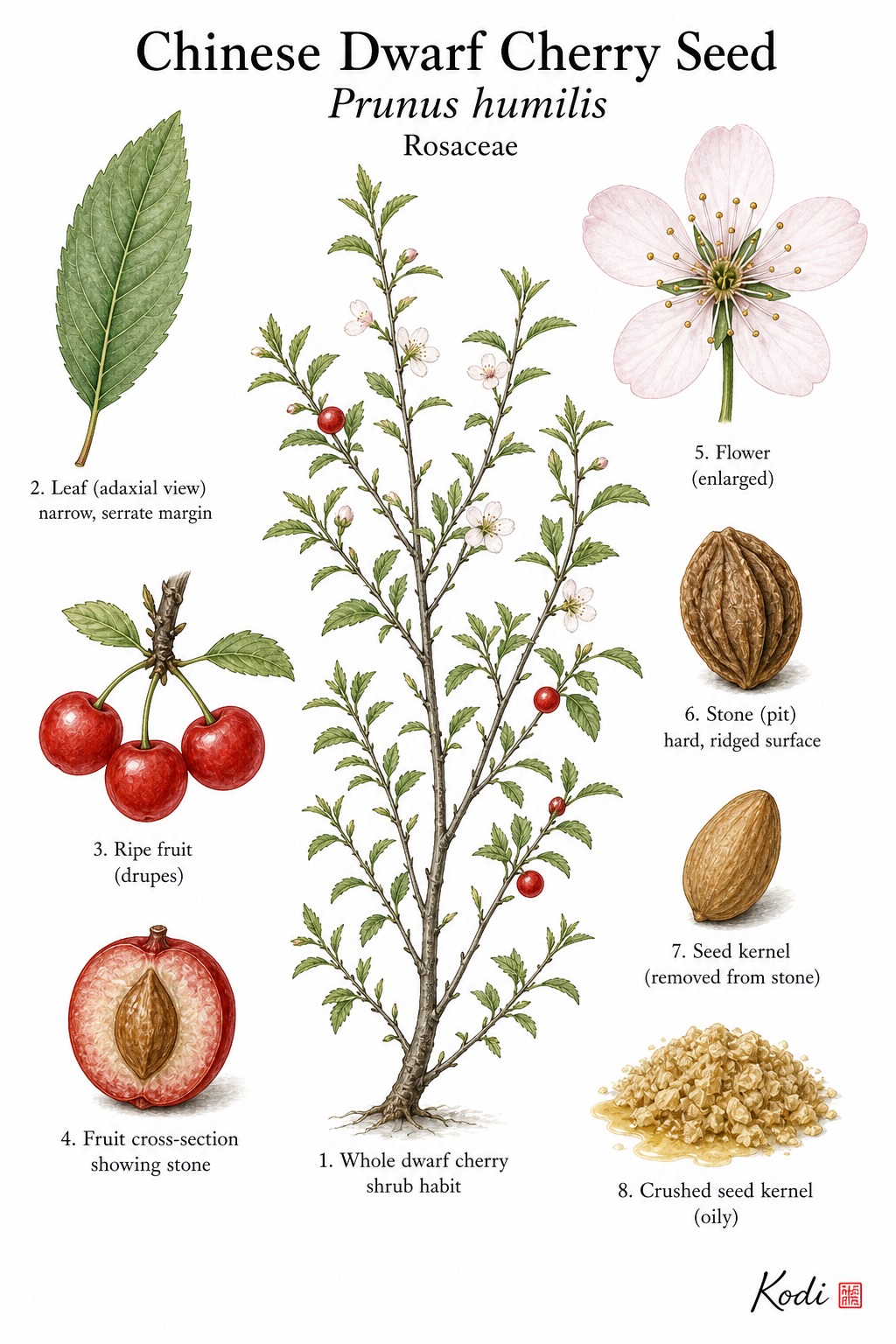
Known in TCM as Yu Li Ren (郁李仁), this acrid and bitter and sweet, neutral herb enters the Large Intestine, Small Intestine, and Spleen. Traditionally, it moistens dryness and unblocks the bowels - Yu Li Ren is a seed-based moist laxative used for constipation from intestinal dryness, Qi stagnation, or weakness after febrile illness, childbirth, or age-related fluid depletion, most often applied for constipation, edema, and abdominal distension. Modern research has identified Multiflorin among its active constituents.
Part used: Seed
Also Known As
Latin: Pruni Semen | Pinyin: Yu Li Ren | Chinese: 郁李仁
TCM Properties
- Taste
- acrid, bitter, sweet
- Temperature
- neutral
- Channels
- Large Intestine, Small Intestine, Spleen
Traditional Use
Primary Actions
- Moistens dryness and unblocks the bowels - Yu Li Ren is a seed-based moist laxative used for constipation from intestinal dryness, Qi stagnation, or weakness after febrile illness, childbirth, or age-related fluid depletion.
- Descends accumulation more actively than gentler nourishing seeds - compared with purely moistening foods, Yu Li Ren has a more definite downward-moving action and is especially used when dry stool is accompanied by abdominal fullness or sluggish movement in the intestines.
- Promotes urination and reduces edema - older materia medica also uses it when water retention, leg edema, or difficult urination overlap with bowel dryness and lower-burner obstruction.
- Relieves leg-Qi-type lower-body congestion - traditional indications include heaviness, swelling, and obstructed downward movement in the lower extremities where stool and fluid stagnation coexist.
Secondary Actions
- Because Yu Li Ren is oily but not overly cold or hot, it is often chosen for elderly or weak patients who need help moving the bowels without the harshness of drastic purgatives.
- It is commonly crushed before decoction so the fixed oils can be released more effectively.
Classic Formulas
- Wu Ren Wan (五仁丸) - classic moistening formula for dry constipation in which Yu Li Ren joins other oily kernels to lubricate the intestines while moving constrained stool.
- Yu Li Ren with Huo Ma Ren (郁李仁配火麻仁) - common seed pairing when constipation reflects combined dryness, weakness, and mild Qi stagnation rather than intense heat.
- Lower-burner dampness and edema formulas using Yu Li Ren with Ze Xie or Fu Ling - traditional pattern-based combinations when stool binding and water retention occur together.
Classical References
- Sacred Lotus and Yin Yang House both describe Yu Li Ren as acrid, bitter, sweet, and neutral, entering the Large Intestine, Small Intestine, and Spleen channels, with actions of stimulating the intestines and promoting urination.
- Traditional category teaching places Yu Li Ren among the moist laxatives and emphasizes its suitability for constipation in weaker constitutions, especially when a lubricating seed is preferable to a harsh purgative.
- The classic preparation note is to crush the seeds before use so their oily constituents can better reach the decoction.
Modern Research
Active Compounds
- Multiflorin A (glycosidic purgative constituent) - a standout candidate explaining the distinctive laxative action of Pruni semen
- Fixed seed oils rich in linoleic and oleic acids - the traditional material basis for its lubricating bowel effect
- Tocopherols and squalene-like lipophilic fractions - supportive antioxidant seed-oil components documented in Rosaceae seed chemistry
- Amygdalin and related cyanogenic glycosides - bitter Prunus seed constituents relevant mainly to toxicologic caution rather than desired purgative use
Studied Effects
- A 2023 mechanistic study found that multiflorin A exerts purgative activity by altering intestinal glucose absorption and permeability, offering a direct modern explanation for Yu Li Ren's bowel-unblocking action (PMID 37054485).
- An in vitro study of Prunus japonica seed extract reported enhanced human sperm hypermotility and intracellular alkalization, showing that Yu Li Ren source species continue to attract reproductive pharmacology interest outside their classical laxative use (PMID 35590125).
- Broader Rosaceae seed-oil research has documented linoleic-acid-, oleic-acid-, tocopherol-, and squalene-rich lipid fractions, helping explain why many medicinal Prunus seeds have lubricating and nutritive physical properties even when the pharmacology varies by species (PMID 28510938).
- A modern review of amygdalin in plant seeds underscores that cyanogenic glycosides remain an important safety consideration in Prunus kernels, reinforcing the need for appropriate dosing and preparation rather than casual use of medicinal seed products (PMID 33924691).
PubMed References
- A novel purgative mechanism of multiflorin A involves changing intestinal glucose absorption and permeability (2023)
- In vitro assessment of Prunus japonica seed extract on human spermatozoa hypermotility and intracellular alkalization (2022)
- Fatty acid, tocopherol and squalene contents of Rosaceae seed oils (2014)
- Amygdalin: Toxicity, Anticancer Activity and Analytical Procedures for Its Determination in Plant Seeds (2021)
Safety & Interactions
Contraindications
- Pregnancy
- Chronic loose stool or diarrhea without true dryness or constipation
- Marked fluid depletion or Yin deficiency where the downward-draining action would aggravate weakness
Cautions
- Yu Li Ren is more draining than food-grade moistening seeds and may cause abdominal cramping or loose stools if overdosed
- As a Prunus kernel medicine, it should not be treated like an unrestricted snack seed because cyanogenic seed chemistry remains a background toxicology concern in this plant group
- The seeds are traditionally crushed before use to release their oily active material more effectively
- MSK page not found - drug interaction data not available from Memorial Sloan Kettering integrative medicine database
Conditions
- Constipation Traditional ★★★★★ JSON
- Edema Traditional ★★★☆☆ JSON
- Abdominal Distension Traditional ★★☆☆☆ JSON
Frequently Asked Questions
What is Chinese Dwarf Cherry Seed used for?
Chinese Dwarf Cherry Seed is traditionally used to Moistens dryness and unblocks the bowels - Yu Li Ren is a seed-based moist laxative used for constipation from intestinal dryness, Qi stagnation, or weakness after febrile illness, childbirth, or age-related fluid depletion., Descends accumulation more actively than gentler nourishing seeds - compared with purely moistening foods, Yu Li Ren has a more definite downward-moving action and is especially used when dry stool is accompanied by abdominal fullness or sluggish movement in the intestines., Promotes urination and reduces edema - older materia medica also uses it when water retention, leg edema, or difficult urination overlap with bowel dryness and lower-burner obstruction., Relieves leg-Qi-type lower-body congestion - traditional indications include heaviness, swelling, and obstructed downward movement in the lower extremities where stool and fluid stagnation coexist.. Research has investigated its effects on: A 2023 mechanistic study found that multiflorin A exerts purgative activity by altering intestinal glucose absorption and permeability, offering a direct modern explanation for Yu Li Ren's bowel-unblocking action (PMID 37054485).; An in vitro study of Prunus japonica seed extract reported enhanced human sperm hypermotility and intracellular alkalization, showing that Yu Li Ren source species continue to attract reproductive pharmacology interest outside their classical laxative use (PMID 35590125)..
What are other names for Chinese Dwarf Cherry Seed?
Chinese Dwarf Cherry Seed is also known as Pruni. In TCM: 郁李仁 (Yu Li Ren); Pruni Semen.
Is Chinese Dwarf Cherry Seed safe during pregnancy?
Chinese Dwarf Cherry Seed is not recommended during pregnancy.
What are the contraindications for Chinese Dwarf Cherry Seed?
Chinese Dwarf Cherry Seed should not be used in: Pregnancy; Chronic loose stool or diarrhea without true dryness or constipation; Marked fluid depletion or Yin deficiency where the downward-draining action would aggravate weakness. Consult a qualified healthcare provider before use.