Chinese Clematis Root
- Chinese
- 威灵仙
- Pinyin
- Wei Ling Xian
- Latin
- Clematidis Radix et Rhizoma
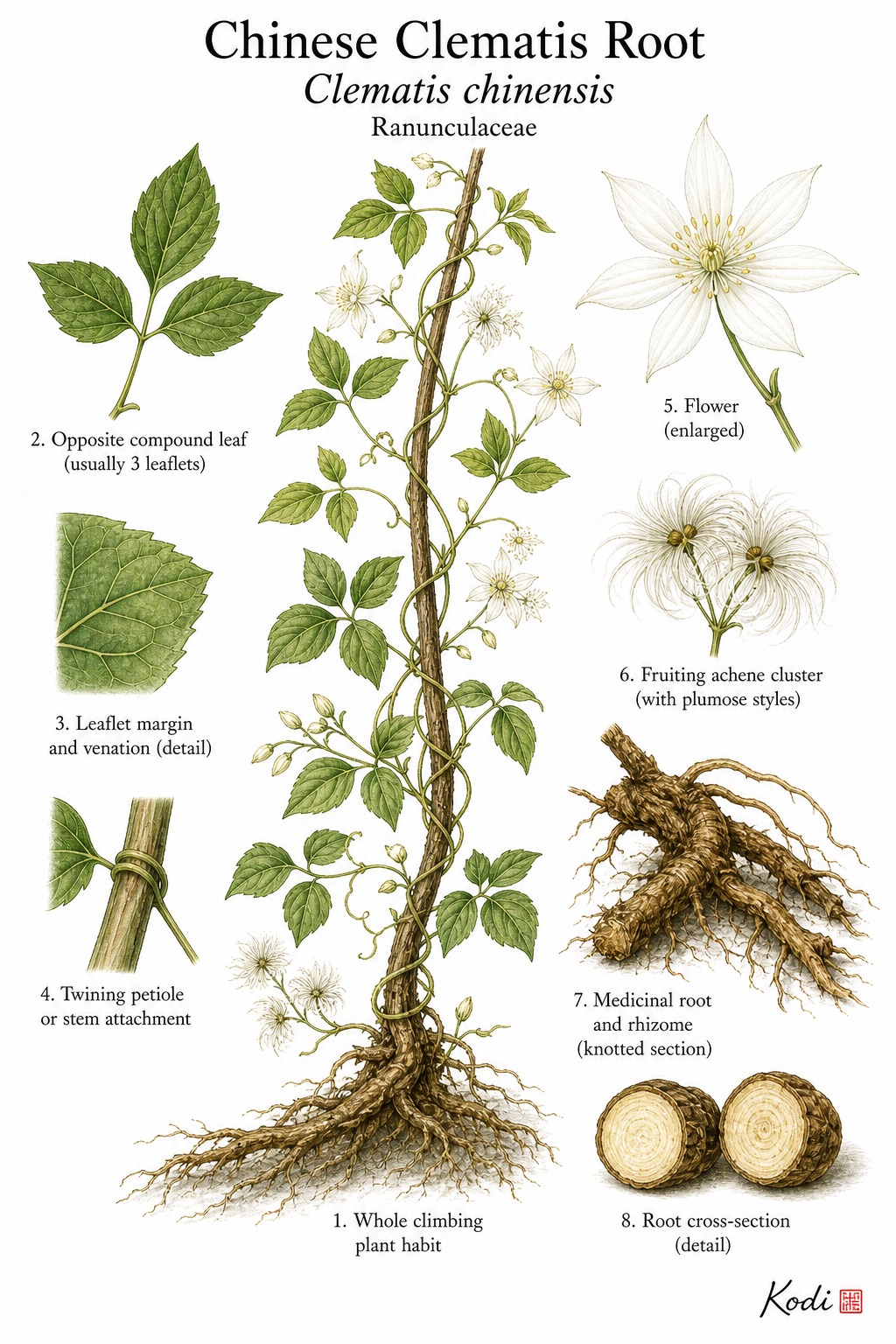
Known in TCM as Wei Ling Xian (威灵仙), this acrid and salty, warm herb enters the Bladder. Traditionally, it dispels wind-damp and powerfully unblocks the channels - Wei Ling Xian is one of the more mobile penetrating Bi-syndrome herbs for severe joint pain, limb numbness, tendon spasm, and stiffness when cold-damp obstruction has lodged deeply in the channels, most often applied for joint pain, rheumatism, and osteoarthritis. Modern research has identified Clematichinenoside among its active constituents.
Part used: Root
Also Known As
Latin: Clematidis Radix et Rhizoma | Pinyin: Wei Ling Xian | Chinese: 威灵仙
TCM Properties
- Taste
- acrid, salty
- Temperature
- warm
- Channels
- Bladder
Traditional Use
Primary Actions
- Dispels wind-damp and powerfully unblocks the channels - Wei Ling Xian is one of the more mobile penetrating Bi-syndrome herbs for severe joint pain, limb numbness, tendon spasm, and stiffness when cold-damp obstruction has lodged deeply in the channels.
- Relieves pain in both upper and lower body obstruction patterns - unlike some wind-damp herbs that are more region-specific, Wei Ling Xian is valued when pain wanders widely or when longstanding painful obstruction affects multiple joints, muscles, and sinews at once.
- Softens and guides downward to address fish bones lodged in the throat - larger doses are traditionally used when a small fish bone is superficially stuck and the herb's acrid-salty, dispersing-softening nature can help release the obstruction.
- Disperses focal accumulation and descends rebellious stagnation - older sources also use it for middle-jiao fullness, hiccup, or focal distention when stubborn obstruction rather than pure deficiency is the main issue.
Secondary Actions
- Wei Ling Xian is often preferred when Bi pain is severe, fixed, and difficult to shift, especially if ordinary gentle wind-damp herbs have not opened the channels enough.
- Its action is strong and somewhat consuming, so it is less suitable as a long-term daily herb for frail or depleted patients unless anchored by tonifying and blood-nourishing ingredients.
Classic Formulas
- Shu Jing Huo Xue Wan (舒筋活血丸) - channel-relaxing and blood-invigorating formula pattern in which Wei Ling Xian helps open collaterals and relieve painful obstruction with blood stasis and wind-damp involvement.
- Bi-syndrome decoctions with Du Huo, Qin Jiao, and Sang Zhi - common traditional pairing logic when cold-damp painful obstruction causes severe pain, numbness, or reduced range of motion in the limbs.
- Single-herb or modified higher-dose use for fish bone lodged in the throat - a classic practical application in which Wei Ling Xian's acrid, salty, and mobile character is emphasized over its arthralgia role.
Classical References
- Sacred Lotus describes Wei Ling Xian as acrid, salty, and warm, entering the Bladder channel, with key actions of dispelling wind-damp, opening the channels, relieving pain, treating stuck fish bones, and dispersing accumulation.
- Yin Yang House similarly places Wei Ling Xian among the stronger wind-damp herbs, emphasizing pain, spasm, numbness, stiffness, and its use in Bi Zheng with severe obstruction.
- Traditional teaching treats Wei Ling Xian as a forceful roaming herb: effective for stubborn obstruction, but to be used cautiously when Qi or Blood are deficient.
Modern Research
Active Compounds
- Clematichinenoside AR and related triterpenoid saponins - the best-known anti-inflammatory marker constituents associated with Radix Clematidis research
- Oleanolic-acid-type and hederagenin-type sapogenins - major pentacyclic triterpenoid backbones underpinning many of the herb's saponin fractions
- Clematis total saponins - multi-component fractions repeatedly studied in rheumatoid-arthritis and inflammatory-joint models
- Organic acids, lignanoids, and minor phenolic constituents - supportive compounds identified alongside the dominant saponin chemistry in modern review work
Studied Effects
- A 2021 review of Clematidis Radix et Rhizoma summarized broad anti-inflammatory, anti-tumor, antimicrobial, and antioxidant findings while emphasizing triterpenoid saponins as the herb's principal modern pharmacologic drivers (PMID 33476714).
- Clematis chinensis extract reduced inflammatory arthritis activity in collagen-induced rat models with effects linked to NF-kB, TNF-alpha, and COX-2 signaling, closely matching the traditional use of Wei Ling Xian for painful obstruction (PMID 21932136).
- Processed Clematidis Radix et Rhizoma showed enhanced anti-rheumatoid-arthritis effects in collagen-II-induced rat studies, with improved cytokine and metabolomic outcomes supporting the long clinical importance of processing methods (PMID 35032583).
- Total saponins of Radix Clematis were reported to regulate fibroblast-like synoviocyte proliferation in rheumatoid arthritis through the lncRNA OIP5-AS1/miR-410-3p/Wnt7b pathway, adding a more specific mechanistic model to the herb's anti-arthritic profile (PMID 35668775).
PubMed References
- Uses, chemical compositions, pharmacological activities and toxicology of Clematidis Radix et Rhizome- a Review (2021)
- Anti-inflammatory effects of Clematis chinensis Osbeck extract(AR-6) may be associated with NF-kB, TNF-alpha, and COX-2 in collagen-induced arthritis in rat (2012)
- Thermal and wine processing enhanced Clematidis Radix et Rhizoma ameliorate collagen Ⅱ induced rheumatoid arthritis in rats (2022)
- Total Saponins of Radix Clematis Regulate Fibroblast-Like Synoviocyte Proliferation in Rheumatoid Arthritis via the LncRNA OIP5-AS1/MiR-410-3p/Wnt7b Signaling Pathway (2022)
Safety & Interactions
Contraindications
- Pregnancy or threatened miscarriage
- Marked Qi or Blood deficiency without true obstructive pathology
- Chronic weakness with dryness or depletion where a strong dispersing herb would be too consuming
Cautions
- Extended or excessive use has been associated in traditional references with gastrointestinal irritation, oral burning or ulceration, vomiting, abdominal pain, and severe diarrhea
- Topical overuse can irritate the skin and has been associated with blistering or allergic-type dermatitis
- This is a strong mobile herb for stubborn obstruction, so it should be matched to an excess or mixed pattern rather than used casually for nonspecific aches
- MSK page not found - drug interaction data not available from Memorial Sloan Kettering integrative medicine database
Conditions
- Joint Pain Traditional ★★★★☆ JSON
- Rheumatism Traditional ★★★★☆ JSON
- Osteoarthritis Research ★★☆☆☆ JSON
- Toothache Traditional ★☆☆☆☆ JSON
Frequently Asked Questions
What is Chinese Clematis Root used for?
Chinese Clematis Root is traditionally used to Dispels wind-damp and powerfully unblocks the channels - Wei Ling Xian is one of the more mobile penetrating Bi-syndrome herbs for severe joint pain, limb numbness, tendon spasm, and stiffness when cold-damp obstruction has lodged deeply in the channels., Relieves pain in both upper and lower body obstruction patterns - unlike some wind-damp herbs that are more region-specific, Wei Ling Xian is valued when pain wanders widely or when longstanding painful obstruction affects multiple joints, muscles, and sinews at once., Softens and guides downward to address fish bones lodged in the throat - larger doses are traditionally used when a small fish bone is superficially stuck and the herb's acrid-salty, dispersing-softening nature can help release the obstruction., Disperses focal accumulation and descends rebellious stagnation - older sources also use it for middle-jiao fullness, hiccup, or focal distention when stubborn obstruction rather than pure deficiency is the main issue.. Research has investigated its effects on: A 2021 review of Clematidis Radix et Rhizoma summarized broad anti-inflammatory, anti-tumor, antimicrobial, and antioxidant findings while emphasizing triterpenoid saponins as the herb's principal modern pharmacologic drivers (PMID 33476714).; Clematis chinensis extract reduced inflammatory arthritis activity in collagen-induced rat models with effects linked to NF-kB, TNF-alpha, and COX-2 signaling, closely matching the traditional use of Wei Ling Xian for painful obstruction (PMID 21932136)..
What are other names for Chinese Clematis Root?
Chinese Clematis Root is also known as Clematidis. In TCM: 威灵仙 (Wei Ling Xian); Clematidis Radix et Rhizoma.
Is Chinese Clematis Root safe during pregnancy?
Chinese Clematis Root is not recommended during pregnancy.
What are the contraindications for Chinese Clematis Root?
Chinese Clematis Root should not be used in: Pregnancy or threatened miscarriage; Marked Qi or Blood deficiency without true obstructive pathology; Chronic weakness with dryness or depletion where a strong dispersing herb would be too consuming. Consult a qualified healthcare provider before use.