Chinese Cinquefoil Herb
- Chinese
- 委陵菜
- Pinyin
- Wei Ling Cai
- Latin
- Potentillae Chinensis Herba
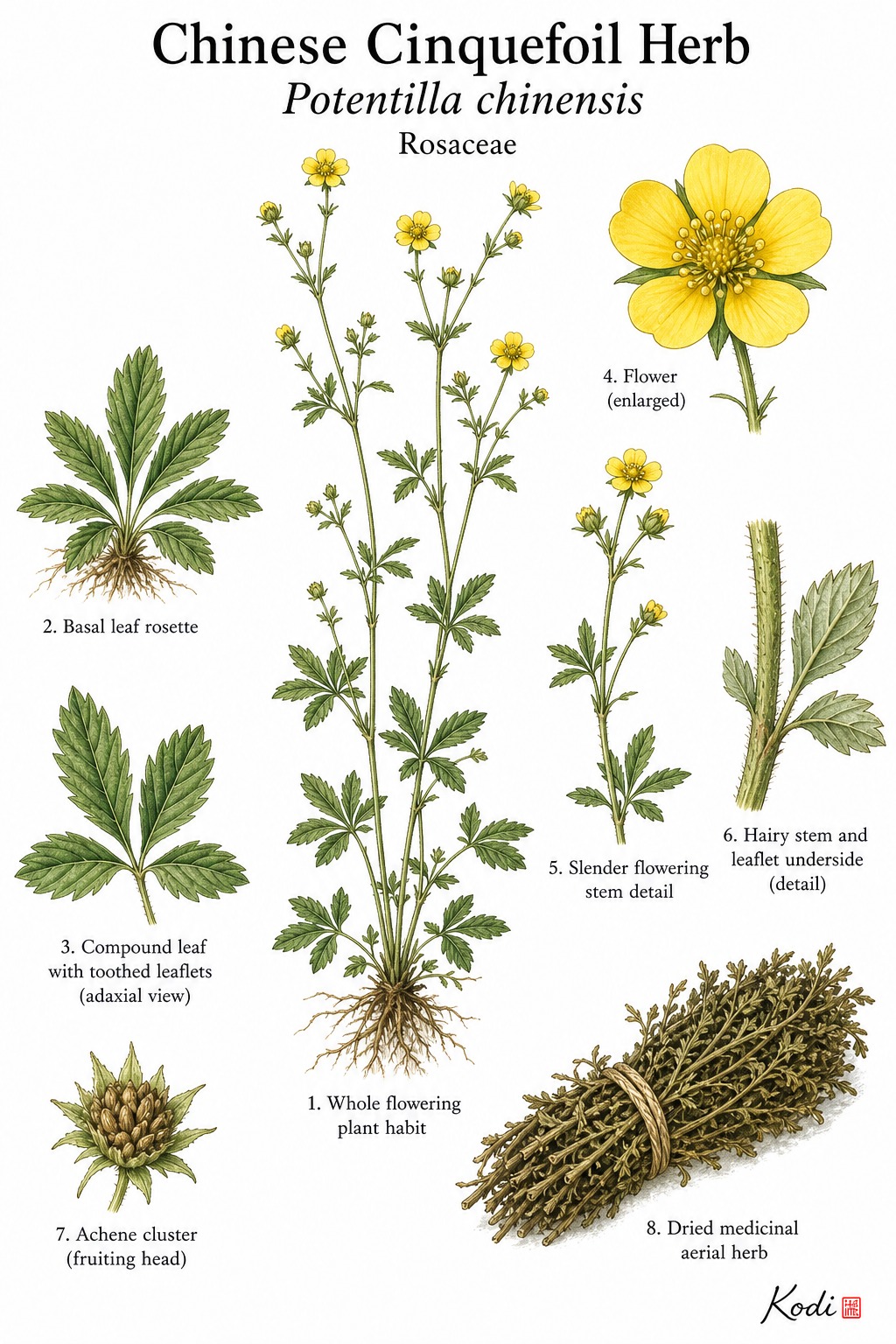
Known in TCM as Wei Ling Cai (委陵菜), this bitter, cold herb enters the Liver and Large Intestine. Traditionally, it clears heat and resolves toxicity - Wei Ling Cai is used for sores, boils, carbuncles, and toxic swellings when redness, inflammation, and damp-heat are prominent, most often applied for dysentery, hemorrhoids, and abscess. Modern research has identified Tormentic among its active constituents.
Also Known As
Latin: Potentillae Chinensis Herba | Pinyin: Wei Ling Cai | Chinese: 委陵菜
TCM Properties
- Taste
- bitter
- Temperature
- cold
- Channels
- Liver, Large Intestine
Traditional Use
Primary Actions
- Clears heat and resolves toxicity - Wei Ling Cai is used for sores, boils, carbuncles, and toxic swellings when redness, inflammation, and damp-heat are prominent.
- Cools blood and checks dysenteric diarrhea - it is especially valued for chronic dysentery with blood, lingering intestinal heat, and hemorrhoidal bleeding.
- Relieves abdominal pain from heat-type dysentery - the herb is suited to cramping abdominal pain with bloody or persistent diarrhea rather than to cold-deficiency loose stool.
- Can be used externally for toxic swelling and bleeding lesions - powders, fresh preparations, or washes extend its use beyond the internal intestinal sphere.
Secondary Actions
- Chinese Pharmacopoeia identifies Wei Ling Cai as the dried aerial part of Potentilla chinensis, collected in spring before stem elongation and dried for medicinal use.
- This is the true Chinese cinquefoil entry in the batch; the neighboring herb #211 was an import mix-up and actually belongs to Bei Dou Gen / Menispermum dauricum.
Classic Formulas
- Wei Ling Cai with Bai Tou Weng, Huang Bai, and Ma Chi Xian (委陵菜配白头翁黄柏马齿苋) - major combination logic for dysenteric diarrhea with heat, blood, and toxicity.
- Single-herb Wei Ling Cai decoction or powder - traditional practice allows it to be used alone for chronic dysentery, hemorrhoidal bleeding, or toxic swelling when the pattern is clear.
- Large-dose heat-bleeding use (委陵菜重用) - some later practitioners extend the dose upward when hemorrhoidal or uterine bleeding clearly reflects heat and toxic stasis.
Classical References
- TCM Wiki lists Wei Ling Cai / Chinese Cinquefoil Herb as bitter and cold, entering the Liver and Large Intestine channels, with actions of clearing heat, removing toxicity, cooling blood, and checking diarrhea.
- The Chinese Pharmacopoeia entry reproduced by ShennongAlpha identifies the herb as Potentillae Chinensis Herba, the dried aerial part of Potentilla chinensis, indicated for dysentery with abdominal pain, persistent diarrhea, bleeding hemorrhoids, and carbuncle or swelling with toxicity.
- American Dragon adds that Wei Ling Cai can be used by itself, is paired with Bai Tou Weng-class dysentery herbs, and is contraindicated in Yang deficiency with cold or Spleen-Stomach deficiency cold.
Modern Research
Active Compounds
- Tormentic acid (pentacyclic triterpene) - one of the best-studied Potentilla chinensis actives with anti-inflammatory and hepatoprotective activity
- Asiatic acid (pentacyclic triterpene) - a major active compound linked to hepatic and inflammatory pathway modulation
- Potentilloside A and related flavonol/flavone glucuronides - leaf-derived antioxidant and skin-protective constituents
- Pentacyclic triterpenes and gallic-acid-bearing phenolics - key anti-inflammatory and pharmacopoeial marker chemistry
- Polysaccharides - macromolecular fractions with reported immunologic activity
Studied Effects
- Tormentic acid isolated from Potentilla chinensis protected against fulminant hepatic failure in mice by suppressing NF-kB-linked inflammatory signaling and apoptosis pathways (PMID 24560903).
- Asiatic acid from Potentilla chinensis attenuated ethanol-induced hepatic injury through antioxidant, Kupffer-cell, and inflammatory-pathway effects, reinforcing the herb's heat-toxic clearing research profile (PMID 24432383).
- Flavonol and flavone glucuronides from Potentilla chinensis leaves reduced ROS, MMP-1 secretion, and inflammatory signaling in TNF-alpha-exposed dermal fibroblasts, supporting modern interest in skin-protective and wound-related applications (PMID 37891882).
- A 2021 chemistry study isolated multiple pentacyclic triterpenes from Potentilla chinensis and found nitric-oxide inhibitory activity in macrophage models, giving a clear constituent-level anti-inflammatory signal (PMID 33524652).
PubMed References
- Protective effect of tormentic acid from Potentilla chinensis against lipopolysaccharide/D-galactosamine induced fulminant hepatic failure in mice (2014)
- Asiatic acid from Potentilla chinensis attenuate ethanol-induced hepatic injury via suppression of oxidative stress and Kupffer cell activation (2014)
- The Effects of Flavonol and Flavone Glucuronides from Potentilla chinensis Leaves on TNF-alpha-Exposed Normal Human Dermal Fibroblasts (2023)
- Pentacyclic triterpenes with nitric oxide inhibitory activity from Potentilla chinensis (2021)
Safety & Interactions
Contraindications
- Yang deficiency with cold or Spleen-Stomach deficiency cold
- Loose stools or diarrhea from cold deficiency rather than heat-toxin
- Pure deficiency bleeding without heat or toxic accumulation
Cautions
- Its bitter-cold action is best suited to heat, toxicity, and blood in the stool, and may worsen cold digestive weakness if used indiscriminately
- Wei Ling Cai is easily confused in trade with related Potentilla herbs and similarly named materials, so botanical identity matters
- MSK page not found - drug interaction data not available from Memorial Sloan Kettering integrative medicine database
Conditions
- Dysentery Traditional ★★★★☆ JSON
- Hemorrhoids Traditional ★★★☆☆ JSON
- Abscess Traditional ★★★☆☆ JSON
- Abdominal Pain Traditional ★★☆☆☆ JSON
Frequently Asked Questions
What is Chinese Cinquefoil Herb used for?
Chinese Cinquefoil Herb is traditionally used to Clears heat and resolves toxicity - Wei Ling Cai is used for sores, boils, carbuncles, and toxic swellings when redness, inflammation, and damp-heat are prominent., Cools blood and checks dysenteric diarrhea - it is especially valued for chronic dysentery with blood, lingering intestinal heat, and hemorrhoidal bleeding., Relieves abdominal pain from heat-type dysentery - the herb is suited to cramping abdominal pain with bloody or persistent diarrhea rather than to cold-deficiency loose stool., Can be used externally for toxic swelling and bleeding lesions - powders, fresh preparations, or washes extend its use beyond the internal intestinal sphere.. Research has investigated its effects on: Tormentic acid isolated from Potentilla chinensis protected against fulminant hepatic failure in mice by suppressing NF-kB-linked inflammatory signaling and apoptosis pathways (PMID 24560903).; Asiatic acid from Potentilla chinensis attenuated ethanol-induced hepatic injury through antioxidant, Kupffer-cell, and inflammatory-pathway effects, reinforcing the herb's heat-toxic clearing research profile (PMID 24432383)..
What are other names for Chinese Cinquefoil Herb?
Chinese Cinquefoil Herb is also known as Potentilla. In TCM: 委陵菜 (Wei Ling Cai); Potentillae Chinensis Herba.
Is Chinese Cinquefoil Herb safe during pregnancy?
The safety of Chinese Cinquefoil Herb during pregnancy has not been established. Consult a qualified healthcare provider before use.
What are the contraindications for Chinese Cinquefoil Herb?
Chinese Cinquefoil Herb should not be used in: Yang deficiency with cold or Spleen-Stomach deficiency cold; Loose stools or diarrhea from cold deficiency rather than heat-toxin; Pure deficiency bleeding without heat or toxic accumulation. Consult a qualified healthcare provider before use.