Asiatic Moonseed Rhizome
- Chinese
- 北豆根
- Pinyin
- Bei Dou Gen
- Latin
- Rhizoma Menispermi
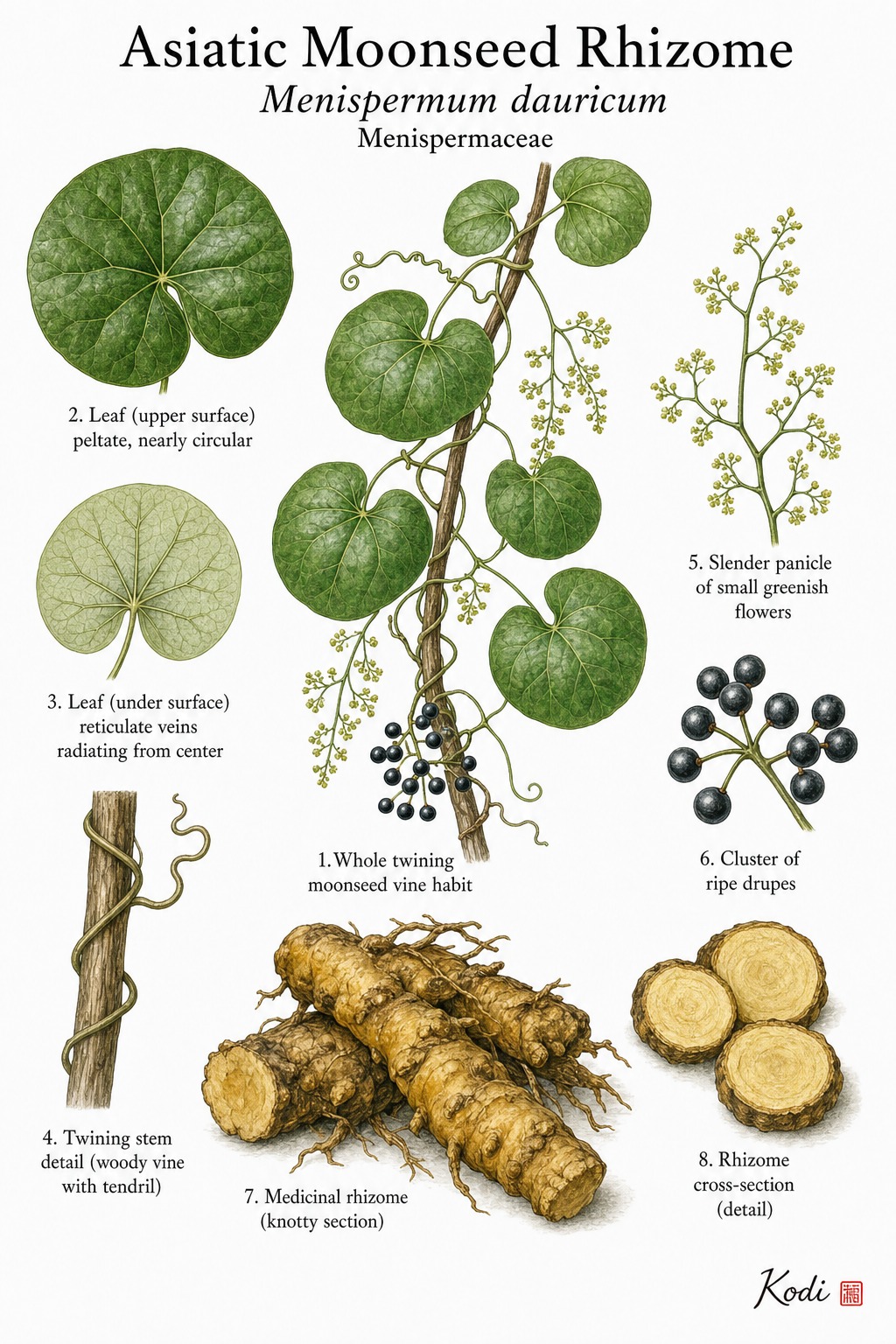
Known in TCM as Bei Dou Gen (北豆根), this bitter, cold herb enters the Lung, Stomach, and Large Intestine. Traditionally, it clears heat and resolves toxicity - Bei Dou Gen is best known for swollen painful throat, mumps, toxic-heat cough, and other inflammatory upper-body conditions in which heat and swelling predominate, most often applied for pharyngitis, tonsillitis, and dysentery. Modern research has identified Dauricine among its active constituents.
Part used: Rhizome
Also Known As
Latin: Rhizoma Menispermi | Pinyin: Bei Dou Gen | Chinese: 北豆根
TCM Properties
- Taste
- bitter
- Temperature
- cold
- Channels
- Lung, Stomach, Large Intestine
Traditional Use
Primary Actions
- Clears heat and resolves toxicity - Bei Dou Gen is best known for swollen painful throat, mumps, toxic-heat cough, and other inflammatory upper-body conditions in which heat and swelling predominate.
- Reduces swelling and alleviates pain - it may be chewed, swallowed slowly, or otherwise used so that its bitter-cold action directly reaches severe sore-throat and throat-swelling presentations.
- Resolves damp-heat and promotes elimination - older indications include dysentery, enteritis, jaundice, and related intestinal heat disorders in which dampness and toxicity mingle.
- Dispels wind-damp for painful obstruction - beyond throat use, it also appears in traditional rheumatic and arthralgia applications when swelling, heat, or toxicity complicate the pain.
Secondary Actions
- Bei Dou Gen is a slightly toxic heat-clearing rhizome and is more forceful than food-grade cooling herbs, so it is not treated as a casual household remedy.
- It should be clearly distinguished from Shan Dou Gen and from the true Chinese cinquefoil entry in this dataset, because the similar names can conceal very different plants and safety profiles.
Classic Formulas
- Bei Dou Gen with Ban Lan Gen and Niu Bang Zi (北豆根配板蓝根牛蒡子) - common toxic-heat sore-throat combination for swelling, pain, and hot cough.
- Bei Dou Gen with Bai Tou Weng and Huang Lian (北豆根配白头翁黄连) - used when damp-heat dysentery or enteritis needs both detoxification and intestinal heat-clearing.
- Slow-swallow throat methods with powdered Bei Dou Gen - traditional administration strategy for severe throat swelling so the bitter-cold action contacts the affected area directly.
Classical References
- TCM Wiki describes Bei Dou Gen / Rhizoma Menispermi as bitter, cold, and slightly toxic, entering the Lung and Stomach systems and used for sore throat, lung-heat cough, mumps, diarrhea, jaundice, rheumatic disease, hemorrhoids, and bites.
- American Dragon adds Large Intestine affinity and warns that overdose can cause epigastric pain, acid regurgitation, vertigo, sweating, chest oppression, tachypnea, agitation, nausea, vomiting, and low blood pressure.
- IMPORT NOTE: the stub slug called this herb 'Chinese Cinquefoil,' but Bei Dou Gen is actually Asiatic moonseed rhizome; the true cinquefoil herb in this sequence is herb #212 Wei Ling Cai.
Modern Research
Active Compounds
- Dauricine (bisbenzylisoquinoline alkaloid) - the best-known Menispermum dauricum constituent with anti-inflammatory, cardiovascular, and antitumor research relevance
- Acutumine and acutumidine-type alkaloids - structurally unusual chlorinated Menispermum alkaloids that contribute to the herb's pharmacologic and toxic profile
- Oxoisoaporphine and aporphine alkaloids - newer alkaloid subclasses identified from the rhizome with measurable anti-inflammatory or cytotoxic activity
- Menispermum polysaccharides - non-alkaloid fractions studied for immunomodulatory effects
Studied Effects
- Rhizome extracts of Menispermum dauricum reduced inflammatory injury in a mouse ulcerative-colitis model, supporting the old use of Bei Dou Gen for enteritis and dysentery-type heat disorders (PMID 27435376).
- Dauricine from Menispermum dauricum protected chondrocytes from inflammatory catabolism and improved osteoarthritic injury signaling through Ca2+ and NF-kB related pathways, offering a mechanistic explanation for rheumatic pain use (PMID 38081396).
- A purified polysaccharide from Menispermum dauricum showed immunological activity in vitro and in vivo, expanding modern research beyond the herb's well-known alkaloid fraction (PMID 35782915).
- N-desmethyldauricine from Menispermum dauricum suppressed triple-negative breast-cancer growth in 2D and 3D models, reinforcing continued interest in the rhizome's alkaloids as antitumor leads (PMID 38908813).
PubMed References
- Intestinal anti-inflammatory effect of the rhizome extracts of Menispermum dauricum DC. on trinitrobenzene sulfonic acid induced ulcerative colitis in mice (2016)
- An alkaloid from Menispermum dauricum, dauricine mediates Ca2+ influx and inhibits NF-kB pathway to protect chondrocytes from IL-1beta-induced inflammation and catabolism (2024)
- Structure Characterization, Immunological Activity, and Mechanism of a Polysaccharide From the Rhizome of Menispermum dauricum DC (2022)
- N-desmethyldauricine from Menispermum dauricum DC suppresses triple-negative breast cancer growth in 2D and 3D models by downregulating the NF-kB signaling pathway (2024)
Safety & Interactions
Contraindications
- Spleen and Stomach deficiency cold
- Diarrhea without heat or toxicity
- Unsupervised high-dose use of this slightly toxic alkaloid-rich rhizome
Cautions
- Bei Dou Gen is a slightly toxic herb with a meaningful alkaloid burden, so the dose should stay within traditional supervised ranges
- Overdose has been reported to cause epigastric pain and fullness, acid regurgitation, vertigo, sweating, chest oppression, tachypnea, agitation, nausea, vomiting, and low blood pressure
- MSK page not found - drug interaction data not available from Memorial Sloan Kettering integrative medicine database
Conditions
- Pharyngitis Traditional ★★★★☆ JSON
- Tonsillitis Traditional ★★★☆☆ JSON
- Dysentery Traditional ★★☆☆☆ JSON
- Rheumatoid Arthritis Traditional ★★☆☆☆ JSON
Frequently Asked Questions
What is Asiatic Moonseed Rhizome used for?
Asiatic Moonseed Rhizome is traditionally used to Clears heat and resolves toxicity - Bei Dou Gen is best known for swollen painful throat, mumps, toxic-heat cough, and other inflammatory upper-body conditions in which heat and swelling predominate., Reduces swelling and alleviates pain - it may be chewed, swallowed slowly, or otherwise used so that its bitter-cold action directly reaches severe sore-throat and throat-swelling presentations., Resolves damp-heat and promotes elimination - older indications include dysentery, enteritis, jaundice, and related intestinal heat disorders in which dampness and toxicity mingle., Dispels wind-damp for painful obstruction - beyond throat use, it also appears in traditional rheumatic and arthralgia applications when swelling, heat, or toxicity complicate the pain.. Research has investigated its effects on: Rhizome extracts of Menispermum dauricum reduced inflammatory injury in a mouse ulcerative-colitis model, supporting the old use of Bei Dou Gen for enteritis and dysentery-type heat disorders (PMID 27435376).; Dauricine from Menispermum dauricum protected chondrocytes from inflammatory catabolism and improved osteoarthritic injury signaling through Ca2+ and NF-kB related pathways, offering a mechanistic explanation for rheumatic pain use (PMID 38081396)..
What are other names for Asiatic Moonseed Rhizome?
Asiatic Moonseed Rhizome is also known as Menispermi. In TCM: 北豆根 (Bei Dou Gen); Rhizoma Menispermi.
Is Asiatic Moonseed Rhizome safe during pregnancy?
The safety of Asiatic Moonseed Rhizome during pregnancy has not been established. Consult a qualified healthcare provider before use.
What are the contraindications for Asiatic Moonseed Rhizome?
Asiatic Moonseed Rhizome should not be used in: Spleen and Stomach deficiency cold; Diarrhea without heat or toxicity; Unsupervised high-dose use of this slightly toxic alkaloid-rich rhizome. Consult a qualified healthcare provider before use.