Chinese Caterpillar Fungus
- Chinese
- 冬虫夏草
- Pinyin
- Dong Chong Xia Cao
- Latin
- Cordyceps
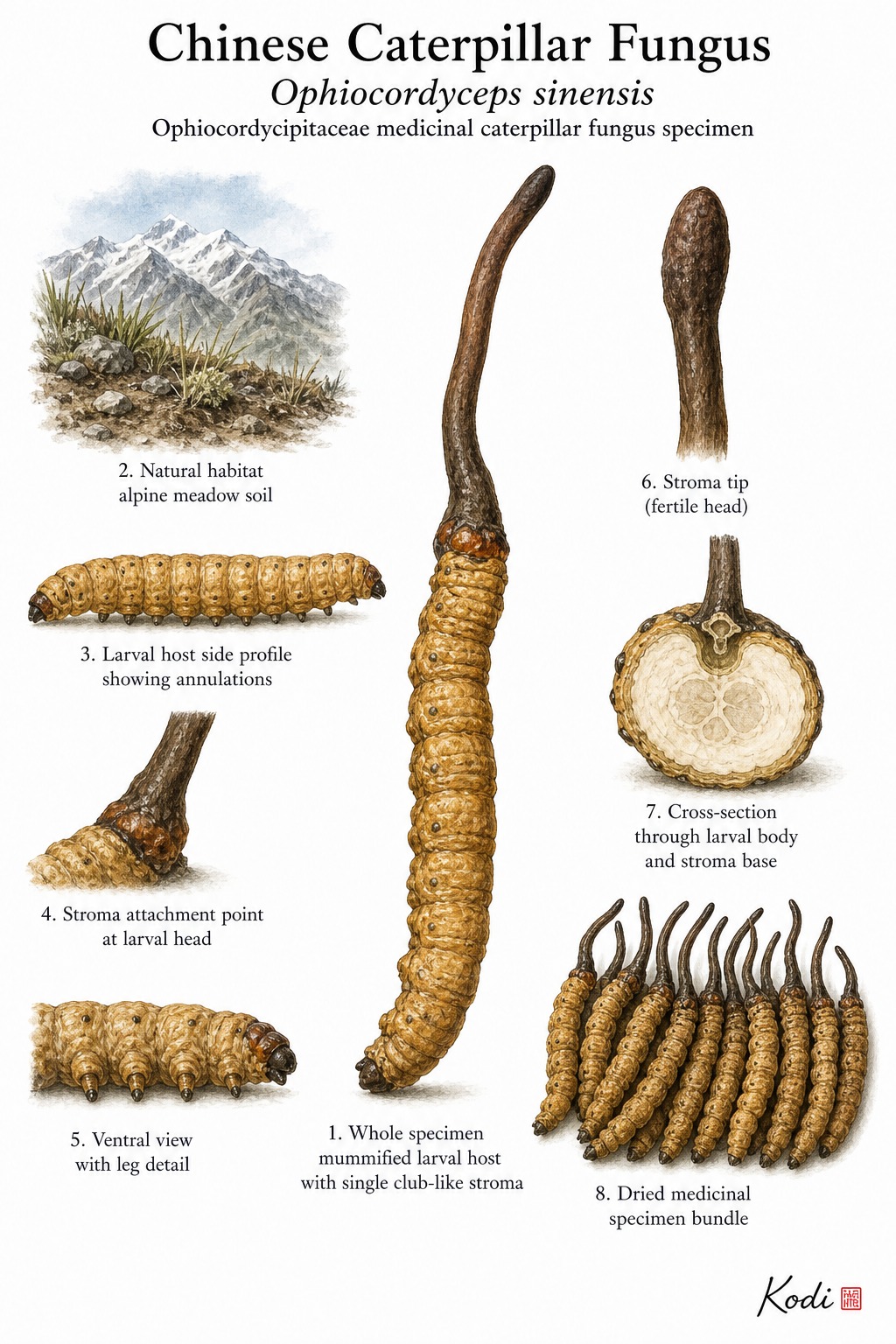
Known in TCM as Dong Chong Xia Cao (冬虫夏草), this sweet, warm herb enters the Lung and Kidney. Traditionally, it tonifies Kidney Yang and supports essence - Dong Chong Xia Cao is prized for chronic weakness with sore low back and knees, impotence, seminal leakage, cold fatigue, or slow post-illness recovery when Kidney depletion sits at the root, most often applied for fatigue, cough, and wheezing. Modern research has identified Cordycepin among its active constituents.
Part used: Fruiting body (fungus)
Also Known As
Latin: Cordyceps | Pinyin: Dong Chong Xia Cao | Chinese: 冬虫夏草
TCM Properties
- Taste
- sweet
- Temperature
- warm
- Channels
- Lung, Kidney
Traditional Use
Primary Actions
- Tonifies Kidney Yang and supports essence - Dong Chong Xia Cao is prized for chronic weakness with sore low back and knees, impotence, seminal leakage, cold fatigue, or slow post-illness recovery when Kidney depletion sits at the root.
- Nourishes the Lungs and calms wheezing - it is especially valued when chronic cough, dyspnea on exertion, weak respiration, or recurrent wheezing reflect Lung-Kidney deficiency rather than acute excess heat.
- Stops bleeding and transforms phlegm in consumptive cough - classical doctors used it for longstanding dry or weak cough with blood-streaked sputum, seeing the bleeding as part of a deeper Lung-Kidney deficiency pattern.
- Provides a rare balanced tonic action across Yin and Yang aspects of deficiency - unlike strongly heating Yang tonics, it is often chosen when weakness, cough, and sexual or renal depletion coexist without wanting to over-dry the patient.
Secondary Actions
- Dong Chong Xia Cao is traditionally grouped among the great tonics alongside ginseng and deer antler, but it is gentler and more specifically oriented toward the Lung-Kidney axis.
- Because the natural wild material is extremely expensive and frequently adulterated, modern practice often relies on cultivated products or related cordyceps materials while trying to preserve the classical functional profile.
Classic Formulas
- Ren Shen Lu Rong Tang modifications (人参鹿茸汤加冬虫夏草) - used when deep deficiency includes fatigue, cough, sexual weakness, and cold low-back soreness requiring both Qi support and Lung-Kidney reinforcement.
- Qi Wei Du Qi Wan modifications (七味都气丸加冬虫夏草) - adds Dong Chong Xia Cao when standard Kidney grasping-Qi support is not enough for chronic dyspnea and breathlessness from Lung-Kidney depletion.
- Deficiency-cough tonics with Ge Jie or Ren Shen - common pairing logic for chronic wheezing, cough with weakness, and post-illness debility when both respiration and Kidney essence need support.
Classical References
- Me and Qi describes Dong Chong Xia Cao as one of Chinese medicine's prized tonics that strengthens the Kidney and nourishes the Lungs for fatigue, cough, breathlessness, lower-back weakness, and recovery from prolonged illness.
- The same source notes a source disagreement over temperature, describing its nature as neutral to slightly warm while still emphasizing Kidney-Yang support and Lung-Yin nourishment together.
- Classical quotations preserved by Me and Qi include Ben Cao Cong Xin and Yao Xing Kao, which credit Dong Chong Xia Cao with benefiting the Lung and Kidney, stopping bleeding, transforming phlegm, and strongly supplementing essence and Qi.
Modern Research
Active Compounds
- Cordycepin (3'-deoxyadenosine nucleoside analogue) - the best-known marker constituent linked to antiplatelet, anticancer, and immunomodulatory research
- Adenosine (purine nucleoside) - a widely discussed cordyceps constituent relevant to vascular, metabolic, and signaling effects
- Cordyceps polysaccharides - macromolecular fractions central to immunologic and renal-support research
- Ergosterol (fungal sterol) - a characterized active constituent with liver-fibrosis relevance in cultured mycelium studies
- Mannitol / cordycepic-acid-type polyols - classic cordyceps marker metabolites often cited in chemical profiling
Studied Effects
- A focused review of cordycepin summarizes anticancer and antimetastatic effects across multiple experimental systems, reinforcing why cordycepin remains the modern flagship active compound associated with cordyceps pharmacology (PMID 25704018).
- A randomized placebo-controlled trial in healthy older adults found that Cs-4 Cordyceps sinensis improved metabolic and ventilatory thresholds over 12 weeks, supporting part of the traditional stamina and recovery narrative while still remaining modest in scope (PMID 20804368).
- Ergosterol was identified as a key anti-liver-fibrosis constituent in cultured Cordyceps sinensis mycelium, giving a specific compound-level bridge between cordyceps chemistry and hepatoprotective research (PMID 25386220).
- Recent clinical-trial work on fermented Cordyceps sinensis reported improvement in insomnia measures over 28 days, suggesting that modern cordyceps products continue to be explored beyond classic kidney-respiratory uses (PMID 40726627).
PubMed References
- Anticancer and antimetastatic effects of cordycepin, an active component of Cordyceps sinensis (2015)
- Effect of Cs-4 (Cordyceps sinensis) on exercise performance in healthy older subjects: a double-blind, placebo-controlled trial (2010)
- Ergosterol Is the Active Compound of Cultured Mycelium Cordyceps sinensis on Antiliver Fibrosis (2014)
- Effectiveness of fermentation broth of Cordyceps sinensis for primary insomnia: a randomized clinical trial with digital health tool (2025)
Safety & Interactions
Contraindications
- Myelogenous-type cancers
- Use of expensive or unverified cordyceps products without authentication
- Patterns of acute excess heat without underlying deficiency
Cautions
- Cordyceps is frequently adulterated, so source quality matters more than with ordinary low-cost tonic herbs
- MSK notes that cordyceps should not be used by those with myelogenous-type cancers because animal studies showed proliferation of erythroid progenitor cells
- A case report of excessive bleeding after a dental procedure has been linked to daily tonic use of cordyceps
Drug Interactions
- Hypoglycemics / insulin … Laboratory studies suggest additive hypoglycemic effects that may increase blood-sugar-lowering activity (Moderate) Source: Memorial Sloan Kettering
- Anticoagulants / antiplatelets … May inhibit platelet aggregation and increase bleeding risk; MSK also cites a case report of excessive bleeding (Moderate) Source: Memorial Sloan Kettering
Conditions
Frequently Asked Questions
What is Chinese Caterpillar Fungus used for?
Chinese Caterpillar Fungus is traditionally used to Tonifies Kidney Yang and supports essence - Dong Chong Xia Cao is prized for chronic weakness with sore low back and knees, impotence, seminal leakage, cold fatigue, or slow post-illness recovery when Kidney depletion sits at the root., Nourishes the Lungs and calms wheezing - it is especially valued when chronic cough, dyspnea on exertion, weak respiration, or recurrent wheezing reflect Lung-Kidney deficiency rather than acute excess heat., Stops bleeding and transforms phlegm in consumptive cough - classical doctors used it for longstanding dry or weak cough with blood-streaked sputum, seeing the bleeding as part of a deeper Lung-Kidney deficiency pattern., Provides a rare balanced tonic action across Yin and Yang aspects of deficiency - unlike strongly heating Yang tonics, it is often chosen when weakness, cough, and sexual or renal depletion coexist without wanting to over-dry the patient.. Research has investigated its effects on: A focused review of cordycepin summarizes anticancer and antimetastatic effects across multiple experimental systems, reinforcing why cordycepin remains the modern flagship active compound associated with cordyceps pharmacology (PMID 25704018).; A randomized placebo-controlled trial in healthy older adults found that Cs-4 Cordyceps sinensis improved metabolic and ventilatory thresholds over 12 weeks, supporting part of the traditional stamina and recovery narrative while still remaining modest in scope (PMID 20804368)..
What are other names for Chinese Caterpillar Fungus?
Chinese Caterpillar Fungus is also known as Cordyceps. In TCM: 冬虫夏草 (Dong Chong Xia Cao); Cordyceps.
Is Chinese Caterpillar Fungus safe during pregnancy?
The safety of Chinese Caterpillar Fungus during pregnancy has not been established. Consult a qualified healthcare provider before use.
What are the contraindications for Chinese Caterpillar Fungus?
Chinese Caterpillar Fungus should not be used in: Myelogenous-type cancers; Use of expensive or unverified cordyceps products without authentication; Patterns of acute excess heat without underlying deficiency. Consult a qualified healthcare provider before use.
Does Chinese Caterpillar Fungus interact with any medications?
Chinese Caterpillar Fungus may interact with: Hypoglycemics / insulin - Laboratory studies suggest additive hypoglycemic effects that may increase blood-sugar-lowering activity - (Moderate severity); Anticoagulants / antiplatelets - May inhibit platelet aggregation and increase bleeding risk; MSK also cites a case report of excessive bleeding - (Moderate severity). Always inform your healthcare provider of any herbal supplements you are taking.