Chicory Herb
- Chinese
- 菊苣
- Pinyin
- Ju Ju
- Latin
- Cichorii Herba
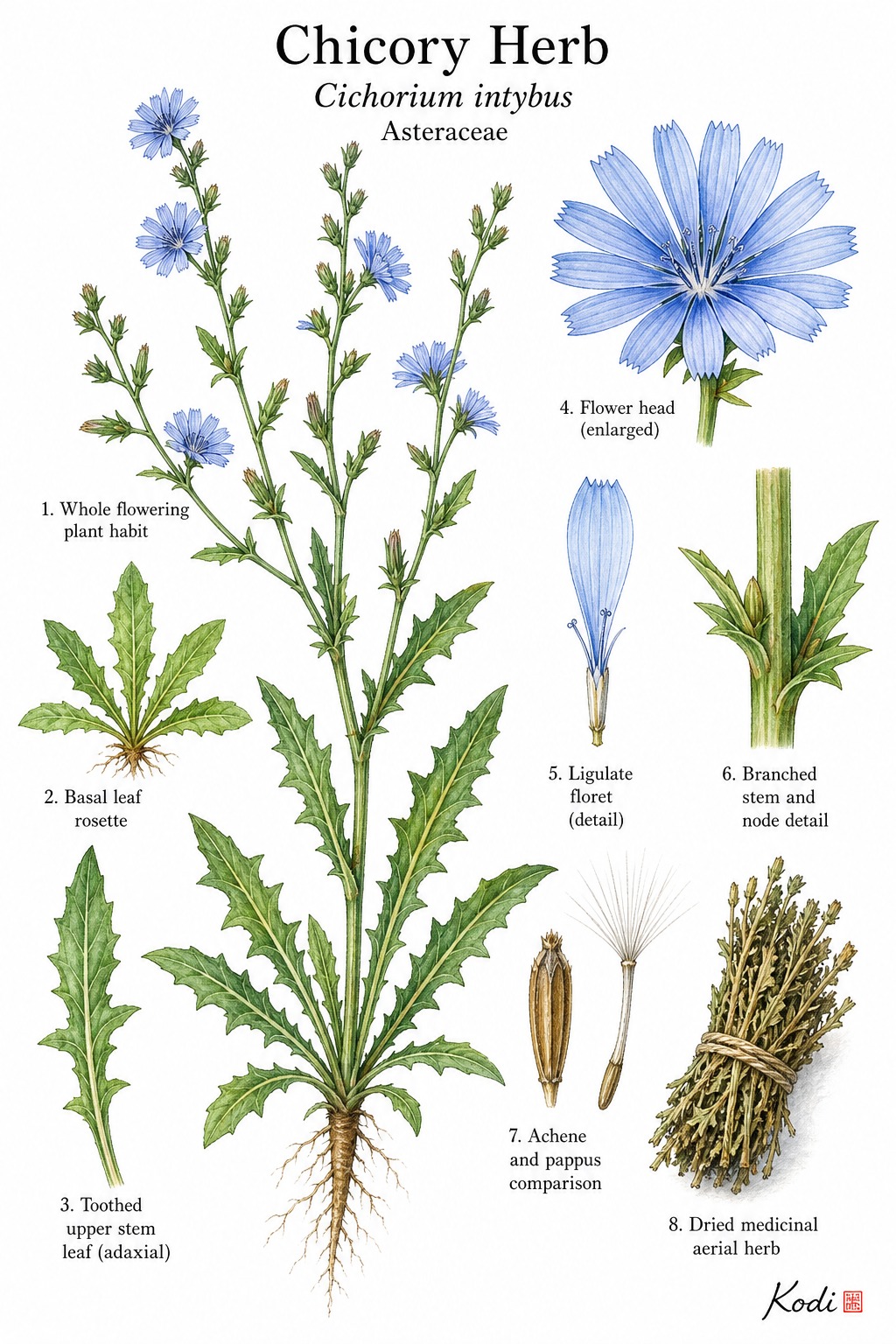
Known in TCM as Ju Ju (菊苣), this bitter and salty, cool herb enters the Liver, Gallbladder, and Stomach. Traditionally, it clears Liver and Gallbladder damp-heat and relieves jaundice - Ju Ju is especially used when yellowing of the eyes or skin, bitter taste, dark urine, rib-side discomfort, and digestive oppression point to damp-heat obstructing bile flow, most often applied for jaundice, poor appetite, and edema. Modern research has identified Chicoric among its active constituents.
Part used: Whole herb
Also Known As
Latin: Cichorii Herba | Pinyin: Ju Ju | Chinese: 菊苣
TCM Properties
- Taste
- bitter, salty
- Temperature
- cool
- Channels
- Liver, Gallbladder, Stomach
Traditional Use
Primary Actions
- Clears Liver and Gallbladder damp-heat and relieves jaundice - Ju Ju is especially used when yellowing of the eyes or skin, bitter taste, dark urine, rib-side discomfort, and digestive oppression point to damp-heat obstructing bile flow.
- Strengthens the Stomach and improves appetite - despite its cooling nature, it is valued when poor appetite, epigastric fullness, nausea, or sluggish digestion arise from damp-heat rather than from pure cold deficiency.
- Promotes urination and reduces edema - Ju Ju helps drain dampness downward when fluid retention, scanty urine, or puffy swelling accompany hepatobiliary or digestive heat patterns.
- Clears heat and resolves toxicity - broader regional practice extends its use to inflammatory damp-heat disorders in which digestive, urinary, and liver-gallbladder symptoms overlap.
Secondary Actions
- Ju Ju entered mainstream Chinese medicine through Uighur practice and remains more closely associated with hepatobiliary, damp-heat, and metabolic patterns than with the older Han-materia-medica core.
- It is commonly paired with Yin Chen Hao and Zhi Zi when jaundice, bitter taste, hypochondriac fullness, poor appetite, and dark urine occur together.
Classic Formulas
- Yin Chen Hao Tang modifications (茵陈蒿汤加菊苣) - used when damp-heat jaundice is accompanied by poor appetite, rib-side discomfort, or sluggish bile flow and the base formula needs stronger Liver-Gallbladder support.
- Ju Ju with Yin Chen Hao and Zhi Zi (菊苣配茵陈栀子) - common modern Uighur-TCM pairing for jaundice, bitter taste, dark urine, and hypochondriac fullness from damp-heat.
- Digestive damp-heat decoctions with Ju Ju and Shan Zha - regional usage for poor appetite, abdominal fullness, and Stomach discomfort when food stagnation overlaps with hepatobiliary damp-heat.
Classical References
- Me and Qi describes Ju Ju as a cooling herb from Uighur medicine now included in the Chinese Pharmacopoeia, emphasizing Liver-Gallbladder damp-heat, jaundice, digestion, and urination.
- The same source identifies the medicinal part as the whole aerial herb and frames its best use in jaundice, poor appetite, edema, and damp-heat digestive patterns.
- SOURCE NOTE: older English databases sometimes place Ju Ju in digestive categories with different channel attributions, but current Chinese-medicine summaries consistently center its hepatobiliary damp-heat use.
Modern Research
Active Compounds
- Chicoric acid (caffeoyltartaric polyphenol) - antioxidant and hepatometabolic constituent widely discussed in chicory pharmacology
- Lactucin, lactucopicrin, and 8-deoxylactucin (sesquiterpene lactones) - bitter marker compounds linked to anti-inflammatory and antiparasitic activity
- 11beta,13-dihydrolactucin and related sesquiterpene lactones - permeable chicory lactones with experimentally observed inflammatory-pathway effects
- Inulin-type fructans - prebiotic storage carbohydrates that help explain chicory's digestive and metabolic research interest
- Chlorogenic-acid-type phenolics - supportive antioxidant compounds relevant to liver and redox studies
Studied Effects
- Hydroalcoholic Cichorium intybus extract reduced liver injury markers and oxidative-inflammatory stress in a rat model of obstructive cholestasis, supporting the old jaundice-clearing reputation of Ju Ju in a modern hepatobiliary context (PMID 32928706).
- Experimental work on chicory sesquiterpene lactones found measurable intestinal permeability and anti-inflammatory signaling effects, with 11beta,13-dihydrolactucin showing notable NFAT-pathway modulation (PMID 33228214).
- Bioassay-guided fractionation linked chicory's anthelmintic activity largely to sesquiterpene lactones, especially 8-deoxylactucin, offering a modern compound-level explanation for some traditional damp-heat and parasite-clearing uses (PMID 33618233).
- A recent natural-products study identified new amino-acid-sesquiterpene-lactone conjugates from chicory roots and reported inhibition of NO, TNF-alpha, IL-6, and COX-2 signaling in macrophage models (PMID 40326224).
PubMed References
- Hepatoprotective effect of the hydroalcoholic extract of Cichorium intybus in a rat model of obstructive cholestasis (2021)
- Assessing the Intestinal Permeability and Anti-Inflammatory Potential of Sesquiterpene Lactones from Chicory (2020)
- Identification of compounds responsible for the anthelmintic effects of chicory (Cichorium intybus) by molecular networking and bio-guided fractionation (2021)
- Two amino acid-sesquiterpene lactone conjugates from chicory roots and their anti-inflammation activity (2025)
Safety & Interactions
Contraindications
- Spleen and Stomach deficiency cold with loose stools or chronic diarrhea
- Known allergy to chicory or other Asteraceae plants
- Pure deficiency patterns without damp-heat, jaundice, or fluid retention
Cautions
- Its cool bitter-salty nature can worsen cold digestion or cause loose stools if overused
- Because chicory is also sold as a food and coffee substitute, medicinal dosing should still be pattern-specific rather than assumed universally gentle
- MSK page not found - drug interaction data not available from Memorial Sloan Kettering integrative medicine database
Conditions
- Jaundice Traditional ★★★★☆ JSON
- Poor Appetite Traditional ★★★☆☆ JSON
- Edema Traditional ★★★☆☆ JSON
- Indigestion Traditional ★★☆☆☆ JSON
Frequently Asked Questions
What is Chicory Herb used for?
Chicory Herb is traditionally used to Clears Liver and Gallbladder damp-heat and relieves jaundice - Ju Ju is especially used when yellowing of the eyes or skin, bitter taste, dark urine, rib-side discomfort, and digestive oppression point to damp-heat obstructing bile flow., Strengthens the Stomach and improves appetite - despite its cooling nature, it is valued when poor appetite, epigastric fullness, nausea, or sluggish digestion arise from damp-heat rather than from pure cold deficiency., Promotes urination and reduces edema - Ju Ju helps drain dampness downward when fluid retention, scanty urine, or puffy swelling accompany hepatobiliary or digestive heat patterns., Clears heat and resolves toxicity - broader regional practice extends its use to inflammatory damp-heat disorders in which digestive, urinary, and liver-gallbladder symptoms overlap.. Research has investigated its effects on: Hydroalcoholic Cichorium intybus extract reduced liver injury markers and oxidative-inflammatory stress in a rat model of obstructive cholestasis, supporting the old jaundice-clearing reputation of Ju Ju in a modern hepatobiliary context (PMID 32928706).; Experimental work on chicory sesquiterpene lactones found measurable intestinal permeability and anti-inflammatory signaling effects, with 11beta,13-dihydrolactucin showing notable NFAT-pathway modulation (PMID 33228214)..
What are other names for Chicory Herb?
Chicory Herb is also known as Cichorium. In TCM: 菊苣 (Ju Ju); Cichorii Herba.
Is Chicory Herb safe during pregnancy?
The safety of Chicory Herb during pregnancy has not been established. Consult a qualified healthcare provider before use.
What are the contraindications for Chicory Herb?
Chicory Herb should not be used in: Spleen and Stomach deficiency cold with loose stools or chronic diarrhea; Known allergy to chicory or other Asteraceae plants; Pure deficiency patterns without damp-heat, jaundice, or fluid retention. Consult a qualified healthcare provider before use.