Chicken Gizzard Lining
- Chinese
- 鸡内金
- Pinyin
- Ji Nei Jin
- Latin
- Endothelium Corneum Gigeriae Galli
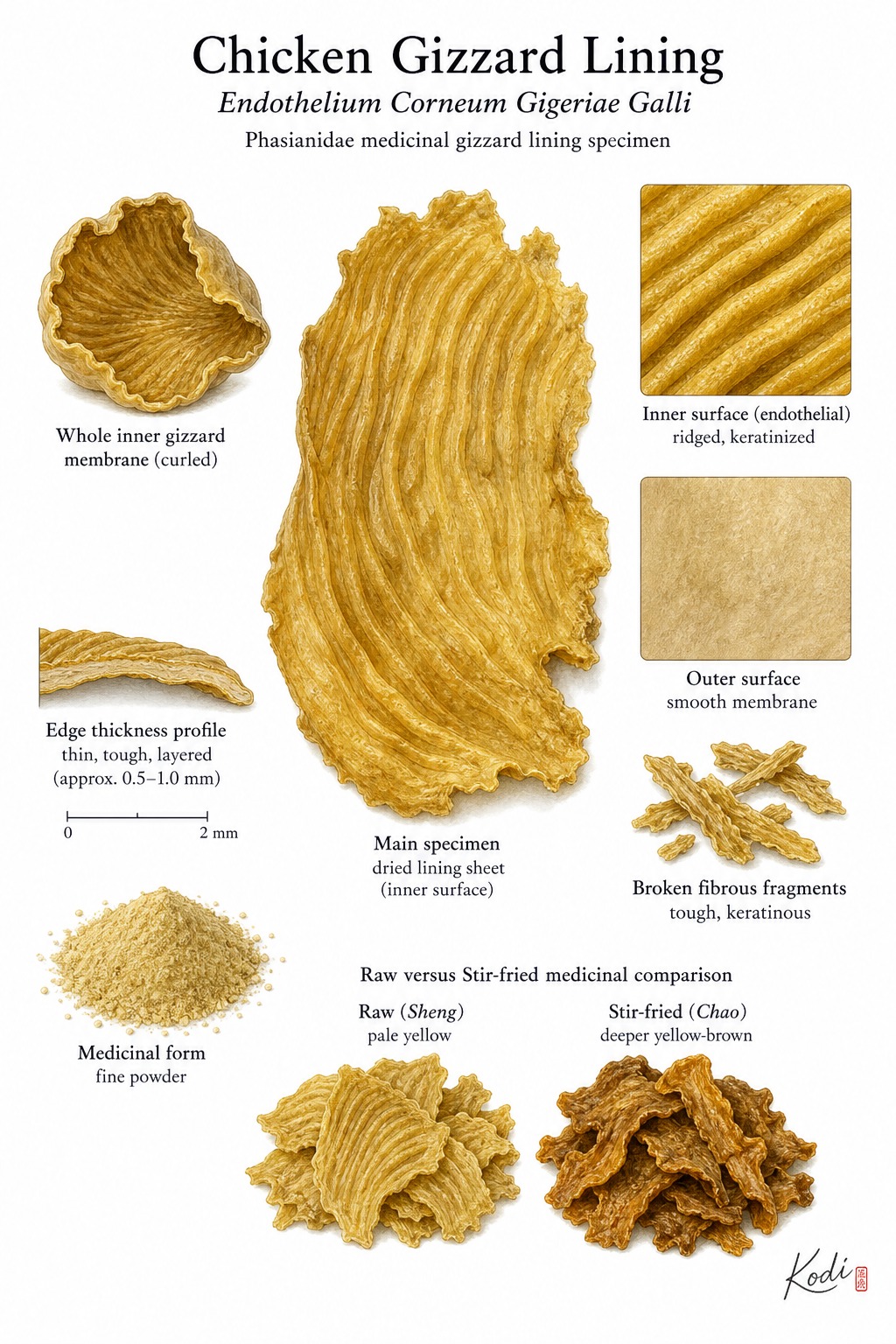
Known in TCM as Ji Nei Jin (鸡内金), this sweet, neutral herb enters the Spleen, Stomach, Small Intestine, and Bladder. Traditionally, it promotes digestion and resolves food stagnation - Ji Nei Jin is a leading digestive aid for stubborn accumulation from grains, starches, dairy, and meat, especially when bloating, poor appetite, nausea, or childhood malnutrition accompany retained food, most often applied for indigestion, poor appetite, and diarrhea. Modern research has identified Protein among its active constituents.
Part used: Inner membrane
Also Known As
Latin: Endothelium Corneum Gigeriae Galli | Pinyin: Ji Nei Jin | Chinese: 鸡内金
TCM Properties
- Taste
- sweet
- Temperature
- neutral
- Channels
- Spleen, Stomach, Small Intestine, Bladder
Traditional Use
Primary Actions
- Promotes digestion and resolves food stagnation - Ji Nei Jin is a leading digestive aid for stubborn accumulation from grains, starches, dairy, and meat, especially when bloating, poor appetite, nausea, or childhood malnutrition accompany retained food.
- Strengthens the Spleen while dispersing accumulation - unlike purely draining digestants, it is used when weak digestive transformation and retained food coexist, such as chronic poor appetite with loose stools and post-illness digestive sluggishness.
- Secures essence and stops enuresis - its astringing lower-burner action makes it useful for bedwetting, frequent urination, and seminal emission patterns when Spleen weakness contributes to insecure Kidney-Bladder function.
- Softens hardness and dissolves urinary or biliary stones - the raw powdered form is traditionally favored for urinary gravel, small stones, and stubborn mineral accumulation, often paired with Jin Qian Cao or Hai Jin Sha.
Secondary Actions
- Ji Nei Jin is widely considered more effective as a swallowed powder than as a long-boiled decoction because prolonged heating can reduce the activity of its enzyme-rich or easily altered fractions.
- Processing matters: raw Ji Nei Jin is preferred for stone-dissolving and hard-accumulation use, while the stir-fried form is more often chosen for diarrhea, poor appetite, and lower-burner insecurity.
Classic Formulas
- Yi Pi Bing (益脾饼) - Zhang Xichun's Spleen-benefiting cake pairing Ji Nei Jin with Bai Zhu to strengthen weak digestion while dispersing food retention and pediatric malnutrition patterns.
- San Jin Tang (三金汤) - stone-dissolving formula pattern based on Ji Nei Jin with Jin Qian Cao and related damp-heat-clearing ingredients for urinary or biliary calculi.
- Ji Pi Zi San (鸡脾子散) - classical pattern using Ji Nei Jin with Sang Piao Xiao and related ingredients for bedwetting, frequent urination, and seminal leakage due to insecure lower-burner function.
Classical References
- Me and Qi describes Ji Nei Jin as the dried inner lining of the chicken gizzard, sweet and neutral, entering the Spleen, Stomach, Small Intestine, and Bladder channels, with key actions of promoting digestion, strengthening the Spleen, securing essence, and dissolving stones.
- The same source notes that Ji Nei Jin is significantly more effective when taken as powder, that the raw form is preferred for stone disorders, and that the stir-fried form is preferred for diarrhea, poor appetite, and enuresis.
- Traditional comparisons place Ji Nei Jin above Mai Ya or Shan Zha when food stagnation is severe or chronic and when stone dissolution or lower-burner astringing are also required.
Modern Research
Active Compounds
- Protein and peptide fractions such as ventriculin-related materials - the structural matrix most often invoked in the herb's digestive and mucosal-support reputation
- Trace digestive enzymes including pepsin- and amylase-like activity - traditionally cited as one reason powdered Ji Nei Jin can outperform prolonged decoction
- Bile-acid fractions identified in ethyl acetate extracts - modern chemical work found multiple bile acids in processed GGEC extracts
- Glycosaminoglycan-rich tissue components - connective-tissue-derived fractions identified in broader chicken gizzard chemistry work
- Amino-acid and keratin-related structural constituents - core nutritional and material components of the dried gizzard lining
Studied Effects
- A 2021 study reported that Galli gigeriae endothelium corneum extracts reinforced intestinal barrier function, increased tight-junction proteins, and reduced inflammatory signaling in vitro while also profiling 33 compounds including bile acids and isoflavones (PMID 33593395).
- Endothelium corneum gigeriae galli extract inhibited calcium oxalate formation and showed anti-urolithic effects, directly supporting the long TCM use of raw Ji Nei Jin for urinary gravel and stones (PMID 30194056).
- A recent review summarizes the expanding chemical profile of GGEC and highlights how modern research has moved beyond crude digestive folklore into bile-acid, peptide, and multi-component chemical characterization (PMID 40771715).
PubMed References
- Galli gigeriae endothelium corneum: its intestinal barrier protective activity in vitro and chemical composition (2021)
- Endothelium corneum gigeriae galli extract inhibits calcium oxalate formation and exerts anti-urolithic effects (2019)
- Research progress on the chemical composition of galli gigeriae endothelium corneum (2025)
Safety & Interactions
Contraindications
- Spleen deficiency without actual food stagnation
- Excess stomach acid or active acid-reflux patterns
- Known poultry-protein allergy
Cautions
- Powdered Ji Nei Jin is traditionally preferred because prolonged boiling may reduce the activity of its more delicate digestive fractions
- Raw powder is usually reserved for stone disorders, while stir-fried Ji Nei Jin is more appropriate for diarrhea, enuresis, and everyday digestive weakness
- MSK page not found - drug interaction data not available from Memorial Sloan Kettering integrative medicine database
Conditions
- Indigestion Traditional ★★★★★ JSON
- Poor Appetite Traditional ★★★★☆ JSON
- Diarrhea Traditional ★★★☆☆ JSON
- Frequent Urination Traditional ★★★☆☆ JSON
- Urolithiasis Research ★★★☆☆ JSON
Frequently Asked Questions
What is Chicken Gizzard Lining used for?
Chicken Gizzard Lining is traditionally used to Promotes digestion and resolves food stagnation - Ji Nei Jin is a leading digestive aid for stubborn accumulation from grains, starches, dairy, and meat, especially when bloating, poor appetite, nausea, or childhood malnutrition accompany retained food., Strengthens the Spleen while dispersing accumulation - unlike purely draining digestants, it is used when weak digestive transformation and retained food coexist, such as chronic poor appetite with loose stools and post-illness digestive sluggishness., Secures essence and stops enuresis - its astringing lower-burner action makes it useful for bedwetting, frequent urination, and seminal emission patterns when Spleen weakness contributes to insecure Kidney-Bladder function., Softens hardness and dissolves urinary or biliary stones - the raw powdered form is traditionally favored for urinary gravel, small stones, and stubborn mineral accumulation, often paired with Jin Qian Cao or Hai Jin Sha.. Research has investigated its effects on: A 2021 study reported that Galli gigeriae endothelium corneum extracts reinforced intestinal barrier function, increased tight-junction proteins, and reduced inflammatory signaling in vitro while also profiling 33 compounds including bile acids and isoflavones (PMID 33593395).; Endothelium corneum gigeriae galli extract inhibited calcium oxalate formation and showed anti-urolithic effects, directly supporting the long TCM use of raw Ji Nei Jin for urinary gravel and stones (PMID 30194056)..
What are other names for Chicken Gizzard Lining?
Chicken Gizzard Lining is also known as Corneum. In TCM: 鸡内金 (Ji Nei Jin); Endothelium Corneum Gigeriae Galli.
Is Chicken Gizzard Lining safe during pregnancy?
The safety of Chicken Gizzard Lining during pregnancy has not been established. Consult a qualified healthcare provider before use.
What are the contraindications for Chicken Gizzard Lining?
Chicken Gizzard Lining should not be used in: Spleen deficiency without actual food stagnation; Excess stomach acid or active acid-reflux patterns; Known poultry-protein allergy. Consult a qualified healthcare provider before use.