Charred Malt
- Chinese
- 焦麦芽
- Pinyin
- Jiao Mai Ya
- Latin
- Fructus Hordei Germinatus Praeparata
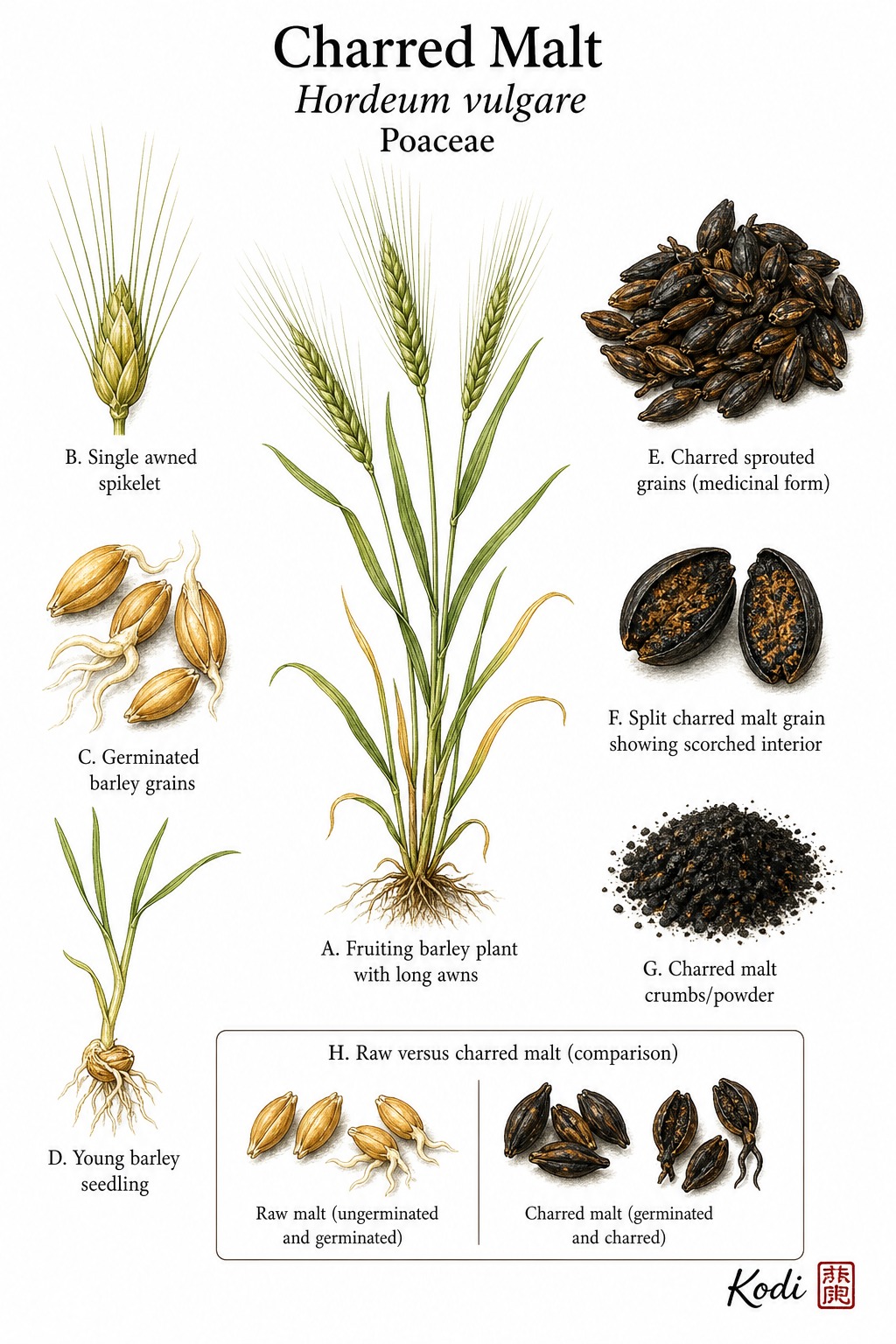
Known in TCM as Jiao Mai Ya (焦麦芽), this sweet, warm herb enters the Spleen, Stomach, and Liver. Traditionally, it strongly resolves food stagnation from grains and starchy foods - Jiao Mai Ya is the scorched form of malt, chosen when undigested rice, bread, noodles, potatoes, or milk-retention in children produces bloating, sour belching, fullness, and poor appetite, most often applied for indigestion, abdominal distension, and diarrhea. Modern research has identified Hordenine among its active constituents.
Part used: Fruit
Also Known As
Latin: Fructus Hordei Germinatus Praeparata | Pinyin: Jiao Mai Ya | Chinese: 焦麦芽
TCM Properties
- Taste
- sweet
- Temperature
- warm
- Channels
- Spleen, Stomach, Liver
Traditional Use
Primary Actions
- Strongly resolves food stagnation from grains and starchy foods - Jiao Mai Ya is the scorched form of malt, chosen when undigested rice, bread, noodles, potatoes, or milk-retention in children produces bloating, sour belching, fullness, and poor appetite.
- Stops diarrhea when food accumulation and loose stools appear together - compared with plain Mai Ya, the charred form gains a more astringing and bowel-stabilizing quality, so it is used when stagnant food is accompanied by foul loose stool rather than simple fullness alone.
- Harmonizes the middle burner and reopens the appetite after overeating - it disperses retained food without the harsh purging quality of stronger downward-draining herbs, making it useful in pediatric and recovery-stage digestive stagnation.
- Retains a milder Liver-Qi-smoothing role but shifts away from the raw herb's broader sprout-enzyme emphasis - charred processing makes digestion and stool regulation the priority rather than gentle long-term support or lactation management.
Secondary Actions
- Jiao Mai Ya is one of the best-known ingredients in Jiao San Xian, the classic trio of charred hawthorn, charred medicated leaven, and charred malt used for festive overeating, pediatric food accumulation, and lingering fullness after rich meals.
- When Jiao Bing Lang is added to that trio, the broader Jiao Si Xian strategy gives more downward movement for stubborn abdominal distension, tenesmus, or foul food retention.
Classic Formulas
- Jiao San Xian (焦三仙) - charred hawthorn, charred medicated leaven, and charred malt for overeating, food retention, foul stool, and abdominal distension, especially in children and after greasy festival meals.
- Jiao Si Xian (焦四仙) - Jiao San Xian plus charred areca seed when food stagnation is more stubborn and requires stronger downward movement.
- Bao He Wan modifications with Jiao Mai Ya (保和丸加焦麦芽) - used when classic food-stagnation treatment needs extra help with starchy retention, sour belching, and stagnation-related diarrhea.
Classical References
- Me and Qi states that Jiao Mai Ya becomes warmer and stronger at resolving severe food stagnation than plain Mai Ya and gains an astringent quality that can help stop diarrhea.
- The same source explicitly identifies Jiao Mai Ya as one of the three ingredients in Jiao San Xian, the classic charred-digestant combination for food accumulation.
- Classical cautions carried forward on the Mai Ya page warn that pregnancy use is not routine and larger doses were historically associated with hastening labor or miscarriage, so the processed form also requires caution in pregnancy.
Modern Research
Active Compounds
- Hordenine (phenethylamine alkaloid) - the best-known barley-sprout constituent linked to prolactin regulation and lactation-related pharmacology
- Hordatines (barley-specific phenolamides) - signature seedling metabolites associated with plant defense and modern metabolomic profiling of young barley
- Saponarin and related flavonoids - antioxidant barley-sprout constituents relevant to functional-food research
- Phenolic acids and flavonoids such as ferulic acid, quercetin, tricine, kaempferol, and catechin - compounds tracked during the frying process of Fructus Hordei Germinatus
- Digestive enzyme fractions including amylase - important to the raw sprout's traditional starch-digesting rationale but partly degraded by intense charring
Studied Effects
- Water extract of Fructus Hordei Germinatus reduced prolactin secretion in hyperprolactinemic models through dopamine D2-receptor-related mechanisms, offering a modern explanation for the long-standing Mai Ya association with reducing breast-milk production at higher doses (PMID 25254056).
- A PubMed-indexed frying-process study found that charring Fructus Hordei Germinatus does not simply make it more effective because of amylase changes; instead, prolonged frying markedly increased 5-hydroxymethylfurfural and acrylamide while altering the profile of tracked phenolics, providing a concrete processing-specific modern note for Jiao Mai Ya (PMID 28933116).
- Metabolomic analysis of barley seedlings showed that hordatines and related precursors dominate early barley metabolite profiles, helping explain why germinated barley differs pharmacologically from ordinary grain and remains a chemically distinctive materia medica source (PMID 35448497).
PubMed References
- Water Extract of Fructus Hordei Germinatus Shows Antihyperprolactinemia Activity via Dopamine D2 Receptor (2014)
- Dynamic change rules of active ingredients and inactive ingredients from Fructus Hordei Germinatus with frying process (2016)
- Hordatines and Associated Precursors Dominate Metabolite Profiles of Barley (Hordeum vulgare L.) Seedlings: A Metabolomics Study of Five Cultivars (2022)
Safety & Interactions
Contraindications
- Pregnancy
- Breastfeeding when continued milk supply is desired
- Spleen and Stomach deficiency without actual food retention
Cautions
- The charred form is stronger and warmer than plain Mai Ya for food stagnation, but excessive use can over-dry the middle burner and is not meant as a routine nutritional barley food
- Classical and modern sources both caution that larger-dose Mai Ya preparations may suppress lactation; this is helpful for weaning but unwanted during active breastfeeding
- Frying-process research found increasing levels of 5-hydroxymethylfurfural and acrylamide with heavier processing, so deeper charring is not automatically safer or better
- MSK page not found - drug interaction data not available from Memorial Sloan Kettering integrative medicine database
Conditions
- Indigestion Traditional ★★★★☆ JSON
- Abdominal Distension Traditional ★★★☆☆ JSON
- Diarrhea Traditional ★★★☆☆ JSON
- Poor Appetite Traditional ★★★☆☆ JSON
Frequently Asked Questions
What is Charred Malt used for?
Charred Malt is traditionally used to Strongly resolves food stagnation from grains and starchy foods - Jiao Mai Ya is the scorched form of malt, chosen when undigested rice, bread, noodles, potatoes, or milk-retention in children produces bloating, sour belching, fullness, and poor appetite., Stops diarrhea when food accumulation and loose stools appear together - compared with plain Mai Ya, the charred form gains a more astringing and bowel-stabilizing quality, so it is used when stagnant food is accompanied by foul loose stool rather than simple fullness alone., Harmonizes the middle burner and reopens the appetite after overeating - it disperses retained food without the harsh purging quality of stronger downward-draining herbs, making it useful in pediatric and recovery-stage digestive stagnation., Retains a milder Liver-Qi-smoothing role but shifts away from the raw herb's broader sprout-enzyme emphasis - charred processing makes digestion and stool regulation the priority rather than gentle long-term support or lactation management.. Research has investigated its effects on: Water extract of Fructus Hordei Germinatus reduced prolactin secretion in hyperprolactinemic models through dopamine D2-receptor-related mechanisms, offering a modern explanation for the long-standing Mai Ya association with reducing breast-milk production at higher doses (PMID 25254056).; A PubMed-indexed frying-process study found that charring Fructus Hordei Germinatus does not simply make it more effective because of amylase changes; instead, prolonged frying markedly increased 5-hydroxymethylfurfural and acrylamide while altering the profile of tracked phenolics, providing a concrete processing-specific modern note for Jiao Mai Ya (PMID 28933116)..
What are other names for Charred Malt?
Charred Malt is also known as Hordei. In TCM: 焦麦芽 (Jiao Mai Ya); Fructus Hordei Germinatus Praeparata.
Is Charred Malt safe during pregnancy?
Charred Malt is not recommended during pregnancy.
What are the contraindications for Charred Malt?
Charred Malt should not be used in: Pregnancy; Breastfeeding when continued milk supply is desired; Spleen and Stomach deficiency without actual food retention. Consult a qualified healthcare provider before use.