Catclaw Buttercup Root
- Chinese
- 猫爪草
- Pinyin
- Mao Zhua Cao
- Latin
- Radix Ranunculi Ternati
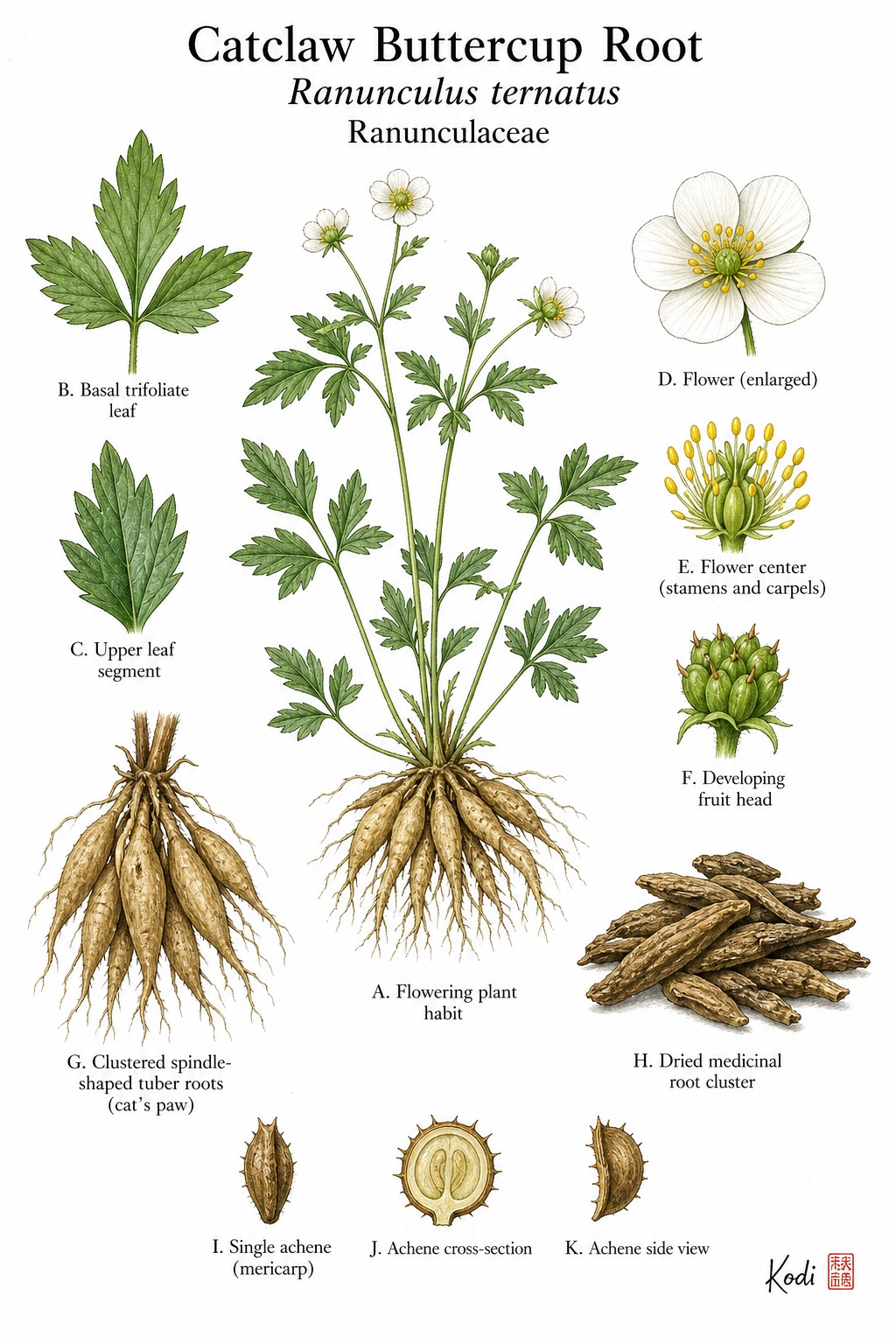
Known in TCM as Mao Zhua Cao (猫爪草), this sweet and acrid, warm herb enters the Liver and Lung. Traditionally, it transforms Phlegm and dissipates nodules - Mao Zhua Cao is best known for softening and dispersing chronic Phlegm-type lumps such as scrofula, swollen lymph nodes, breast lumps, and thyroid nodules, especially in the neck and upper-body pathways of the Liver and Lung channels, most often applied for thyroid nodule, scrofula, and abscess. Modern research has identified Total among its active constituents.
Part used: Root
Also Known As
Latin: Radix Ranunculi Ternati | Pinyin: Mao Zhua Cao | Chinese: 猫爪草
TCM Properties
- Taste
- sweet, acrid
- Temperature
- warm
- Channels
- Liver, Lung
Traditional Use
Primary Actions
- Transforms Phlegm and dissipates nodules - Mao Zhua Cao is best known for softening and dispersing chronic Phlegm-type lumps such as scrofula, swollen lymph nodes, breast lumps, and thyroid nodules, especially in the neck and upper-body pathways of the Liver and Lung channels.
- Resolves toxicity and reduces swelling - it is traditionally used for abscesses, boils, and toxic swellings when constrained Phlegm and toxin combine into painful localized masses.
- Disperses accumulations and chronic concretions - beyond superficial swellings, it is applied to deeper longstanding masses and tumor-like lesions in folk and regional oncology-oriented practice, usually as part of a larger phlegm-resolving and toxin-clearing strategy.
- Supports treatment of scrofula and tuberculosis-type nodular disease - older regional usage emphasizes its role when hard neck lumps, chronic glandular swelling, and lingering toxic-phlegm obstruction are the dominant presentation.
Secondary Actions
- Mao Zhua Cao is a comparatively late-entering Chinese medicinal rather than one of the great early classics, but it became important in regional practice because of its strong affinity for stubborn nodules.
- The herb's name comes from its clustered spindle-shaped tubers, which resemble a cat's paw; this distinctive morphology is also important for correct identification and avoiding substitution with related Ranunculus species.
Classic Formulas
- Mao Zhua Cao with Xia Ku Cao (猫爪草配夏枯草) - classic modern pairing for thyroid nodules, scrofula, and hot-phlegm masses, combining warm phlegm-dissolving movement with cold softening of hardness.
- Mao Zhua Cao with Jiang Can (猫爪草配僵蚕) - nodular-mass pairing that strengthens Phlegm transformation and collateral penetration for chronic neck lumps and glandular swellings.
- High-dose single-herb Mao Zhua Cao decoction with rice wine - regional clinical protocol used historically for scrofula and chronic cervical nodules under close supervision.
Classical References
- Me and Qi describes Mao Zhao Cao / Mao Zhua Cao as warm, sweet, and acrid, entering the Liver and Lung channels and chiefly transforming Phlegm, dissipating nodules, resolving toxicity, and reducing swelling.
- The herb does not appear as a major named entry in the oldest materia medica canons; later regional handbooks instead emphasize its practical use for neck scrofula and nodular disease.
- IDENTITY NOTE: the pinyin appears as both Mao Zhua Cao and Mao Zhao Cao in modern sources; this record keeps the more literal claw-based reading while preserving the same herb identity.
Modern Research
Active Compounds
- Total saponins (triterpenoid saponin fraction) - one of the major bioactive clusters studied for antitumor and inflammatory signaling effects
- Alkaloid fractions - increasingly studied for anti-metastatic and cell-signaling activity in modern oncology models
- Water-soluble polysaccharides - traditional tonic-detoxifying fractions explored for immune and antiproliferative effects
- Flavonoid-type phenolics - supportive antioxidant and signaling-modulating constituents reported in broader Ranunculus research
- Trace anemonin/protoanemonin-related irritant chemistry - relevant to the slight-toxicity and skin-irritation cautions associated with fresh buttercup-family material
Studied Effects
- Total saponins of Ranunculus ternatus showed anti-breast-cancer effects in vivo and in vitro, with reported influence on JAK2/STAT3 signaling, inflammatory mediators, tumor growth, and apoptosis pathways (PMID 40351419).
- A 2024 study reported that alkaloids from Ranunculus ternatus attenuated colorectal-cancer metastasis through epithelial-mesenchymal-transition suppression, supporting the herb's long nodular-mass association in a modern mechanistic frame (PMID 40541119).
- Ranunculus ternatus extract attenuated renal fibrosis in diabetic nephropathy models via SMYD2-related signaling, showing that research interest now extends beyond oncology into fibrosis and inflammatory remodeling (PMID 35142600).
PubMed References
- Mechanism of total saponins of Ranunculus ternatus Thunb. in treatment of breast cancer based on liquid chromatography-mass spectrometry and network analysis (2025)
- Ranunculus ternatus Thunb. alkaloids attenuate colorectal cancer metastasis through EMT suppression (2025)
- Ranunculus ternatus Thunb extract attenuates renal fibrosis of diabetic nephropathy via inhibiting SMYD2 (2022)
Safety & Interactions
Contraindications
- Known buttercup-family hypersensitivity
- Fresh-plant use on fragile or highly reactive skin
- Unsupervised use for unexplained enlarging masses
Cautions
- Modern materia medica sources often classify Mao Zhua Cao as slightly toxic, largely because fresh Ranunculus-family material can irritate the skin and mucosa
- Possible adverse effects from overuse include gastrointestinal irritation, dizziness, dry mouth, and contact blistering from fresh or improperly handled material
- MSK page not found - drug interaction data not available from Memorial Sloan Kettering integrative medicine database
Conditions
- Thyroid Nodule Traditional ★★★★☆ JSON
- Scrofula Traditional ★★★★☆ JSON
- Abscess Traditional ★★★☆☆ JSON
- Tuberculosis Traditional ★★☆☆☆ JSON
- Cancer Preclinical ★★☆☆☆ JSON
Frequently Asked Questions
What is Catclaw Buttercup Root used for?
Catclaw Buttercup Root is traditionally used to Transforms Phlegm and dissipates nodules - Mao Zhua Cao is best known for softening and dispersing chronic Phlegm-type lumps such as scrofula, swollen lymph nodes, breast lumps, and thyroid nodules, especially in the neck and upper-body pathways of the Liver and Lung channels., Resolves toxicity and reduces swelling - it is traditionally used for abscesses, boils, and toxic swellings when constrained Phlegm and toxin combine into painful localized masses., Disperses accumulations and chronic concretions - beyond superficial swellings, it is applied to deeper longstanding masses and tumor-like lesions in folk and regional oncology-oriented practice, usually as part of a larger phlegm-resolving and toxin-clearing strategy., Supports treatment of scrofula and tuberculosis-type nodular disease - older regional usage emphasizes its role when hard neck lumps, chronic glandular swelling, and lingering toxic-phlegm obstruction are the dominant presentation.. Research has investigated its effects on: Total saponins of Ranunculus ternatus showed anti-breast-cancer effects in vivo and in vitro, with reported influence on JAK2/STAT3 signaling, inflammatory mediators, tumor growth, and apoptosis pathways (PMID 40351419).; A 2024 study reported that alkaloids from Ranunculus ternatus attenuated colorectal-cancer metastasis through epithelial-mesenchymal-transition suppression, supporting the herb's long nodular-mass association in a modern mechanistic frame (PMID 40541119)..
What are other names for Catclaw Buttercup Root?
Catclaw Buttercup Root is also known as Ranunculi. In TCM: 猫爪草 (Mao Zhua Cao); Radix Ranunculi Ternati.
Is Catclaw Buttercup Root safe during pregnancy?
The safety of Catclaw Buttercup Root during pregnancy has not been established. Consult a qualified healthcare provider before use.
What are the contraindications for Catclaw Buttercup Root?
Catclaw Buttercup Root should not be used in: Known buttercup-family hypersensitivity; Fresh-plant use on fragile or highly reactive skin; Unsupervised use for unexplained enlarging masses. Consult a qualified healthcare provider before use.