Carp
- Chinese
- 鲤鱼
- Pinyin
- Li Yu
- Latin
- Cyprinus carpio
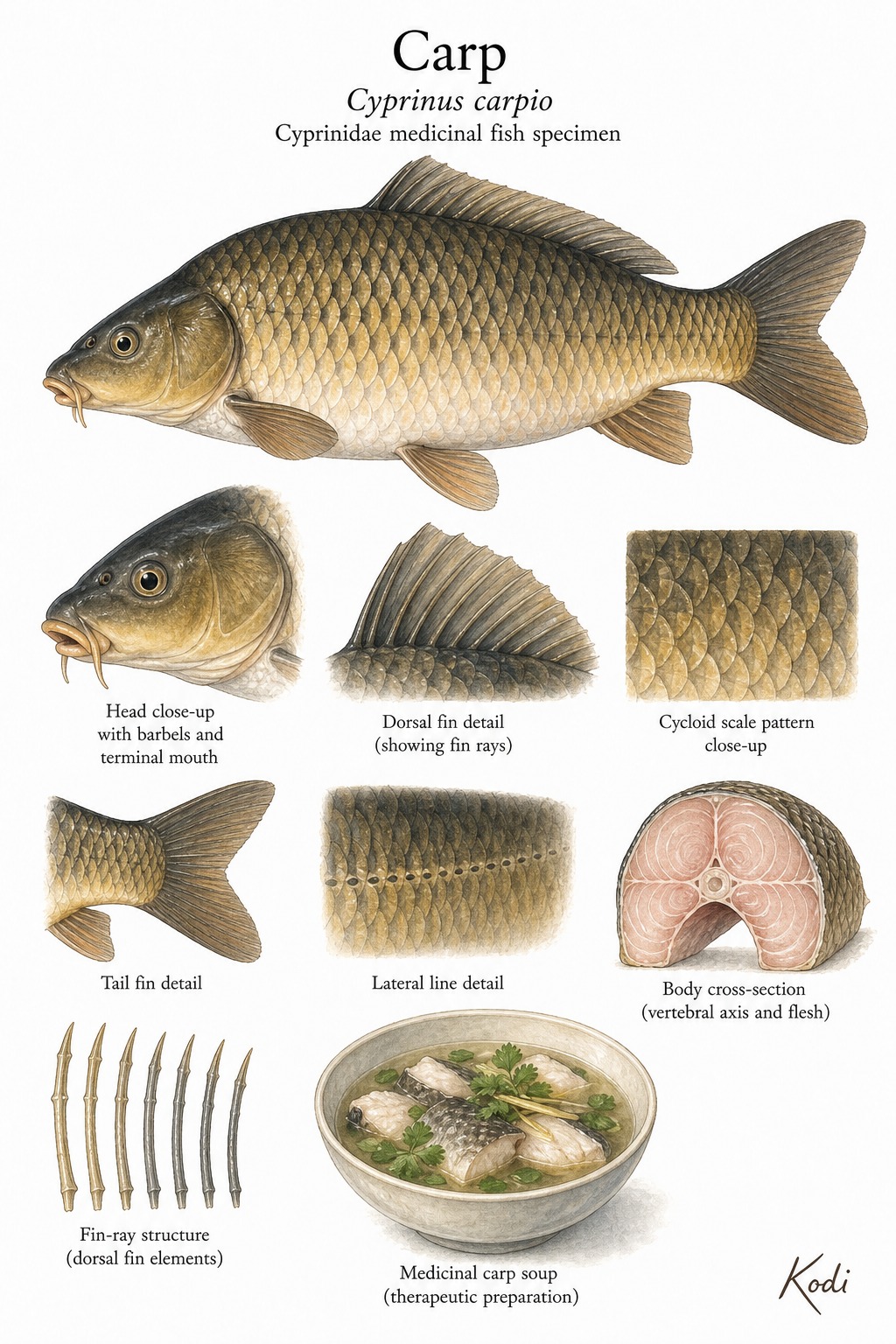
Known in TCM as Li Yu (鲤鱼), this sweet, neutral herb enters the Spleen and Kidney. Traditionally, it promotes urination and reduces swelling - Li Yu is a classic food-medicine for edema, ascites, puffy limbs, and damp water retention, especially when prepared as therapeutic soups rather than dried decoction material, most often applied for edema, insufficient lactation, and jaundice. Modern research has identified Fish among its active constituents.
Also Known As
Latin: Cyprinus carpio | Pinyin: Li Yu | Chinese: 鲤鱼
TCM Properties
- Taste
- sweet
- Temperature
- neutral
- Channels
- Spleen, Kidney
Traditional Use
Primary Actions
- Promotes urination and reduces swelling - Li Yu is a classic food-medicine for edema, ascites, puffy limbs, and damp water retention, especially when prepared as therapeutic soups rather than dried decoction material.
- Directs Qi downward and relieves cough or wheezing - traditional texts extend its use to cough with rebellious Qi and fullness from retained fluids, particularly when damp obstruction burdens the chest and middle burner.
- Promotes lactation - widely used postpartum or in dietary therapy when breast milk is insufficient and the patient also shows weakness, fluid imbalance, or poor appetite.
- Supports chronic deficiency-water patterns - later dietetic traditions value carp for nephropathy, chronic edema, jaundice, and convalescent weakness because it supplies nourishment while also helping fluid metabolism.
Secondary Actions
- Li Yu sits at the border of materia medica and diet therapy, so it often appears as soups and food formulas with adzuki bean, ginger, citrus peel, or Huang Qi rather than as a standard powdered pharmacy herb.
- Classical external use also includes charring the fish and applying the powder topically, showing that the medicinal tradition extends beyond simple food use.
Classic Formulas
- Li Yu Chi Xiao Dou Tang (鲤鱼赤小豆汤) - classical carp and adzuki-bean soup for edema, ascites, water retention, and nephropathy-related swelling, with later dietetic variants adding Bai Mao Gen, Sang Bai Pi, and Huang Qi.
- Cyprinus carpio decoction - the well-known food-medicine preparation discussed in both classical and modern Chinese nephropathy literature for proteinuria, edema, and chronic water retention.
- Carp with red bean and Chen Pi or Sheng Jiang - common therapeutic soup lineage for postpartum swelling, poor lactation, obesity with damp accumulation, and chronic puffy-fluid patterns.
- Charred Li Yu powder - traditional external preparation mentioned for local application after stir-baking and powdering the fish.
Classical References
- TCM Wiki summarizes Li Yu as sweet and neutral, entering the Spleen and Kidney channels, with actions of promoting urination, reducing swelling, directing Qi downward, and promoting lactation.
- The Cyprinus carpio decoction nephropathy paper cites Compendium of Materia Medica and related classical traditions describing carp as sweet and gentle, able to alleviate water retention, strengthen the Spleen, and eliminate dampness.
- Dietetic tradition preserves the older saying that boiled carp treats edema, promotes urination, relieves wheezing, and supports milk production, which explains why Li Yu remains more common in therapeutic soups than in raw-herb cabinets.
Modern Research
Active Compounds
- Fish collagen and gelatin peptides - structural proteins from skin, scale, and connective tissues that underpin modern biomaterial and antioxidant research
- Bioactive roe protein hydrolysates - peptide-rich fractions from carp egg investigated for immune-supporting effects
- Omega-3 fatty acids including DHA - nutritionally relevant lipids identified in carp roe hydrolysate studies
- Essential amino acids and mineral-rich protein fractions - major nutritive constituents that help explain Li Yu's food-medicine reputation
- Carp-derived antimicrobial and antioxidant peptides such as KC14 - newer peptide leads isolated from Cyprinus carpio research
Studied Effects
- A rat nephropathy study on Cyprinus carpio decoction found improved nutrition and immunity, reduced proteinuria, and increased nephrin and CD2AP expression, giving unusually direct modern support to the traditional use of carp decoctions for edema and renal water disorders (PMID 22675377).
- Common carp egg protein hydrolysates enhanced splenic lymphocyte proliferation, natural-killer-cell activity, secretory IgA, and serum IgA in mice, supporting the food-medicine theme of nourishment plus immune support (PMID 25592018).
- Peptides generated from Cyprinus carpio scale gelatin showed antioxidant, metal-chelating, and lipid-peroxidation-inhibiting activity in simulated gastrointestinal digestion models, suggesting carp byproducts can yield bioactive antioxidant fractions (PMID 31775386).
- Cyprinus carpio collagen has also been developed into antibiotic-releasing wound sponges that reduced MRSA burden in infected rat wounds, showing that modern carp research often centers on tissue-derived biomaterials rather than direct validation of Li Yu as a standalone herb (PMID 31782696).
PubMed References
- Cyprinus carpio Decoction Improves Nutrition and Immunity and Reduces Proteinuria through Nephrin and CD2AP Expressions in Rats with Adriamycin-Induced Nephropathy (2012)
- Chemical composition and immunomodulatory effects of enzymatic protein hydrolysates from common carp (Cyprinus carpio) egg (2015)
- In Vitro Antioxidant Activity of Peptides from Simulated Gastro-Intestinal Digestion Products of Cyprinus carpio haematopterus Scale Gelatin (2019)
- Vancomycin-releasing cross-linked collagen sponges as wound dressings (2021)
Safety & Interactions
Contraindications
- Known fish or fish-protein allergy
- Use of spoiled, contaminated, or improperly prepared carp in place of a properly sourced therapeutic food
Cautions
- Li Yu is generally a food-grade medicine, but persistent edema, jaundice, or severe breathing difficulty require medical evaluation rather than relying on dietary therapy alone
- Bone burden, river or pond contaminants, and preparation hygiene matter more here than with dried plant herbs because the medicine is commonly consumed as food
- Modern biomedical evidence for carp is substantial in nutrition, peptide, and biomaterial research, but direct human clinical validation of classical Li Yu indications remains limited
- MSK page not found - drug interaction data not available from Memorial Sloan Kettering integrative medicine database
Conditions
Frequently Asked Questions
What is Carp used for?
Carp is traditionally used to Promotes urination and reduces swelling - Li Yu is a classic food-medicine for edema, ascites, puffy limbs, and damp water retention, especially when prepared as therapeutic soups rather than dried decoction material., Directs Qi downward and relieves cough or wheezing - traditional texts extend its use to cough with rebellious Qi and fullness from retained fluids, particularly when damp obstruction burdens the chest and middle burner., Promotes lactation - widely used postpartum or in dietary therapy when breast milk is insufficient and the patient also shows weakness, fluid imbalance, or poor appetite., Supports chronic deficiency-water patterns - later dietetic traditions value carp for nephropathy, chronic edema, jaundice, and convalescent weakness because it supplies nourishment while also helping fluid metabolism.. Research has investigated its effects on: A rat nephropathy study on Cyprinus carpio decoction found improved nutrition and immunity, reduced proteinuria, and increased nephrin and CD2AP expression, giving unusually direct modern support to the traditional use of carp decoctions for edema and renal water disorders (PMID 22675377).; Common carp egg protein hydrolysates enhanced splenic lymphocyte proliferation, natural-killer-cell activity, secretory IgA, and serum IgA in mice, supporting the food-medicine theme of nourishment plus immune support (PMID 25592018)..
What are other names for Carp?
Carp is also known as Cyprinus. In TCM: 鲤鱼 (Li Yu); Cyprinus carpio.
Is Carp safe during pregnancy?
The safety of Carp during pregnancy has not been established. Consult a qualified healthcare provider before use.
What are the contraindications for Carp?
Carp should not be used in: Known fish or fish-protein allergy; Use of spoiled, contaminated, or improperly prepared carp in place of a properly sourced therapeutic food. Consult a qualified healthcare provider before use.