Carbonized Palm Fiber
- Chinese
- 棕榈炭
- Pinyin
- Zong Lv Tan
- Latin
- Petiolus Trachycarpi Carbonisatus
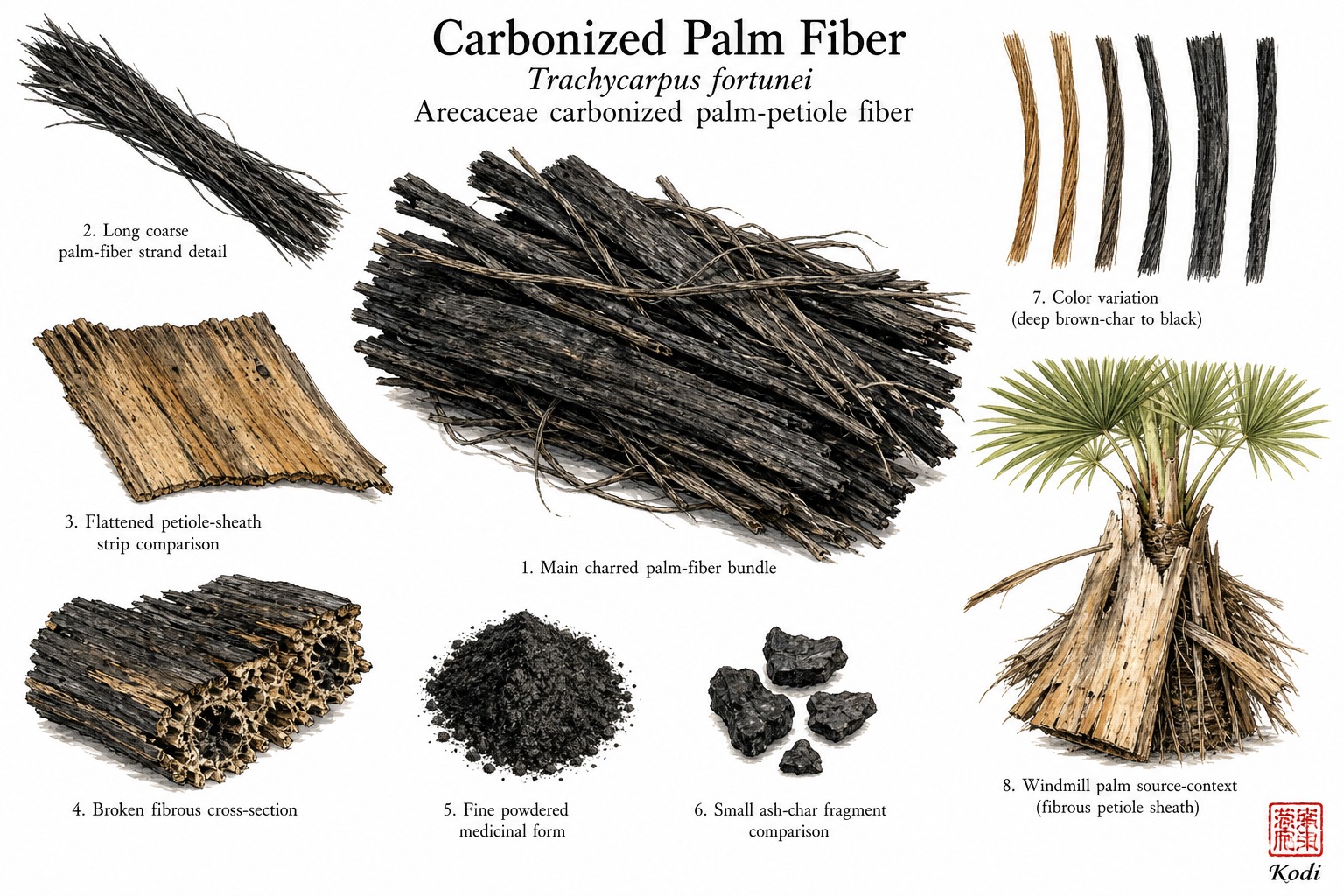
Known in TCM as Zong Lv Tan (棕榈炭), this bitter and astringent, neutral herb enters the Liver, Lung, Large Intestine, and Spleen. Traditionally, it astringes and stops bleeding - used broadly for hemorrhage but especially valued for metrorrhagia, metrostaxis, and chronic uterine leakage where a firm hemostatic astringent is needed, most often applied for abnormal uterine bleeding, menorrhagia, and diarrhea. Modern research has identified Charred among its active constituents.
Part used: Leaf stalk
Also Known As
Latin: Petiolus Trachycarpi Carbonisatus | Pinyin: Zong Lv Tan | Chinese: 棕榈炭
TCM Properties
- Taste
- bitter, astringent
- Temperature
- neutral
- Channels
- Liver, Lung, Large Intestine, Spleen
Traditional Use
Primary Actions
- Astringes and stops bleeding - used broadly for hemorrhage but especially valued for metrorrhagia, metrostaxis, and chronic uterine leakage where a firm hemostatic astringent is needed.
- Stops bleeding in heat-type upper-tract hemorrhage when combined appropriately - classical formulas pair it with cooling-blood medicinals for hematemesis, hemoptysis, and other reckless-Blood presentations.
- Secures chronic deficiency-cold bleeding when paired with warming medicinals - traditional combinations such as those with Pao Jiang target uterine bleeding from Chong-Ren insecurity and cold weakness.
- Astringes the intestines and checks chronic leakage - extended to long-standing diarrhea, dysentery, and abnormal leucorrhea when persistent discharge reflects failure to contain fluids.
Secondary Actions
- Compared with raw Zong Lu Pi, the carbonized form is more strongly hemostatic and astringent, even though some classical sources blur the raw fiber and charcoal names together.
- It is most suitable when bleeding is not dominated by major Blood stasis; if clotted dark stasis is prominent, more actively stasis-transforming hemostatics may be needed.
Classic Formulas
- Gu Chong Tang (固冲汤) - classical formula for flooding and spotting in which Zong Lv Tan helps secure the Chong and stop uterine bleeding.
- Shi Hui San (十灰散) - classic heat-bleeding formula where Zong Lu Tan serves as one of the charcoal medicinals to arrest reckless Blood.
- Ru Sheng San (如圣散) - traditional pairing approach with Pao Jiang for deficiency-cold uterine bleeding and insecure Chong-Ren patterns.
Classical References
- TCM Wiki describes Zong Lv Tan as bitter, astringent, and neutral, entering the Liver, Lung, and Large Intestine channels and stopping bleeding in all forms, especially gynecologic bleeding, chronic diarrhea, dysentery, and leucorrhea.
- Sacred Lotus lists the closely related raw-fiber monograph Zong Lu Pi with Zong Lu Tan as an alternate name and places the drug in both Gu Chong Tang and Shi Hui San, confirming the long hemostatic tradition of the palm-fiber lineage.
- PREPARATION NOTE: this file focuses on the carbonized hemostatic form, Zong Lv Tan, rather than the broader raw-fiber identity, because charring shifts the medicine toward stronger astringent bleeding control.
Modern Research
Active Compounds
- Charred lignocellulosic palm-fiber matrix - the structural core created from carbonized Trachycarpus sheath or petiole fiber
- Mineral ash fraction with potassium, calcium, and silica traces - part of the residual inorganic profile after carbonization
- Residual plant polyphenol and tannin-like astringent fraction - diminished by charring but still relevant to the traditional constraining profile
- Absorbent fibrous carbon scaffold - a plausible physical basis for local drying and astringent action
Studied Effects
- Direct PubMed literature on Zong Lv Tan itself is sparse, and modern support remains grounded more in classical empirical hemostatic use than in dedicated clinical trials.
- The most plausible modern rationale is local astringent and absorbent action from the charred palm-fiber matrix, especially in chronic uterine or intestinal leakage states.
- Broader Trachycarpus fortunei research exists on other plant parts, but it should not be assumed to validate the carbonized petiole preparation directly.
Safety & Interactions
Contraindications
- Bleeding accompanied by significant Blood stasis
- Damp-Heat dysentery
Cautions
- The stronger astringent charcoal form may trap pathology if the real problem is unresolved excess Heat-Damp or obvious congealed stasis
- Use medicinally processed palm-fiber charcoal rather than decorative palm charcoal or non-medicinal plant fiber products
- The evidence base for Zong Lv Tan remains much more classical than modern-trial driven
- MSK page not found - drug interaction data not available from Memorial Sloan Kettering integrative medicine database
Conditions
- Abnormal Uterine Bleeding Traditional ★★★★★ JSON
- Menorrhagia Traditional ★★★★☆ JSON
- Diarrhea Traditional ★★☆☆☆ JSON
- Dysentery Traditional ★★☆☆☆ JSON
- Leucorrhea Traditional ★★☆☆☆ JSON
Frequently Asked Questions
What is Carbonized Palm Fiber used for?
Carbonized Palm Fiber is traditionally used to Astringes and stops bleeding - used broadly for hemorrhage but especially valued for metrorrhagia, metrostaxis, and chronic uterine leakage where a firm hemostatic astringent is needed., Stops bleeding in heat-type upper-tract hemorrhage when combined appropriately - classical formulas pair it with cooling-blood medicinals for hematemesis, hemoptysis, and other reckless-Blood presentations., Secures chronic deficiency-cold bleeding when paired with warming medicinals - traditional combinations such as those with Pao Jiang target uterine bleeding from Chong-Ren insecurity and cold weakness., Astringes the intestines and checks chronic leakage - extended to long-standing diarrhea, dysentery, and abnormal leucorrhea when persistent discharge reflects failure to contain fluids.. Research has investigated its effects on: Direct PubMed literature on Zong Lv Tan itself is sparse, and modern support remains grounded more in classical empirical hemostatic use than in dedicated clinical trials.; The most plausible modern rationale is local astringent and absorbent action from the charred palm-fiber matrix, especially in chronic uterine or intestinal leakage states..
What are other names for Carbonized Palm Fiber?
Carbonized Palm Fiber is also known as Trachycarpi. In TCM: 棕榈炭 (Zong Lv Tan); Petiolus Trachycarpi Carbonisatus.
Is Carbonized Palm Fiber safe during pregnancy?
The safety of Carbonized Palm Fiber during pregnancy has not been established. Consult a qualified healthcare provider before use.
What are the contraindications for Carbonized Palm Fiber?
Carbonized Palm Fiber should not be used in: Bleeding accompanied by significant Blood stasis; Damp-Heat dysentery. Consult a qualified healthcare provider before use.