Carbonized Chinese Ink
- Chinese
- 墨炭
- Pinyin
- Mo Tan
- Latin
- Carbonized Chinese Ink
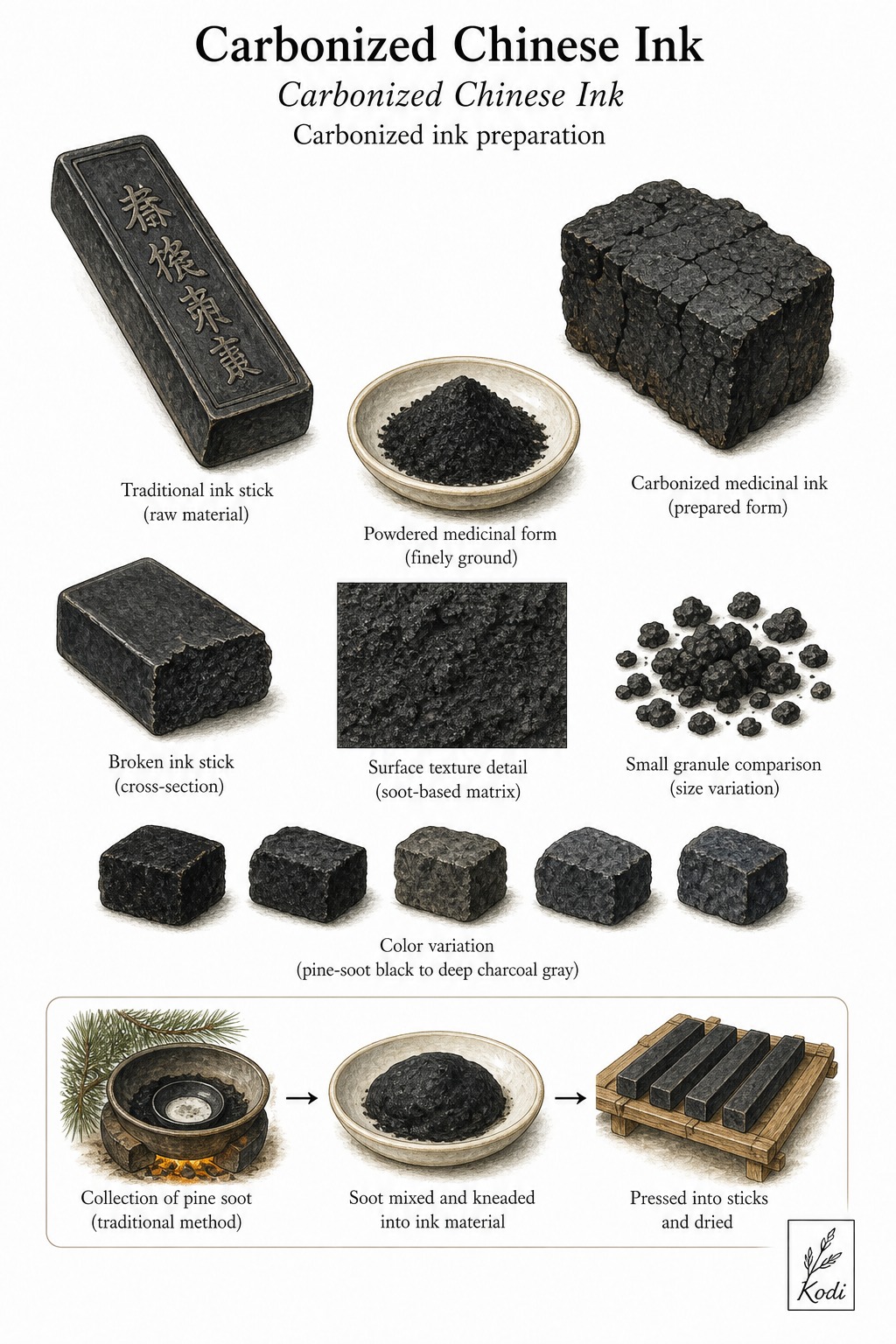
Known in TCM as Mo Tan (墨炭), this acrid and bitter, neutral herb enters the Heart, Liver, and Kidney. Traditionally, it stops bleeding in diverse hemorrhagic presentations - classical summary sources apply Mo Tan to hematemesis, epistaxis, uterine bleeding, postpartum bleeding, and bloody stool when a prepared carbonized adjunct is used to help secure the blood, most often applied for abnormal uterine bleeding, traumatic injury, and carbuncle. Modern research has identified Pine-soot-derived among its active constituents.
Also Known As
Latin: Carbonized Chinese Ink | Pinyin: Mo Tan | Chinese: 墨炭
TCM Properties
- Taste
- acrid, bitter
- Temperature
- neutral
- Channels
- Heart, Liver, Kidney
Traditional Use
Primary Actions
- Stops bleeding in diverse hemorrhagic presentations - classical summary sources apply Mo Tan to hematemesis, epistaxis, uterine bleeding, postpartum bleeding, and bloody stool when a prepared carbonized adjunct is used to help secure the blood.
- Stops bleeding while reducing swelling and moving residual stasis - unlike a purely plugging astringent, Mo Tan is remembered in traditional notes for helping bleeding lesions that are also swollen, congealed, or painful.
- Promotes skin regeneration in ulcerative or suppurative lesions - external use traditions extend Mo Tan to boils, ulcerated sores, and damaged skin that need both contraction and surface repair.
- Transforms phlegm-stasis swellings in external-surgery formulas - it appears in classical pill traditions for hard deep-rooted nodules, scrofula, mammary swellings, and yin-type abscess patterns where cold-damp, phlegm, and Blood stasis knot together.
Secondary Actions
- Mo Tan is an obscure prepared medicine made from traditional Chinese ink sticks rather than a mainstream single herb, so it appears more often as a formula ingredient or adjunct than as a standalone monograph item.
- Traditional manufacture starts with old soot-based ink prepared from pine smoke and glue, then further carbonizes the material for medicinal use.
Classic Formulas
- Shi Hui San (十灰散) - TCM Wiki notes that the powdered formula is traditionally taken with lotus-rhizome juice or carrot juice containing ground Chinese ink, using the ink as a hemostatic adjunct in heat-bleeding patterns.
- Xiao Jin Dan (小金丹) - external-surgery pill tradition in which Mo Tan helps reduce swelling and transform Blood stasis within cold-damp phlegm nodules and deep-rooted sores.
Classical References
- The Iatrism materia medica entry for Mo Tan describes it as acrid, bitter, and neutral, entering the Heart, Liver, and Kidney channels, with uses in vomiting blood, nosebleed, abnormal uterine bleeding, blood in stool, postpartum bleeding, suppurative skin disease, and swelling.
- Modern explanatory summaries of older practice describe medicinal Mo Tan as prepared from aged pine-soot ink blocks kneaded with glue and then carbonized, underscoring that it is not interchangeable with ordinary commercial liquid ink.
- American Dragon's Xiao Jin Dan monograph specifically assigns Mo Tan the role of dispersing swelling and transforming stasis, which helps explain why this carbonized hemostatic also appears in external-surgery traditions.
Modern Research
Active Compounds
- Pine-soot-derived amorphous carbon / carbon black particles - the dominant structural material of traditional Chinese ink
- Proteinaceous animal-glue binder residues - part of the matrix that hardens the original ink stick before medicinal carbonization
- Aromatic resin and fragrance additives from traditional ink manufacture - minor constituents that vary by source and processing
- Trace mineral ash and oxidized carbon surface groups - likely contributors to adsorption and photothermal behavior in modern materials studies
Studied Effects
- Direct biomedical literature on medicinal Mo Tan itself is sparse, but traditional Hu-ink dispersions have shown strong near-infrared photothermal behavior and acceptable biocompatibility in experimental metastatic-lymph-node therapy models, illustrating a modern materials-science reuse of Chinese ink rather than a direct validation of the classical hemostatic indication (PMID 30023740).
- Nanoparticles derived from ancient ink also demonstrated cancer photothermal potential in the second near-infrared window, again highlighting contemporary interest in the carbon material more than in the old bleeding-focused TCM use (PMID 32226902).
- Overall, current research treats Chinese ink mainly as a functional nanocarbon material, so direct PubMed support for Mo Tan's traditional uses in bleeding and swelling remains limited.
PubMed References
Safety & Interactions
Contraindications
- Substituting modern commercial inks or industrial pigments for properly prepared medicinal Mo Tan
- Unsupervised use for major active hemorrhage that needs urgent medical care
Cautions
- Mo Tan is a specialized traditional preparation and should not be equated with everyday calligraphy ink, bottled art ink, or modern carbon-black products
- Commercial inks may contain solvents, dyes, preservatives, or contaminants that are unsuitable for medicinal use
- The historical record for Mo Tan is stronger than the modern clinical evidence base, so claims beyond classical hemostatic and swelling-related use should be made cautiously
- MSK page not found - drug interaction data not available from Memorial Sloan Kettering integrative medicine database
Conditions
- Abnormal Uterine Bleeding Traditional ★★★★☆ JSON
- Traumatic Injury Traditional ★★☆☆☆ JSON
- Carbuncle Traditional ★★☆☆☆ JSON
- Breast Abscess Traditional ★★☆☆☆ JSON
- Dysentery Traditional ★☆☆☆☆ JSON
Frequently Asked Questions
What is Carbonized Chinese Ink used for?
Carbonized Chinese Ink is traditionally used to Stops bleeding in diverse hemorrhagic presentations - classical summary sources apply Mo Tan to hematemesis, epistaxis, uterine bleeding, postpartum bleeding, and bloody stool when a prepared carbonized adjunct is used to help secure the blood., Stops bleeding while reducing swelling and moving residual stasis - unlike a purely plugging astringent, Mo Tan is remembered in traditional notes for helping bleeding lesions that are also swollen, congealed, or painful., Promotes skin regeneration in ulcerative or suppurative lesions - external use traditions extend Mo Tan to boils, ulcerated sores, and damaged skin that need both contraction and surface repair., Transforms phlegm-stasis swellings in external-surgery formulas - it appears in classical pill traditions for hard deep-rooted nodules, scrofula, mammary swellings, and yin-type abscess patterns where cold-damp, phlegm, and Blood stasis knot together.. Research has investigated its effects on: Direct biomedical literature on medicinal Mo Tan itself is sparse, but traditional Hu-ink dispersions have shown strong near-infrared photothermal behavior and acceptable biocompatibility in experimental metastatic-lymph-node therapy models, illustrating a modern materials-science reuse of Chinese ink rather than a direct validation of the classical hemostatic indication (PMID 30023740).; Nanoparticles derived from ancient ink also demonstrated cancer photothermal potential in the second near-infrared window, again highlighting contemporary interest in the carbon material more than in the old bleeding-focused TCM use (PMID 32226902)..
What are other names for Carbonized Chinese Ink?
Carbonized Chinese Ink is also known as Carbonized. In TCM: 墨炭 (Mo Tan); Carbonized Chinese Ink.
Is Carbonized Chinese Ink safe during pregnancy?
The safety of Carbonized Chinese Ink during pregnancy has not been established. Consult a qualified healthcare provider before use.
What are the contraindications for Carbonized Chinese Ink?
Carbonized Chinese Ink should not be used in: Substituting modern commercial inks or industrial pigments for properly prepared medicinal Mo Tan; Unsupervised use for major active hemorrhage that needs urgent medical care. Consult a qualified healthcare provider before use.