Caper Spurge Seed
- Chinese
- 千金子
- Pinyin
- Qian Jin Zi
- Latin
- Semen Euphorbiae Lathyridis
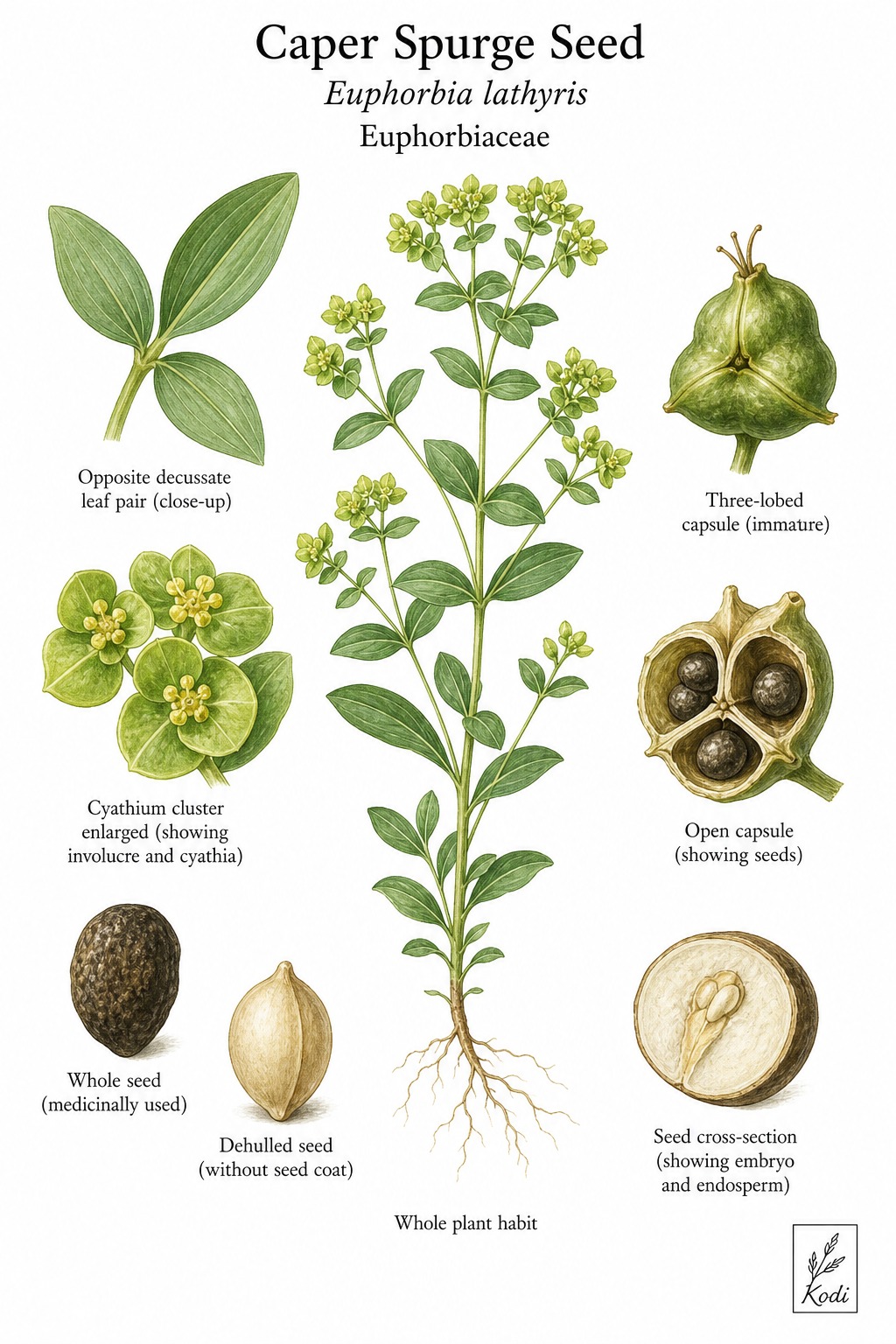
Known in TCM as Qian Jin Zi (千金子), this sour and acrid, warm herb enters the Lung, Stomach, Large Intestine, and Bladder. Traditionally, it expels water and reduces swelling - a harsh downward-draining seed used for severe edema, ascites, and fluid accumulation in robust excess patterns, most often applied for edema, constipation, and amenorrhea. Modern research has identified Lathyrane-type among its active constituents.
Part used: Seed
Also Known As
Latin: Semen Euphorbiae Lathyridis | Pinyin: Qian Jin Zi | Chinese: 千金子
TCM Properties
- Taste
- sour, acrid
- Temperature
- warm
- Channels
- Lung, Stomach, Large Intestine, Bladder
Traditional Use
Primary Actions
- Expels water and reduces swelling - a harsh downward-draining seed used for severe edema, ascites, and fluid accumulation in robust excess patterns.
- Drives out retained fluid and opens the bowels - especially when water retention is complicated by constipation or obstructed elimination.
- Breaks up masses and disperses blood stasis - extended to abdominal masses and amenorrhea from congealed obstruction in classical practice.
- Kills parasites and attacks stubborn lesions externally - applied in paste form for warts, fungal lesions, snakebite traditions, and difficult skin disorders.
Secondary Actions
- Qian Jin Zi is a drastic purgative seed, not a gentle diuretic or tonic; the herb must be matched to strong excess pathology and used only briefly.
- Traditional processing often includes dehulling and deoiling, and the spreadsheet's separate Qian Jin Zi Shuang record should be understood as the less oily processed powder product rather than a different herb identity.
Classic Formulas
- Zi Jin Ding / Yu Shu Dan (紫金锭 / 玉枢丹) - classic formula using Qian Jin Zi to resolve phlegm, attack toxin, and reduce severe swelling.
- Qian Jin Zi with Da Huang or Gan Sui - strong downward-draining combinations for edema, water accumulation, and obstructed bowels in excess patterns.
- Topical Qian Jin Zi paste - traditional external application for warts, difficult skin lesions, or toxic swellings when a corrosive expulsive seed is desired.
Classical References
- TCM Wiki describes Qian Jin Zi as sour, warm, and slightly toxic, entering the channels of water movement and used for edema, masses, difficult elimination, amenorrhea, phlegm-retained fluid, and parasite-related lesions.
- American Dragon places Qian Jin Zi in the harsh cathartic category and stresses its short-term use for edema, constipation with retained fluids, masses, and external parasite or skin applications.
- PROCESSING NOTE: the spreadsheet also contains Qian Jin Zi Shuang as a separate future record. That processed powder is derived from the same seed and should be treated as a preparation-state variant rather than a different species.
Modern Research
Active Compounds
- Lathyrane-type diterpenoids including Euphorbia factors - the main bioactive and toxic constituent family of the seeds
- Macrocyclic diterpene esters - strongly bioactive compounds responsible for much of the seed's purgative and cytotoxic interest
- Ingenol-related diterpene biosynthetic intermediates - part of the broader Euphorbia lathyris diterpene network
- Seed-oil lipid matrix - influences extraction, processing, and the difference between crude seeds and processed powder products
Studied Effects
- Modern chemistry work continues to characterize lathyrane diterpenoids from Euphorbia lathyris seeds, clarifying the seed's potent medicinal but toxic phytochemical basis (PMID 24856111).
- Metabolism studies directly comparing Semen Euphorbiae and Semen Euphorbiae Pulveratum in rats show that diterpenoids are the major effective chemical cluster and are primarily eliminated through the colon after ingestion (PMID 35514208).
- Preclinical oncology-oriented research found lathyrane diterpenes from Euphorbia lathyris can modulate multidrug resistance in HepG2/ADR cells, illustrating why the seed attracts modern pharmacologic interest even though its classical use is dominated by drastic purgation (PMID 31751870).
PubMed References
- Lathyrane-type diterpenoids from the seeds of Euphorbia lathyris (2014)
- Characterization of diterpene metabolism in rats with ingestion of seed products from Euphorbia lathyris L. (Semen Euphorbiae and Semen Euphorbiae Pulveratum) using UHPLC-Q-Exactive MS (2022)
- Lathyrane diterpenes from Euphorbia lathyris and the potential mechanism to reverse the multi-drug resistance in HepG2/ADR cells (2020)
Safety & Interactions
Contraindications
- Pregnancy
- Loose stools or chronic diarrhea
- Constitutional weakness, dehydration, or deficiency patterns
- Unsupervised internal use
Cautions
- Qian Jin Zi is a toxic harsh cathartic seed that can cause violent purgation, dehydration, abdominal pain, and systemic toxicity if misused
- Short-term use only; traditional processing such as dehulling and deoiling helps but does not remove the need for strict dose control
- External use can also irritate damaged skin and mucosa because the diterpene-rich seed is biologically aggressive
- MSK page not found - drug interaction data not available from Memorial Sloan Kettering integrative medicine database
Conditions
- Edema Traditional ★★★★★ JSON
- Constipation Traditional ★★★★☆ JSON
- Amenorrhea Traditional ★★☆☆☆ JSON
- Phlegm Accumulation Traditional ★★☆☆☆ JSON
- Fungal Infection Traditional ★☆☆☆☆ JSON
Frequently Asked Questions
What is Caper Spurge Seed used for?
Caper Spurge Seed is traditionally used to Expels water and reduces swelling - a harsh downward-draining seed used for severe edema, ascites, and fluid accumulation in robust excess patterns., Drives out retained fluid and opens the bowels - especially when water retention is complicated by constipation or obstructed elimination., Breaks up masses and disperses blood stasis - extended to abdominal masses and amenorrhea from congealed obstruction in classical practice., Kills parasites and attacks stubborn lesions externally - applied in paste form for warts, fungal lesions, snakebite traditions, and difficult skin disorders.. Research has investigated its effects on: Modern chemistry work continues to characterize lathyrane diterpenoids from Euphorbia lathyris seeds, clarifying the seed's potent medicinal but toxic phytochemical basis (PMID 24856111).; Metabolism studies directly comparing Semen Euphorbiae and Semen Euphorbiae Pulveratum in rats show that diterpenoids are the major effective chemical cluster and are primarily eliminated through the colon after ingestion (PMID 35514208)..
What are other names for Caper Spurge Seed?
Caper Spurge Seed is also known as Euphorbia. In TCM: 千金子 (Qian Jin Zi); Semen Euphorbiae Lathyridis.
Is Caper Spurge Seed safe during pregnancy?
Caper Spurge Seed is not recommended during pregnancy.
What are the contraindications for Caper Spurge Seed?
Caper Spurge Seed should not be used in: Pregnancy; Loose stools or chronic diarrhea; Constitutional weakness, dehydration, or deficiency patterns; Unsupervised internal use. Consult a qualified healthcare provider before use.