Persimmon Calyx
- Chinese
- 柿蒂
- Pinyin
- Shi Di
- Latin
- Calyx Kaki
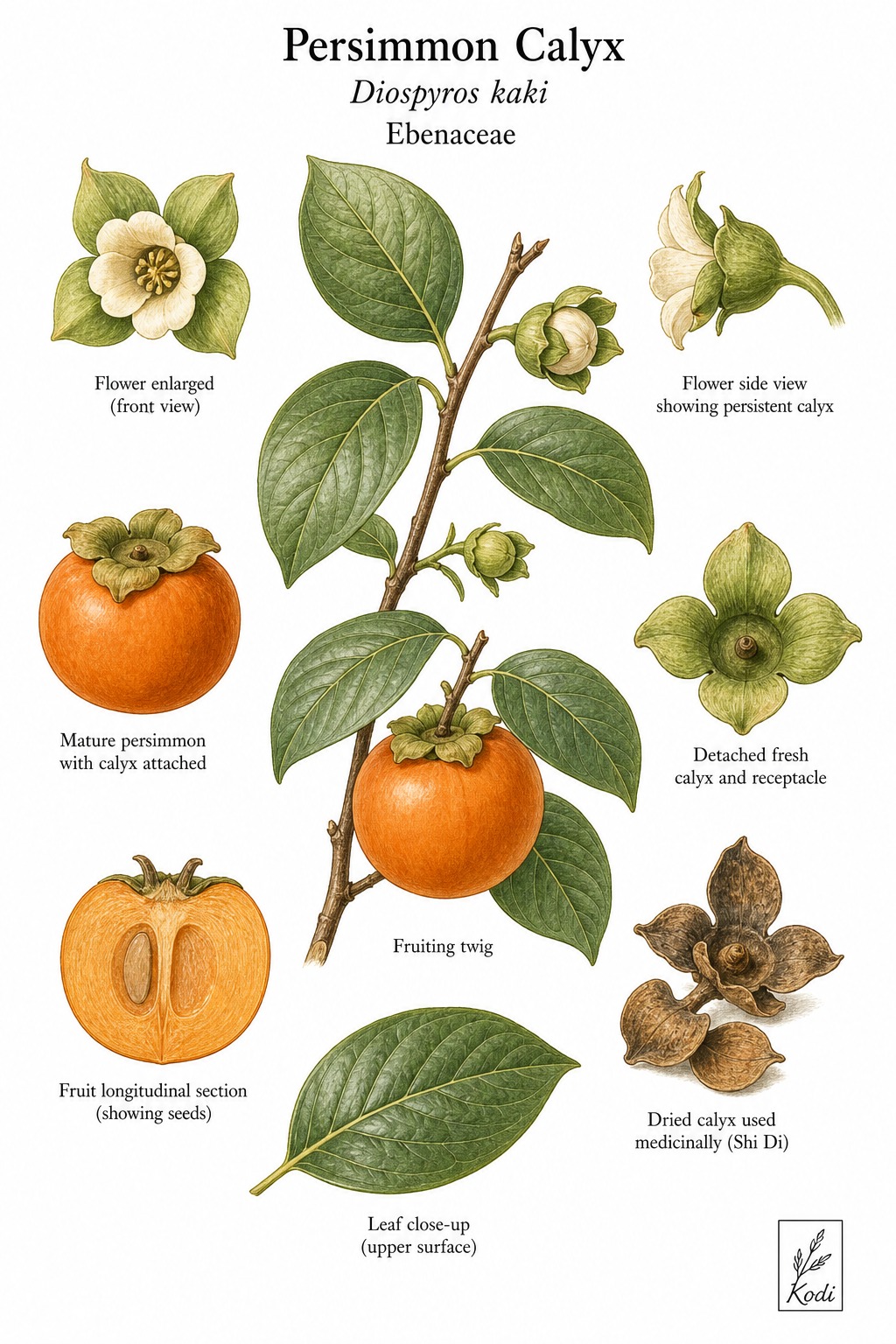
Known in TCM as Shi Di (柿蒂), this bitter and astringent, neutral herb enters the Stomach. Traditionally, it directs rebellious Stomach Qi downward and stops hiccups - this is the defining classical action and the reason Shi Di is regarded as the essential anti-hiccup herb, most often applied for nausea, acid reflux, and abdominal pain. Modern research has identified Triterpene among its active constituents.
Part used: Calyx
Also Known As
Latin: Calyx Kaki | Pinyin: Shi Di | Chinese: 柿蒂
TCM Properties
- Taste
- bitter, astringent
- Temperature
- neutral
- Channels
- Stomach
Traditional Use
Primary Actions
- Directs rebellious Stomach Qi downward and stops hiccups - this is the defining classical action and the reason Shi Di is regarded as the essential anti-hiccup herb.
- Stops belching and helps settle nausea from upward-rushing Stomach Qi - especially when the core problem is failed descent rather than severe Phlegm obstruction.
- Adapts to both cold and heat hiccup patterns - because Shi Di itself is neutral, it can be paired with warming or cooling companion herbs depending on the cause.
Secondary Actions
- Shi Di is a targeted qi-direction herb rather than a broad digestive tonic; its specialty is restoring the Stomach's proper downward movement.
- Traditional processing variants include ginger-prepared Shi Di for colder patterns and charred Shi Di for stronger astringent or hemostatic use.
Classic Formulas
- Ding Xiang Shi Di Tang (丁香柿蒂汤) - the classic anti-hiccup formula pairing Shi Di's descending action with warming support for Stomach Cold and Qi deficiency.
- Shi Di with Zhu Ru - heat-pattern hiccup and belching pairing that cools the Stomach while directing rebellious Qi downward.
- Shi Di with Sheng Jiang - common combination for nausea, vomiting, or hiccups with cold or weak Stomach function.
Classical References
- Me & Qi describes Shi Di as the most widely used Chinese medicine herb for stopping persistent hiccups because its bitter and astringent nature strongly redirects Stomach Qi downward.
- The same source emphasizes that its neutral temperature makes it usable in both cold and hot hiccup presentations depending on the companion herbs in the formula.
- Modern Korean and Chinese literature still treats Shi Di as a highly specific anti-hiccup and anti-belching drug rather than as a general antiemetic for every digestive complaint.
Modern Research
Active Compounds
- Triterpene acids such as oleanolic acid, ursolic acid, and betulinic acid - major persimmon-calyx triterpenoids of pharmacologic interest
- Flavonoids including quercetin and kaempferol derivatives - polyphenolic compounds linked to anti-inflammatory activity
- Tannins and related astringent polyphenols - likely contributors to the calyx's anchoring and anti-rebellious profile in traditional thinking
- Phytosterols and minor phenolic acids - part of the broader chemical matrix of the dried stalk and calyx
Studied Effects
- Modern Korean studies on Diospyros kaki calyx extracts reported anti-inflammatory and anti-allergic activity, including suppression of mast-cell activation and atopic-dermatitis-like skin inflammation, even though these studies are not direct modern trials for hiccups.
- A persimmon-calyx extract also demonstrated antiproliferative effects in human colorectal cancer cells through cyclin D1 downregulation, showing that the plant part has meaningful bioactivity beyond its narrow classical symptom focus (PMID 28870200).
- Direct clinical PubMed literature on Shi Di for hiccups remains surprisingly sparse, so the traditional anti-hiccup reputation still rests more on materia medica continuity than on modern standalone trials.
PubMed References
Safety & Interactions
Contraindications
- Qi deficiency with sinking or prolapse patterns
- Use inside a warming hiccup formula when the presentation is clearly heat-predominant unless cooling companion herbs are added
Cautions
- Shi Di is generally regarded as non-toxic, but it is best matched to true rebellious Stomach Qi rather than used as a generic digestive remedy
- If the underlying problem is obvious Qi sinking or prolapse, a strongly descending herb may not be appropriate
- MSK page not found - drug interaction data not available from Memorial Sloan Kettering integrative medicine database
Conditions
- Nausea Traditional ★★★★☆ JSON
- Acid Reflux Traditional ★★★☆☆ JSON
- Abdominal Pain Traditional ★☆☆☆☆ JSON
- Cough Traditional ★☆☆☆☆ JSON
Frequently Asked Questions
What is Persimmon Calyx used for?
Persimmon Calyx is traditionally used to Directs rebellious Stomach Qi downward and stops hiccups - this is the defining classical action and the reason Shi Di is regarded as the essential anti-hiccup herb., Stops belching and helps settle nausea from upward-rushing Stomach Qi - especially when the core problem is failed descent rather than severe Phlegm obstruction., Adapts to both cold and heat hiccup patterns - because Shi Di itself is neutral, it can be paired with warming or cooling companion herbs depending on the cause.. Research has investigated its effects on: Modern Korean studies on Diospyros kaki calyx extracts reported anti-inflammatory and anti-allergic activity, including suppression of mast-cell activation and atopic-dermatitis-like skin inflammation, even though these studies are not direct modern trials for hiccups.; A persimmon-calyx extract also demonstrated antiproliferative effects in human colorectal cancer cells through cyclin D1 downregulation, showing that the plant part has meaningful bioactivity beyond its narrow classical symptom focus (PMID 28870200)..
What are other names for Persimmon Calyx?
Persimmon Calyx is also known as Kaki. In TCM: 柿蒂 (Shi Di); Calyx Kaki.
Is Persimmon Calyx safe during pregnancy?
The safety of Persimmon Calyx during pregnancy has not been established. Consult a qualified healthcare provider before use.
What are the contraindications for Persimmon Calyx?
Persimmon Calyx should not be used in: Qi deficiency with sinking or prolapse patterns; Use inside a warming hiccup formula when the presentation is clearly heat-predominant unless cooling companion herbs are added. Consult a qualified healthcare provider before use.