Calcined Ark Shell
- Chinese
- 煅瓦楞子
- Pinyin
- Duan Wa Leng Zi
- Latin
- Concha Arcae Praeparata
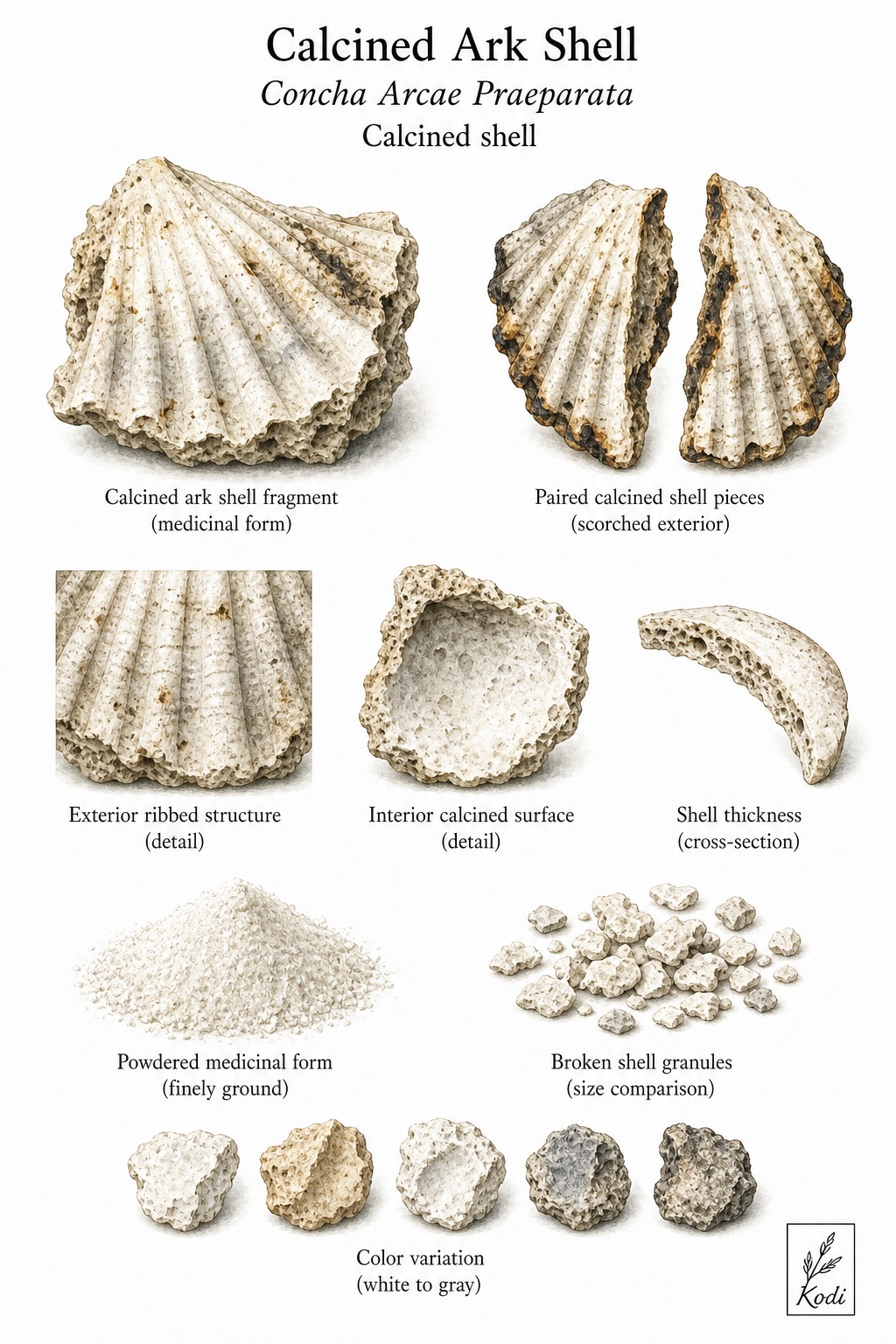
Known in TCM as Duan Wa Leng Zi (煅瓦楞子), this salty and sweet, neutral herb enters the Lung, Stomach, and Liver. Traditionally, it controls acidity and stops pain - the calcined form is classically used for acid regurgitation, gastric discomfort, epigastric pain, and sour reflux when excess stomach acid or constrained Stomach Qi is prominent, most often applied for acid reflux, gastric ulcer, and abdominal pain. Modern research has identified Calcium among its active constituents.
Part used: Shell
Also Known As
Latin: Concha Arcae Praeparata | Pinyin: Duan Wa Leng Zi | Chinese: 煅瓦楞子
TCM Properties
- Taste
- salty, sweet
- Temperature
- neutral
- Channels
- Lung, Stomach, Liver
Traditional Use
Primary Actions
- Controls acidity and stops pain - the calcined form is classically used for acid regurgitation, gastric discomfort, epigastric pain, and sour reflux when excess stomach acid or constrained Stomach Qi is prominent.
- Astringes and stops bleeding in ulcerative stomach disorders - powdered Duan Wa Leng Zi is used when acid injury contributes to hematemesis, occult ulcer bleeding, or painful erosive stomach conditions.
- Retains a secondary hardness-softening and stasis-transforming role - although milder in this respect than the raw shell, the processed form still belongs to the Wa Leng Zi lineage that softens hardness and disperses accumulations.
Secondary Actions
- Calcination shifts Wa Leng Zi away from a heavier raw-shell mass-dispersing profile and toward a more focused antacid, mucosal-protective, and hemostatic powder use.
- It is usually ground and taken as a fine powder or added late after prior calcination rather than relied on as an ordinary crude shell decoction.
Classic Formulas
- Wa Leng Zi San (瓦楞子散) - classic powder for acid regurgitation and epigastric pain in which calcined Wa Leng Zi is the key antacid shell.
- Calcined Wa Leng Zi with Yan Hu Suo and Wu Bei Zi - a traditional combination pattern for ulcer-type stomach pain with sour regurgitation and fixed epigastric discomfort.
- Calcined Wa Leng Zi with Hai Piao Xiao - paired when a stronger mineral astringent and acid-neutralizing strategy is needed for stomach pain with bleeding.
Classical References
- Me & Qi and older materia medica traditions agree that Wa Leng Zi softens hardness, transforms stasis, and especially controls acidity and stops pain in the Stomach.
- Li Shizhen's Ben Cao Gang Mu, as summarized in the existing raw-shell record, specifically notes that calcining Wa Leng Zi strengthens the antacid and hemostatic functions.
- PREPARATION NOTE: this file focuses on Duan Wa Leng Zi, the calcined ark shell powder used more specifically for acid regurgitation and ulcer-type bleeding than the broader raw-shell record.
Modern Research
Active Compounds
- Calcium carbonate-rich shell minerals - the dominant acid-buffering matrix inherited from the ark shell
- Thermally altered calcium salts created during calcination - part of the processed shell chemistry that changes reactivity and powder behavior
- Trace minerals such as magnesium, iron, zinc, and manganese - minor shell constituents that vary by species and source
- Reduced organic shell-matrix residues - raw shell proteins are diminished by calcination, shifting the processed form toward a more purely mineral profile
Studied Effects
- Modern understanding of Duan Wa Leng Zi is dominated by straightforward acid-buffering pharmacology: calcined shell powders act as natural antacids and help explain the classical use for sour regurgitation and ulcer pain.
- The existing Concha Arcae literature also supports an astringent mucosal-protective role in upper gastrointestinal irritation, though dedicated standalone clinical trials on the processed TCM powder remain sparse.
- Compared with the raw shell, the calcined form is better understood as a functional mineral antacid than as a source of anti-mass organic shell compounds.
Safety & Interactions
Contraindications
- Spleen-Stomach deficiency-cold with weak digestion but no acid regurgitation or heat irritation
- Routine long-term use when low stomach acid rather than hyperacidity is the real problem
Cautions
- Like other calcium-rich shell medicines, Duan Wa Leng Zi can interfere with the absorption of certain medications when taken at the same time
- Only properly cleaned and medicinally calcined shell should be used; shell products from uncertain sourcing may carry contamination or microbial residue risk
- The processed powder is aimed at excess acidity and ulcer irritation, not at indiscriminate long-course supplementation
- MSK page not found - drug interaction data not available from Memorial Sloan Kettering integrative medicine database
Drug Interactions
- Fluoroquinolone antibiotics (ciprofloxacin, levofloxacin) - calcium-rich shell minerals can chelate the drug and reduce absorption; separate by several hours
- Tetracycline antibiotics - calcium binding can reduce antibiotic bioavailability; stagger dosing
- Levothyroxine - calcium-containing minerals may impair thyroid hormone absorption; separate by at least 4 hours
- Iron supplements - concurrent calcium can reduce iron absorption; take at different times
Conditions
- Acid Reflux Research ★★★★☆ JSON
- Gastric Ulcer Research ★★★★☆ JSON
- Abdominal Pain Traditional ★★★☆☆ JSON
- Uterine Bleeding Traditional ★★☆☆☆ JSON
Frequently Asked Questions
What is Calcined Ark Shell used for?
Calcined Ark Shell is traditionally used to Controls acidity and stops pain - the calcined form is classically used for acid regurgitation, gastric discomfort, epigastric pain, and sour reflux when excess stomach acid or constrained Stomach Qi is prominent., Astringes and stops bleeding in ulcerative stomach disorders - powdered Duan Wa Leng Zi is used when acid injury contributes to hematemesis, occult ulcer bleeding, or painful erosive stomach conditions., Retains a secondary hardness-softening and stasis-transforming role - although milder in this respect than the raw shell, the processed form still belongs to the Wa Leng Zi lineage that softens hardness and disperses accumulations.. Research has investigated its effects on: Modern understanding of Duan Wa Leng Zi is dominated by straightforward acid-buffering pharmacology: calcined shell powders act as natural antacids and help explain the classical use for sour regurgitation and ulcer pain.; The existing Concha Arcae literature also supports an astringent mucosal-protective role in upper gastrointestinal irritation, though dedicated standalone clinical trials on the processed TCM powder remain sparse..
What are other names for Calcined Ark Shell?
Calcined Ark Shell is also known as Arca. In TCM: 煅瓦楞子 (Duan Wa Leng Zi); Concha Arcae Praeparata.
Is Calcined Ark Shell safe during pregnancy?
The safety of Calcined Ark Shell during pregnancy has not been established. Consult a qualified healthcare provider before use.
What are the contraindications for Calcined Ark Shell?
Calcined Ark Shell should not be used in: Spleen-Stomach deficiency-cold with weak digestion but no acid regurgitation or heat irritation; Routine long-term use when low stomach acid rather than hyperacidity is the real problem. Consult a qualified healthcare provider before use.
Does Calcined Ark Shell interact with any medications?
Calcined Ark Shell may interact with: Fluoroquinolone antibiotics (ciprofloxacin, levofloxacin) - calcium-rich shell minerals can chelate the drug and reduce absorption; separate by several hours; Tetracycline antibiotics - calcium binding can reduce antibiotic bioavailability; stagger dosing; Levothyroxine - calcium-containing minerals may impair thyroid hormone absorption; separate by at least 4 hours; Iron supplements - concurrent calcium can reduce iron absorption; take at different times. Always inform your healthcare provider of any herbal supplements you are taking.