Bottle Gourd Peel
- Chinese
- 葫芦壳
- Pinyin
- Hu Lu Ke
- Latin
- Pericarpium Lagenariae
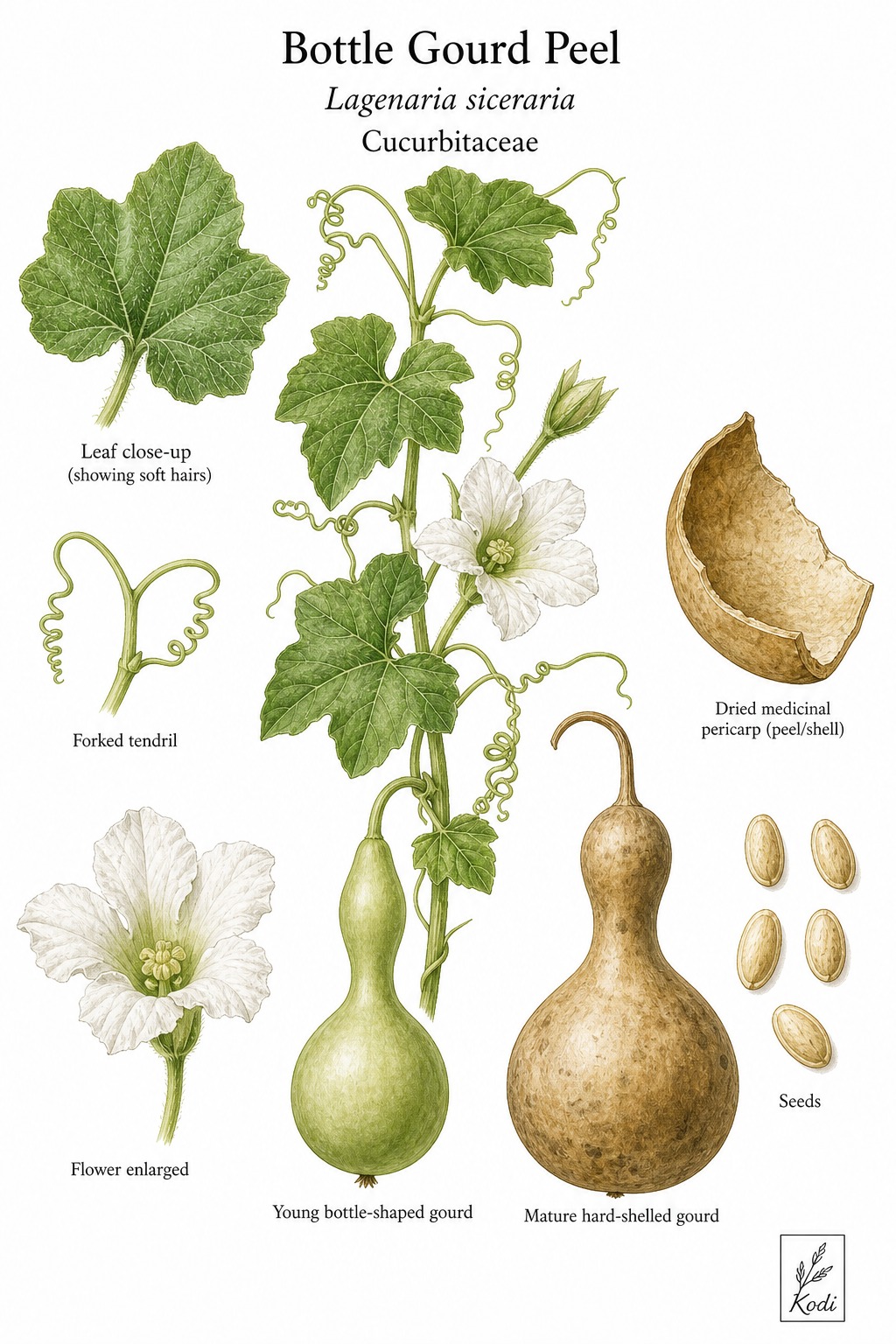
Known in TCM as Hu Lu Ke (葫芦壳), this sweet, neutral herb enters the Lung and Kidney. Traditionally, it promotes urination and reduces edema - used for facial swelling, abdominal distention from water retention, scanty urine, and damp fluid accumulation that needs a gentle draining herb, most often applied for edema, jaundice, and hematuria. Modern research has identified Isoorientin among its active constituents.
Part used: Peel
Also Known As
Latin: Pericarpium Lagenariae | Pinyin: Hu Lu Ke | Chinese: 葫芦壳
TCM Properties
- Taste
- sweet
- Temperature
- neutral
- Channels
- Lung, Kidney
Traditional Use
Primary Actions
- Promotes urination and reduces edema - used for facial swelling, abdominal distention from water retention, scanty urine, and damp fluid accumulation that needs a gentle draining herb.
- Drains Dampness and supports resolution of jaundice and urinary heat - extended to damp-heat jaundice, hot strangury, and hematuria in regional and folk practice.
- Relieves mild fluid-related fullness and swelling through a light food-medicine approach - the dried peel is milder than harsher diuretics and is often used when daily-life retention patterns need steady, moderate support.
Secondary Actions
- As a peel medicine, Hu Lu Ke is used more for fluid movement than for nourishment; it should be distinguished from the fresh vegetable, the seeds, and the bitter toxic fruit variants.
- Its reputation is strongest in household, regional, and adjunctive TCM use rather than in a handful of famous named classical formulas.
Classic Formulas
- Hu Lu Ke with Fu Ling, Zhu Ling, and Ze Xie - a straightforward edema pairing strategy for swelling, oliguria, and generalized water retention.
- Hu Lu Ke with Hua Shi, Mu Tong, and Che Qian Zi - used when damp-heat obstructs urination and produces burning, dribbling, or dark scanty urine.
- Hu Lu Ke with Yin Chen, Zhi Zi, and Jin Qian Cao - regional combination pattern for damp-heat jaundice with yellowing, abdominal fullness, and poor fluid movement.
Classical References
- IMPORT NOTE: the source XLSX used the generic pinyin 'Hu Lu' while the Latin clearly specifies Pericarpium Lagenariae. This record standardizes the drug-part identity to Hu Lu Ke, the dried bottle gourd peel or shell.
- TCMLY records Hu Lu Ke as sweet and relatively neutral, acting mainly through the Lung and Kidney channels, with traditional use for edema, difficult urination, jaundice, and hematuria.
- Regional sources vary in whether they describe the peel, shell, or whole fruit and in how strongly they emphasize modern metabolic uses, but they consistently agree on the core water-draining and swelling-reducing function.
Modern Research
Active Compounds
- Isoorientin and isovitexin (flavone C-glycosides) - antioxidant phenolics identified in bottle gourd material
- Saponarin (flavonoid glycoside) - a notable flavonoid constituent associated with antioxidant and metabolic research interest
- Phytosterols and triterpenes - lipid-modulating plant constituents investigated in whole-fruit and peel-related extracts
- Cucurbitacins (bitter tetracyclic triterpenoids) - toxic constituents that become especially relevant when bottle gourd material tastes unusually bitter
Studied Effects
- Antihyperlipidemic effects - oral Lagenaria siceraria fruit extracts lowered cholesterol, triglycerides, and LDL while increasing HDL in rat studies; this supports the herb's regional reputation in metabolic swelling and heaviness disorders, though the research is mostly on whole fruit rather than the pharmacopoeial peel (PMID 17205712)
- Phytosterol-driven lipid benefits - isolated sterol fractions from Lagenaria siceraria showed additional antihyperlipidemic activity in preclinical work (PMID 22076759)
- Antioxidant and alpha-glucosidase inhibitory activity - phenolic-rich bottle gourd extracts demonstrated antioxidant and carbohydrate-metabolism effects, helping explain why modern discussions sometimes extend Hu Lu Ke toward glycemic support (PMID 24059845)
- Severe bitter-fruit toxicity is well documented - bottle gourd material with pronounced bitterness can trigger abdominal pain, hematemesis, shock, and life-threatening reactions because of high cucurbitacin exposure (PMID 24360122)
PubMed References
- Hypolipidemic and antihyperlipidemic effects of Lagenaria siceraria (Mol.) fruit extracts (2007)
- Isolation of phytosterols and antihyperlipidemic activity of Lagenaria siceraria (2011)
- Antioxidant and alpha-glucosidase inhibitory activities of cucurbit fruit vegetables and identification of active and major constituents from phenolic-rich extracts of Lagenaria siceraria and Sechium edule (2013)
- Bitter bottle gourd (Lagenaria siceraria) toxicity (2014)
Safety & Interactions
Contraindications
- Spleen and Stomach deficiency-cold
- Chronic loose stools or watery diarrhea
- Marked fluid depletion without true edema or damp retention
Cautions
- This record refers to Hu Lu Ke, the dried medicinal peel or shell, not to indiscriminate use of raw bottle gourd juice or bitter household fruit
- Any bottle gourd material with an unusually bitter taste should be discarded because cucurbitacin toxicity can cause severe gastrointestinal bleeding, shock, and medical emergencies
- Most modern metabolic studies use whole-fruit extracts rather than the peel-specific TCM drug part, so research claims should be interpreted conservatively
- MSK page not found - drug interaction data not available from Memorial Sloan Kettering integrative medicine database
Conditions
Frequently Asked Questions
What is Bottle Gourd Peel used for?
Bottle Gourd Peel is traditionally used to Promotes urination and reduces edema - used for facial swelling, abdominal distention from water retention, scanty urine, and damp fluid accumulation that needs a gentle draining herb., Drains Dampness and supports resolution of jaundice and urinary heat - extended to damp-heat jaundice, hot strangury, and hematuria in regional and folk practice., Relieves mild fluid-related fullness and swelling through a light food-medicine approach - the dried peel is milder than harsher diuretics and is often used when daily-life retention patterns need steady, moderate support.. Research has investigated its effects on: Antihyperlipidemic effects - oral Lagenaria siceraria fruit extracts lowered cholesterol, triglycerides, and LDL while increasing HDL in rat studies; this supports the herb's regional reputation in metabolic swelling and heaviness disorders, though the research is mostly on whole fruit rather than the pharmacopoeial peel (PMID 17205712); Phytosterol-driven lipid benefits - isolated sterol fractions from Lagenaria siceraria showed additional antihyperlipidemic activity in preclinical work (PMID 22076759).
What are other names for Bottle Gourd Peel?
Bottle Gourd Peel is also known as Lagenaria. In TCM: 葫芦壳 (Hu Lu Ke); Pericarpium Lagenariae.
Is Bottle Gourd Peel safe during pregnancy?
The safety of Bottle Gourd Peel during pregnancy has not been established. Consult a qualified healthcare provider before use.
What are the contraindications for Bottle Gourd Peel?
Bottle Gourd Peel should not be used in: Spleen and Stomach deficiency-cold; Chronic loose stools or watery diarrhea; Marked fluid depletion without true edema or damp retention. Consult a qualified healthcare provider before use.