Sharp-Nosed Pit Viper
- Chinese
- 白花蛇
- Pinyin
- Bai Hua She
- Latin
- Deinagkistrodon acutus
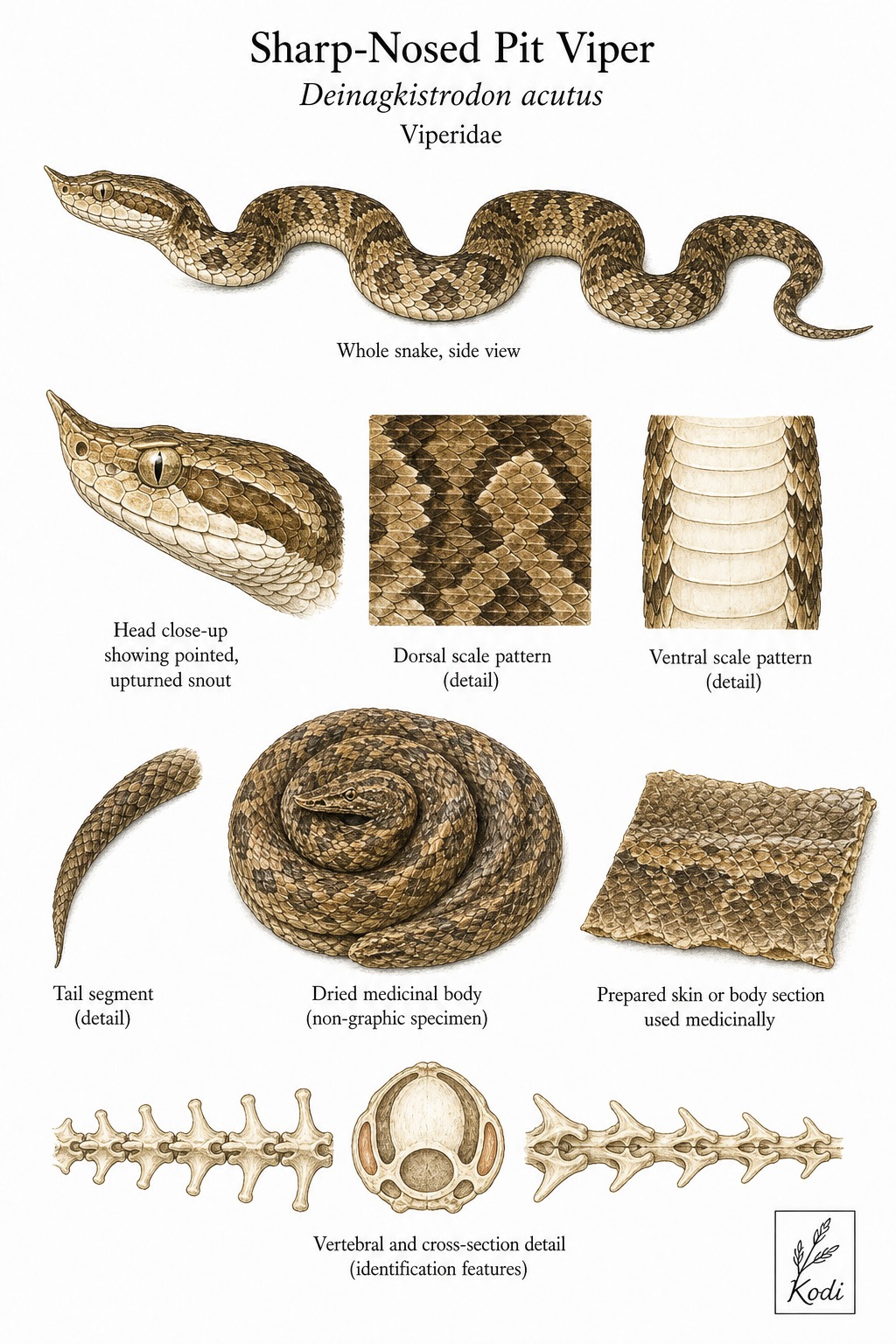
Known in TCM as Bai Hua She (白花蛇), this sweet and salty, warm herb enters the Liver. Traditionally, it dispels Wind-Damp and unblocks the collaterals - used for stubborn Bi syndrome, numbness, joint pain, and chronic channel obstruction that ordinary wind-damp herbs do not reach deeply enough, most often applied for joint pain, stroke, and eczema. Modern research has identified Snake-venom among its active constituents.
Also Known As
Latin: Deinagkistrodon acutus | Pinyin: Bai Hua She | Chinese: 白花蛇
TCM Properties
- Taste
- sweet, salty
- Temperature
- warm
- Channels
- Liver
Traditional Use
Primary Actions
- Dispels Wind-Damp and unblocks the collaterals - used for stubborn Bi syndrome, numbness, joint pain, and chronic channel obstruction that ordinary wind-damp herbs do not reach deeply enough.
- Extinguishes wind and stops spasms - applied to tetany, convulsions, tremor, facial paralysis, and post-stroke hemiplegia when internal wind has lodged in the channels and sinews.
- Searches out wind to relieve itching and chronic toxic skin disease - classically used for persistent pruritic eruptions, scaly skin disorders, and wind-toxin conditions with numbness or deformity.
- Acts as the stronger, more toxic counterpart to Wu Shao She - traditionally chosen when a penetrating snake medicinal is needed for severe, long-standing obstruction rather than milder patterns.
Secondary Actions
- Bai Hua She is usually processed, powdered, or prepared with wine rather than simmered casually in long decoctions; the goal is to preserve its channel-penetrating action while controlling toxicity.
- This record follows the classical Bai Hua She lineage centered on Qi She and the sharp-nosed pit viper; the separate 'Jin Qian Bai Hua She' stub remains available for the juvenile krait trade concept imported elsewhere in the spreadsheet.
Classic Formulas
- Da Huo Luo Dan (大活络丹) - major wind-damp and stroke-sequelae formula in which Bai Hua She helps search out deep channel wind, relieve pain, and restore movement.
- Classical Bai Hua She powders and medicated-wine preparations - the processed snake is used alone or with other wind-extinguishing substances when chronic Bi, paralysis, or spasms have become fixed and stubborn.
- Bai Hua She with Wu Shao She or Quan Xie - traditional pairings used when severe wind-damp numbness, convulsions, or difficult skin disorders require stronger animal medicinals than plant herbs alone.
Classical References
- Me & Qi describes Bai Hua She as sweet, salty, warm, entering the Liver channel, and specifically stronger and more toxic than Wu Shao She for stubborn Wind-Damp, spasms, itching, and windstroke sequelae.
- Sacred Lotus preserves the older cross-referencing of Bai Hua She with Agkistrodon and Bungarus naming traditions, showing why the modern trade and older texts can look taxonomically inconsistent.
- DATA QUALITY NOTE: the source XLSX imported this file with the Latin 'Bungarus Parvus' while also creating a later stub for Jin Qian Bai Hua She under the same Latin. Modern primary references identify the mainstream Bai Hua She drug more closely with Qi She / Deinagkistrodon acutus, so this record corrects the herb identity while leaving the duplicate krait-style record for separate cleanup.
Modern Research
Active Compounds
- Snake-venom metalloproteinases (SVMPs) - major proteolytic venom proteins relevant to tissue, vascular, and inflammatory effects
- Phospholipase A2 isoenzymes (PLA2 proteins) - lipid-membrane active venom constituents with strong inflammatory and pharmacologic relevance
- Serine proteases and protein C activators - coagulation-active venom proteins that help explain modern hemostatic and antithrombotic research interest
- Low-molecular-weight peptides from processed Agkistrodon material - peptide fractions studied as potential anti-inflammatory and antiarthritic mediators
Studied Effects
- Antiarthritic peptide fractions - peptides isolated from medicinal Agkistrodon reduced TNF-alpha, IL-1beta, and IL-6 while improving collagen-induced arthritis in rats, aligning with the herb's traditional use for severe painful obstruction (PMID 29853972)
- Osteoarthritis pain and cartilage protection - ethanol extract of Agkistrodon acutus reduced pain behavior and chondrocyte hypertrophy in a rat osteoarthritis model (PMID 30529425)
- Antithrombotic activity - a purified protein from Deinagkistrodon acutus showed anticoagulant and antithrombotic effects in modern pharmacology work, illustrating how strongly bioactive the venom-derived protein fraction remains (PMID 33773469)
- Venom proteomics and toxicity profiling - modern proteomic analysis continues to map the toxic and coagulation-active venom composition of Deinagkistrodon acutus, reinforcing the need for careful authentication and supervised processing in medicinal use (PMID 35408629)
PubMed References
- Small Peptides Compound Isolated from Agkistrodon with Antiarthritic Effect in Collagen-Induced Arthritis Rats (2018)
- Agkistrodon ameliorates pain response and prevents cartilage degradation in monosodium iodoacetate-induced osteoarthritic rats by inhibiting chondrocyte hypertrophy and apoptosis (2018)
- Antithrombotic and anticoagulant effects of a novel protein isolated from the venom of the Deinagkistrodon acutus snake (2021)
- Analysis of the Composition of Deinagkistrodon acutus Snake Venom Based on Proteomics, and Its Antithrombotic Activity and Toxicity Studies (2022)
Safety & Interactions
Contraindications
- Pregnancy
- Blood deficiency or Yin deficiency presentations without true Wind-Damp obstruction or spasm
- Mild patterns that can be managed with gentler non-toxic wind-damp medicinals
Cautions
- Bai Hua She is a toxic animal medicinal from a venomous snake and should only be used in properly processed medicinal-grade form under professional supervision
- Because the source animal is heavily bioactive and historically overcollected, species authentication, legal sourcing, and parasite-safe processing all matter
- The same venom protein families that make modern pharmacology interesting also mean unsupervised use can be dangerous, especially around bleeding, tissue injury, or overdose risk
- MSK page not found - drug interaction data not available from Memorial Sloan Kettering integrative medicine database
Conditions
- Joint Pain Traditional ★★★★★ JSON
- Stroke Traditional ★★★★☆ JSON
- Eczema Traditional ★★★★☆ JSON
- Epilepsy Traditional ★★★☆☆ JSON
- Osteoarthritis Preclinical ★★☆☆☆ JSON
Frequently Asked Questions
What is Sharp-Nosed Pit Viper used for?
Sharp-Nosed Pit Viper is traditionally used to Dispels Wind-Damp and unblocks the collaterals - used for stubborn Bi syndrome, numbness, joint pain, and chronic channel obstruction that ordinary wind-damp herbs do not reach deeply enough., Extinguishes wind and stops spasms - applied to tetany, convulsions, tremor, facial paralysis, and post-stroke hemiplegia when internal wind has lodged in the channels and sinews., Searches out wind to relieve itching and chronic toxic skin disease - classically used for persistent pruritic eruptions, scaly skin disorders, and wind-toxin conditions with numbness or deformity., Acts as the stronger, more toxic counterpart to Wu Shao She - traditionally chosen when a penetrating snake medicinal is needed for severe, long-standing obstruction rather than milder patterns.. Research has investigated its effects on: Antiarthritic peptide fractions - peptides isolated from medicinal Agkistrodon reduced TNF-alpha, IL-1beta, and IL-6 while improving collagen-induced arthritis in rats, aligning with the herb's traditional use for severe painful obstruction (PMID 29853972); Osteoarthritis pain and cartilage protection - ethanol extract of Agkistrodon acutus reduced pain behavior and chondrocyte hypertrophy in a rat osteoarthritis model (PMID 30529425).
What are other names for Sharp-Nosed Pit Viper?
Sharp-Nosed Pit Viper is also known as Deinagkistrodon. In TCM: 白花蛇 (Bai Hua She); Deinagkistrodon acutus.
Is Sharp-Nosed Pit Viper safe during pregnancy?
Sharp-Nosed Pit Viper is not recommended during pregnancy.
What are the contraindications for Sharp-Nosed Pit Viper?
Sharp-Nosed Pit Viper should not be used in: Pregnancy; Blood deficiency or Yin deficiency presentations without true Wind-Damp obstruction or spasm; Mild patterns that can be managed with gentler non-toxic wind-damp medicinals. Consult a qualified healthcare provider before use.