Zhejiang Fritillary Bulb
- Chinese
- 浙贝母
- Pinyin
- Zhe Bei Mu
- Latin
- Bulbus Fritillariae Thunbergii
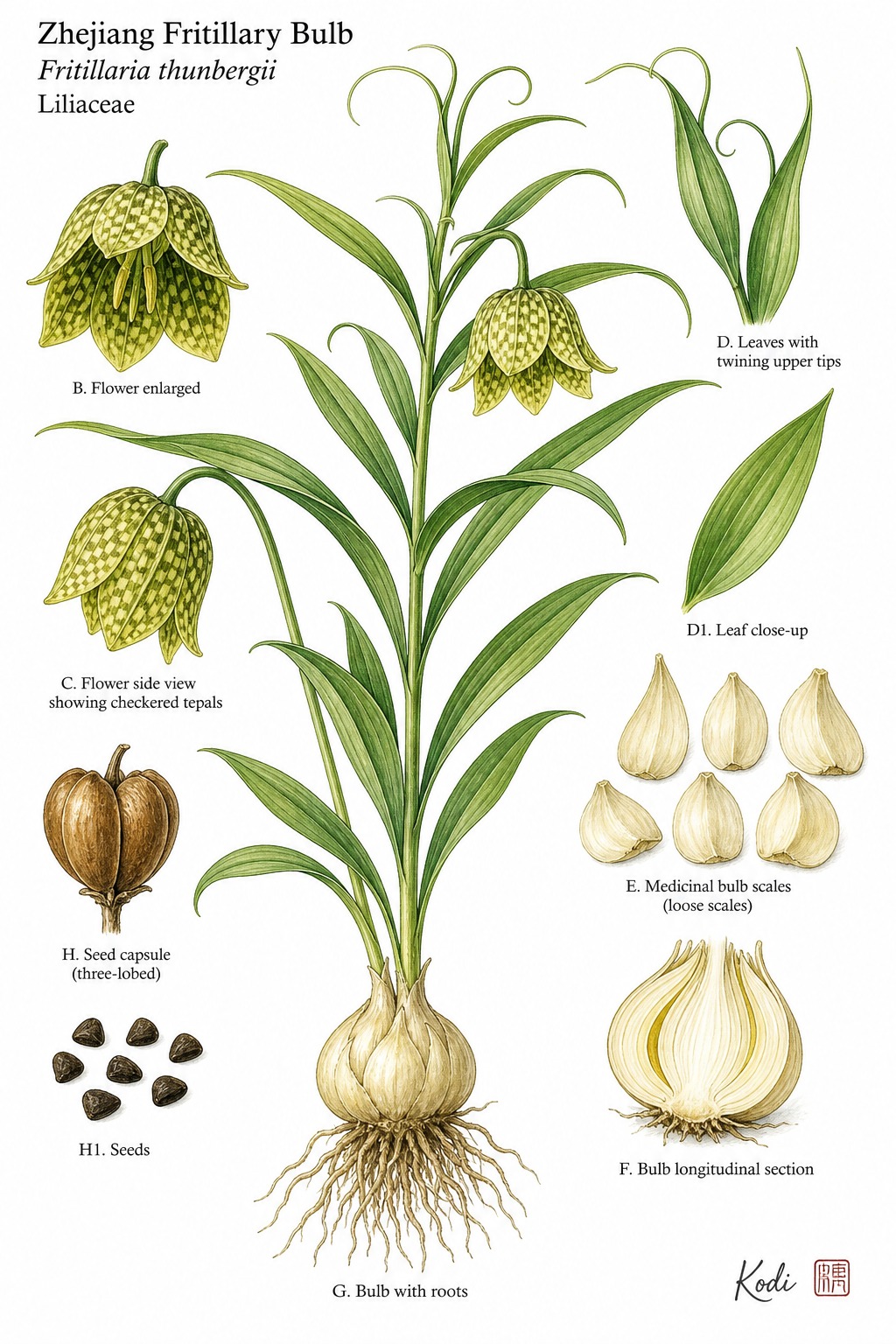
Known in TCM as Zhe Bei Mu (浙贝母), this bitter, cold herb enters the Heart and Lung. Traditionally, it clears Lung heat, transforms phlegm, and stops forceful cough - the stronger Bei Mu for acute cough with thick yellow sputum, Lung fire, wind-heat phlegm, or obstructed downward Lung Qi, most often applied for productive cough, cough, and thyroid nodule. Modern research has identified Peimine among its active constituents.
Part used: Bulb
Also Known As
Latin: Bulbus Fritillariae Thunbergii | Pinyin: Zhe Bei Mu | Chinese: 浙贝母
TCM Properties
- Taste
- bitter
- Temperature
- cold
- Channels
- Heart, Lung
Traditional Use
Primary Actions
- Clears Lung heat, transforms phlegm, and stops forceful cough - the stronger Bei Mu for acute cough with thick yellow sputum, Lung fire, wind-heat phlegm, or obstructed downward Lung Qi.
- Clears heat and disperses nodules - especially valued for scrofula, goiter, thyroid masses, breast lumps, and hard phlegm-fire swellings where a colder, more dispersing fritillary is needed.
- Resolves toxin and reduces swelling - extended to sore throat, abscesses, mastitis, and phlegm-heat sores when heat, phlegm, and local swelling combine.
- Drains downward more strongly than Chuan Bei Mu - making it the preferred fritillary for excess, acute, and more palpable phlegm-heat accumulations rather than chronic deficiency-dryness cough.
Secondary Actions
- Historically, generic Bei Mu was only later divided into Chuan and Zhe forms; modern Zhe Bei Mu inherited the reputation for being larger, more bitter, colder, and more focused on toxins and nodules.
- Older aliases such as Xiang Bei and Tu Bei can create sourcing confusion, so this record keeps Zhe Bei Mu clearly distinct from both Chuan Bei Mu and the unrelated modern Tu Bei Mu (Bolbostemma).
Classic Formulas
- Hai Zao Yu Hu Tang (海藻玉壶汤) - classic formula for goiter and thyroid nodules in which Zhe Bei Mu helps dissolve phlegm masses in the neck alongside seaweed, kelp, and Qi-regulating herbs.
- Xiao Luo Wan (消瘰丸) - the hallmark scrofula and lymph-node formula pairing Zhe Bei Mu with Xuan Shen and Mu Li to clear heat, nourish Yin, soften hardness, and dissolve phlegm nodules.
- Sang Xing Tang (桑杏汤) - uses Zhe Bei Mu in warm-dryness cough to cool and transform Lung phlegm while protecting fluids, showing its role in acute heat-related respiratory conditions.
- Er Mu pairings with Zhi Mu - although not always a standalone formula title, the classical 'Two Mothers' combination highlights Zhe Bei Mu's strength for Lung heat with phlegm and fluid damage.
Classical References
- Me & Qi and Sacred Lotus agree that Zhe Bei Mu is bitter and cold, enters the Heart and Lung, transforms phlegm-heat, stops cough, and disperses nodules while remaining distinctly stronger and colder than Chuan Bei Mu.
- Me & Qi's historical review explains that the formal Chuan/Zhe split emerged in the Ming and Qing periods, after older texts had simply recorded Bei Mu without modern species distinction.
- Traditional Zhejiang materia medica regards Zhe Bei Mu as one of the celebrated 'Zhe Ba Wei' herbs and emphasizes its role in hard nodules, toxic swellings, and acute phlegm-heat rather than purely deficiency cough.
Modern Research
Active Compounds
- Peimine (isosteroidal alkaloid) - a major marker constituent repeatedly quantified in Zhe Bei Mu
- Peiminine (isosteroidal alkaloid) - a key alkaloid with strong anti-inflammatory and airway-related research relevance
- Peimisine and peimisine glucosides - important quantified alkaloid markers in Fritillaria thunbergii extracts
- Verticine, ebeiedine, and suchengbeisine - named Zhe Bei Mu alkaloids studied for mucin and airway effects
- Yibeissine and related steroidal alkaloids - additional marker compounds found in modern extract profiling
Studied Effects
- Fritillaria thunbergii extract improved lung inflammation, fibrosis, and lung-function markers in a pulmonary-fibrosis model through PI3K/AKT/FOXO-related signaling, supporting the herb's ongoing respiratory relevance (PMID 39938765).
- Anti-inflammatory cell studies showed Fritillaria thunbergii extract suppressed nitric oxide, IL-6, TNF-alpha, NF-kappaB translocation, and ERK/JNK signaling in LPS-stimulated macrophages (PMID 33747168).
- Peiminine attenuated LPS-induced acute lung injury by inhibiting lipid-raft formation and inflammatory signaling, adding a focused mechanistic correlate for the herb's phlegm-heat airway use (PMID 32152924).
- Verticine, ebeiedine, and suchengbeisine from Fritillaria thunbergii inhibited MUC5AC mucin gene expression and mucin production in airway epithelial cells, supporting its expectorant and mucoregulating reputation (PMID 26926170).
- Comparative Beimu pharmacology showed that the alkaloid profile of Zhe Bei Mu correlates strongly with tracheobronchial relaxant activity, helping explain why species distinction matters clinically (PMID 28842340).
PubMed References
- Fritillaria thunbergii Miq. Extract ameliorated experimental pulmonary fibrosis partly through the PI3K/AKT/FOXO signalling pathway (2025)
- Anti-inflammatory effects of Fritillaria thunbergii Miquel extracts in LPS-stimulated murine macrophage RAW 264.7 cells (2021)
- Peiminine Attenuates Acute Lung Injury Induced by LPS Through Inhibiting Lipid Rafts Formation (2020)
- Verticine, ebeiedine and suchengbeisine isolated from the bulbs of Fritillaria thunbergii Miq. inhibited the gene expression and production of MUC5AC mucin from human airway epithelial cells (2016)
- Investigation of association of chemical profiles with the tracheobronchial relaxant activity of Chinese medicinal herb Beimu derived from various Fritillaria species (2018)
Safety & Interactions
Contraindications
- Concurrent use with aconite-family substances such as Fu Zi, Chuan Wu, and Cao Wu
- Cold-phlegm or damp-phlegm cough with thin, clear, copious sputum
- Spleen and Stomach deficiency-cold with weak appetite, loose stools, or diarrhea
Cautions
- Because Zhe Bei Mu is bitter and cold, prolonged use or larger doses can weaken digestion and may contribute to loose stools in fragile patients
- Large doses of fritillary alkaloids may lower blood pressure or depress respiration mildly in preclinical settings, so dosing should stay within standard medicinal use
- Species confusion is common in trade; Zhe Bei Mu is frequently mixed with Chuan, Ping, Yi, or historically named Tu Bei materials, which can change both potency and indication
- MSK page not found - drug interaction data not available from Memorial Sloan Kettering integrative medicine database
Conditions
- Productive Cough Traditional ★★★★★ JSON
- Cough Traditional ★★★★☆ JSON
- Thyroid Nodule Traditional ★★★★☆ JSON
- Pharyngitis Traditional ★★★☆☆ JSON
- Breast Abscess Traditional ★★★☆☆ JSON
Frequently Asked Questions
What is Zhejiang Fritillary Bulb used for?
Zhejiang Fritillary Bulb is traditionally used to Clears Lung heat, transforms phlegm, and stops forceful cough - the stronger Bei Mu for acute cough with thick yellow sputum, Lung fire, wind-heat phlegm, or obstructed downward Lung Qi., Clears heat and disperses nodules - especially valued for scrofula, goiter, thyroid masses, breast lumps, and hard phlegm-fire swellings where a colder, more dispersing fritillary is needed., Resolves toxin and reduces swelling - extended to sore throat, abscesses, mastitis, and phlegm-heat sores when heat, phlegm, and local swelling combine., Drains downward more strongly than Chuan Bei Mu - making it the preferred fritillary for excess, acute, and more palpable phlegm-heat accumulations rather than chronic deficiency-dryness cough.. Research has investigated its effects on: Fritillaria thunbergii extract improved lung inflammation, fibrosis, and lung-function markers in a pulmonary-fibrosis model through PI3K/AKT/FOXO-related signaling, supporting the herb's ongoing respiratory relevance (PMID 39938765).; Anti-inflammatory cell studies showed Fritillaria thunbergii extract suppressed nitric oxide, IL-6, TNF-alpha, NF-kappaB translocation, and ERK/JNK signaling in LPS-stimulated macrophages (PMID 33747168)..
What are other names for Zhejiang Fritillary Bulb?
Zhejiang Fritillary Bulb is also known as Fritillaria. In TCM: 浙贝母 (Zhe Bei Mu); Bulbus Fritillariae Thunbergii.
Is Zhejiang Fritillary Bulb safe during pregnancy?
The safety of Zhejiang Fritillary Bulb during pregnancy has not been established. Consult a qualified healthcare provider before use.
What are the contraindications for Zhejiang Fritillary Bulb?
Zhejiang Fritillary Bulb should not be used in: Concurrent use with aconite-family substances such as Fu Zi, Chuan Wu, and Cao Wu; Cold-phlegm or damp-phlegm cough with thin, clear, copious sputum; Spleen and Stomach deficiency-cold with weak appetite, loose stools, or diarrhea. Consult a qualified healthcare provider before use.