Sichuan Fritillary Bulb
- Chinese
- 川贝母
- Pinyin
- Chuan Bei Mu
- Latin
- Bulbus Fritillariae Cirrhosae
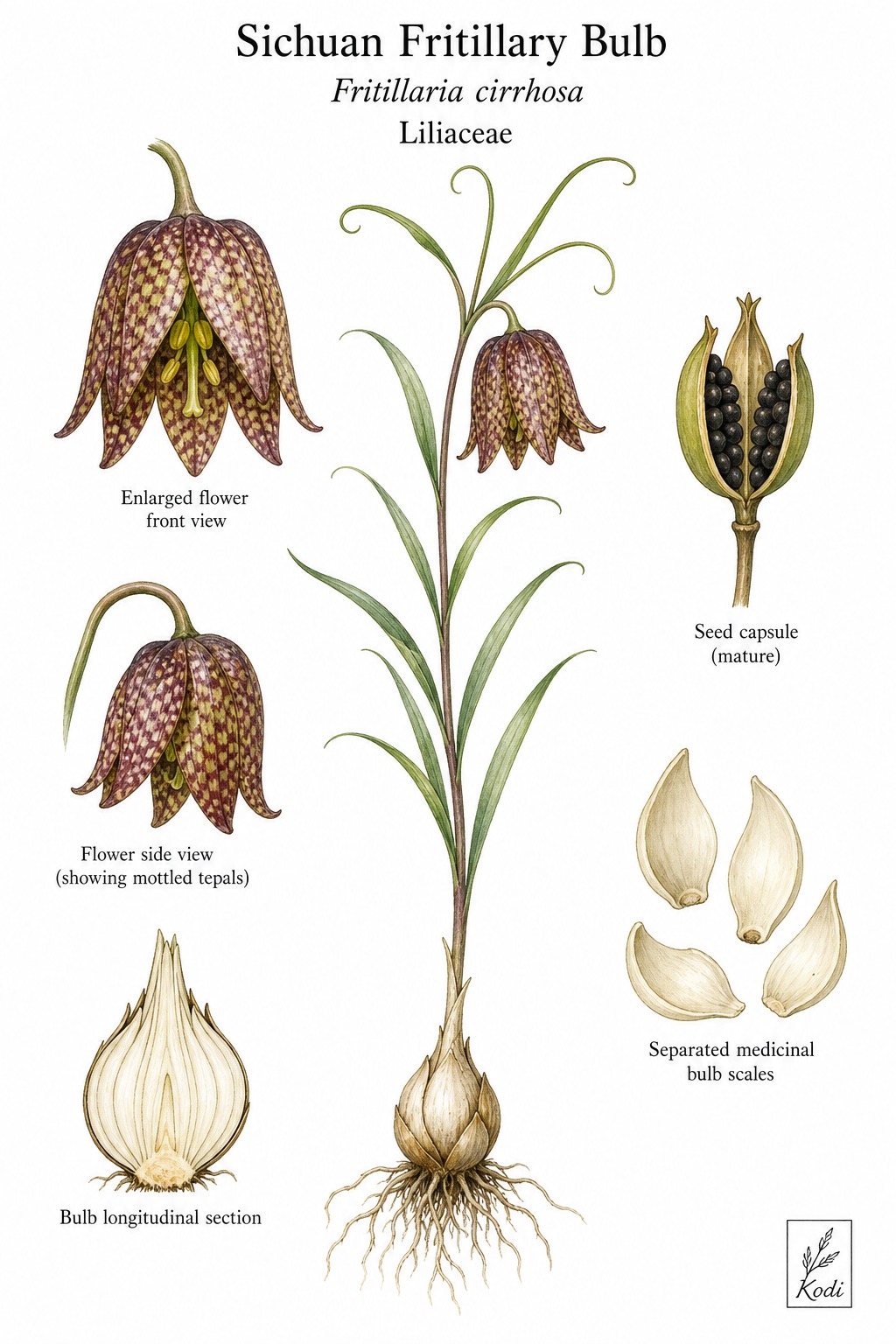
Known in TCM as Chuan Bei Mu (川贝母), this bitter and sweet, cool herb enters the Heart and Lung. Traditionally, it moistens the Lungs, clears heat, transforms dry phlegm, and stops cough - the species-specific Bei Mu of choice for chronic dry cough, scant sticky sputum, throat dryness, and Yin-deficient or post-febrile Lung heat, most often applied for dry cough, cough, and pharyngitis. Modern research has identified Imperialine among its active constituents.
Part used: Bulb
Also Known As
Latin: Bulbus Fritillariae Cirrhosae | Pinyin: Chuan Bei Mu | Chinese: 川贝母
TCM Properties
- Taste
- bitter, sweet
- Temperature
- cool
- Channels
- Heart, Lung
Traditional Use
Primary Actions
- Moistens the Lungs, clears heat, transforms dry phlegm, and stops cough - the species-specific Bei Mu of choice for chronic dry cough, scant sticky sputum, throat dryness, and Yin-deficient or post-febrile Lung heat.
- Stops cough without excessive drying - especially valued when heat and phlegm are present but the patient's fluids are already damaged, making harsher bitter-cold phlegm herbs less suitable.
- Clears heat and disperses nodules - applied to scrofula, goiter, breast or Lung abscesses, and other phlegm-fire swellings, though with a gentler and more moistening profile than Zhe Bei Mu.
- Can address phlegm with upper-burner Qi constraint - classical formula traditions use it when cough or throat discomfort is accompanied by chest or epigastric stifling rather than simple dryness alone.
Secondary Actions
- Modern Chuan Bei Mu is a premium high-altitude medicine derived from multiple official Fritillaria species, which is one reason authentic material is expensive and often adulterated or substituted in trade.
- Relative to Zhe Bei Mu, Chuan Bei Mu is sweeter, milder, and more appropriate for chronic deficiency-dryness cough, while Zhe Bei Mu is more bitter, colder, and stronger for acute heat-phlegm and hard nodules.
Classic Formulas
- Bei Mu Gua Lou San (贝母瓜蒌散) - the archetypal dry-phlegm formula in which Chuan Bei Mu moistens the Lung, transforms sticky phlegm, regulates upper-burner Qi, and stops cough.
- Bai He Gu Jin Tang (百合固金汤) - enriches Lung and Kidney Yin while Chuan Bei Mu moistens the Lung and resolves phlegm in chronic dry cough, blood-streaked sputum, and dry sore throat.
- Yang Yin Qing Fei Tang (养阴清肺汤) - uses Chuan Bei Mu to clear phlegm-heat, moisten the Lung, and relieve swollen painful throat in Yin-damaged upper-burner heat disorders.
- Qi Ge San (七隔散) - classical formula for upper-burner Qi stagnation and phlegm affecting the chest and swallowing, highlighting Chuan Bei Mu's ability to transform phlegm without adding dryness.
Classical References
- Sacred Lotus describes Chuan Bei Mu as bitter, sweet, and cool, entering the Heart and Lung to moisten the Lung, clear heat, stop cough, and disperse nodules.
- Me & Qi similarly frames Chuan Bei Mu as the fritillary used for dry cough, bloody sputum, scrofula, mastitis, asthma, chest congestion, and throat obstruction, with Bei Mu Gua Lou San and Bai He Gu Jin Tang as key formula examples.
- Modern pharmacognosy and authentication studies emphasize that true Fritillariae Cirrhosae Bulbus comes from six official source species and is frequently adulterated as wild resources decline, so species-level identification matters clinically and commercially.
Modern Research
Active Compounds
- Imperialine (isosteroidal alkaloid) - a major antitussive marker constituent of Chuan Bei Mu
- Peimisine (isosteroidal alkaloid) - one of the recurrent quantified alkaloids in Fritillariae Cirrhosae Bulbus studies
- Peimine or verticine (isosteroidal alkaloid) - a core fritillary alkaloid associated with respiratory and anti-inflammatory activity
- Peiminine or verticinone (isosteroidal alkaloid) - a major companion alkaloid with inflammation-modulating and airway relevance
- Imperialine-3-beta-D-glucoside and related alkaloid glycosides - modern marker constituents in quality and pharmacokinetic studies
Studied Effects
- A systematic review of Fritillariae Cirrhosae Bulbus summarized antitussive, expectorant, analgesic, anti-inflammatory, anticancer, and antioxidative activities and highlighted alkaloids as the main active ingredients, reinforcing Chuan Bei Mu's modern respiratory research core (PMID 33273948).
- Fritillaria cirrhosa reduced eosinophil accumulation, Th2 cytokines, IgE, and histamine in an ovalbumin asthma model, supporting the herb's traditional use for chronic cough and airway inflammation with heat and phlegm (PMID 17309526).
- Total alkaloids of Fritillaria cirrhosa improved inflammatory and fibrotic markers in a pulmonary-fibrosis rat model through TGF-beta and NF-kappaB-related pathways, extending the herb's relevance to chronic inflammatory lung remodeling (PMID 38187805).
- Imperialine absorption studies helped define the intestinal behavior of a key Chuan Bei Mu antitussive alkaloid, supporting its continued role as a pharmacokinetic marker compound (PMID 26051111).
- Recent amplicon-sequencing authentication work showed why older PCR-RFLP methods can misidentify genuine source material, underscoring the sourcing and adulteration issues surrounding true Chuan Bei Mu (PMID 38419104).
PubMed References
- A Systematic Review on Traditional Uses, Sources, Phytochemistry, Pharmacology, Pharmacokinetics, and Toxicity of Fritillariae Cirrhosae Bulbus (2020)
- Fritillaria cirrhosa, Anemarrhena asphodeloides, Lee-Mo-Tang and cyclosporine a inhibit ovalbumin-induced eosinophil accumulation and Th2-mediated bronchial hyperresponsiveness in a murine model of asthma (2007)
- Total alkaloids of bulbus of Fritillaria cirrhosa alleviate bleomycin-induced inflammation and pulmonary fibrosis in rats by inhibiting TGF-β and NF-κB signaling pathway (2023)
- Intestinal absorption characteristics of imperialine: in vitro and in situ assessments (2015)
- Determination of ITS1 haplotypes of Fritillariae Cirrhosae Bulbus by amplicon sequencing (2024)
Safety & Interactions
Contraindications
- Cold-phlegm or damp-phlegm cough with thin, clear, copious sputum
- Spleen and Stomach deficiency-cold with loose stools or weak digestion
- Concurrent use with aconite-family substances such as Fu Zi, Chuan Wu, or Cao Wu
Cautions
- Unprocessed raw material should not be taken internally; clinically used Chuan Bei Mu is processed medicinal material
- Because authentic Chuan Bei Mu is scarce and expensive, substitution with Zhe Bei Mu or other Fritillaria species is common and can change the clinical effect substantially
- Use with practitioner guidance in pregnancy or in very weak patients because the herb is still cool and phlegm-transforming despite its gentler nature
- MSK page not found - drug interaction data not available from Memorial Sloan Kettering integrative medicine database
Classic formulas that use Sichuan Fritillary Bulb
Herbs are rarely taken alone in Chinese medicine. These formula pages show what this herb does inside a classic prescription and which pattern that prescription is chosen for.
Conditions
- Dry Cough Traditional ★★★★★ JSON
- Cough Traditional ★★★★☆ JSON
- Pharyngitis Traditional ★★★☆☆ JSON
- Pneumonia Traditional ★★★☆☆ JSON
- Thyroid Nodule Traditional ★★☆☆☆ JSON
Frequently Asked Questions
What is Sichuan Fritillary Bulb used for?
Sichuan Fritillary Bulb is traditionally used to Moistens the Lungs, clears heat, transforms dry phlegm, and stops cough - the species-specific Bei Mu of choice for chronic dry cough, scant sticky sputum, throat dryness, and Yin-deficient or post-febrile Lung heat., Stops cough without excessive drying - especially valued when heat and phlegm are present but the patient's fluids are already damaged, making harsher bitter-cold phlegm herbs less suitable., Clears heat and disperses nodules - applied to scrofula, goiter, breast or Lung abscesses, and other phlegm-fire swellings, though with a gentler and more moistening profile than Zhe Bei Mu., Can address phlegm with upper-burner Qi constraint - classical formula traditions use it when cough or throat discomfort is accompanied by chest or epigastric stifling rather than simple dryness alone.. Research has investigated its effects on: A systematic review of Fritillariae Cirrhosae Bulbus summarized antitussive, expectorant, analgesic, anti-inflammatory, anticancer, and antioxidative activities and highlighted alkaloids as the main active ingredients, reinforcing Chuan Bei Mu's modern respiratory research core (PMID 33273948).; Fritillaria cirrhosa reduced eosinophil accumulation, Th2 cytokines, IgE, and histamine in an ovalbumin asthma model, supporting the herb's traditional use for chronic cough and airway inflammation with heat and phlegm (PMID 17309526)..
What are other names for Sichuan Fritillary Bulb?
Sichuan Fritillary Bulb is also known as Fritillaria. In TCM: 川贝母 (Chuan Bei Mu); Bulbus Fritillariae Cirrhosae.
Is Sichuan Fritillary Bulb safe during pregnancy?
The safety of Sichuan Fritillary Bulb during pregnancy has not been established. Consult a qualified healthcare provider before use.
What are the contraindications for Sichuan Fritillary Bulb?
Sichuan Fritillary Bulb should not be used in: Cold-phlegm or damp-phlegm cough with thin, clear, copious sputum; Spleen and Stomach deficiency-cold with loose stools or weak digestion; Concurrent use with aconite-family substances such as Fu Zi, Chuan Wu, or Cao Wu. Consult a qualified healthcare provider before use.