Indian Iphigenia Bulb
- Chinese
- 草贝母
- Pinyin
- Cao Bei Mu
- Latin
- Bulbus Iphigeniae Indicae
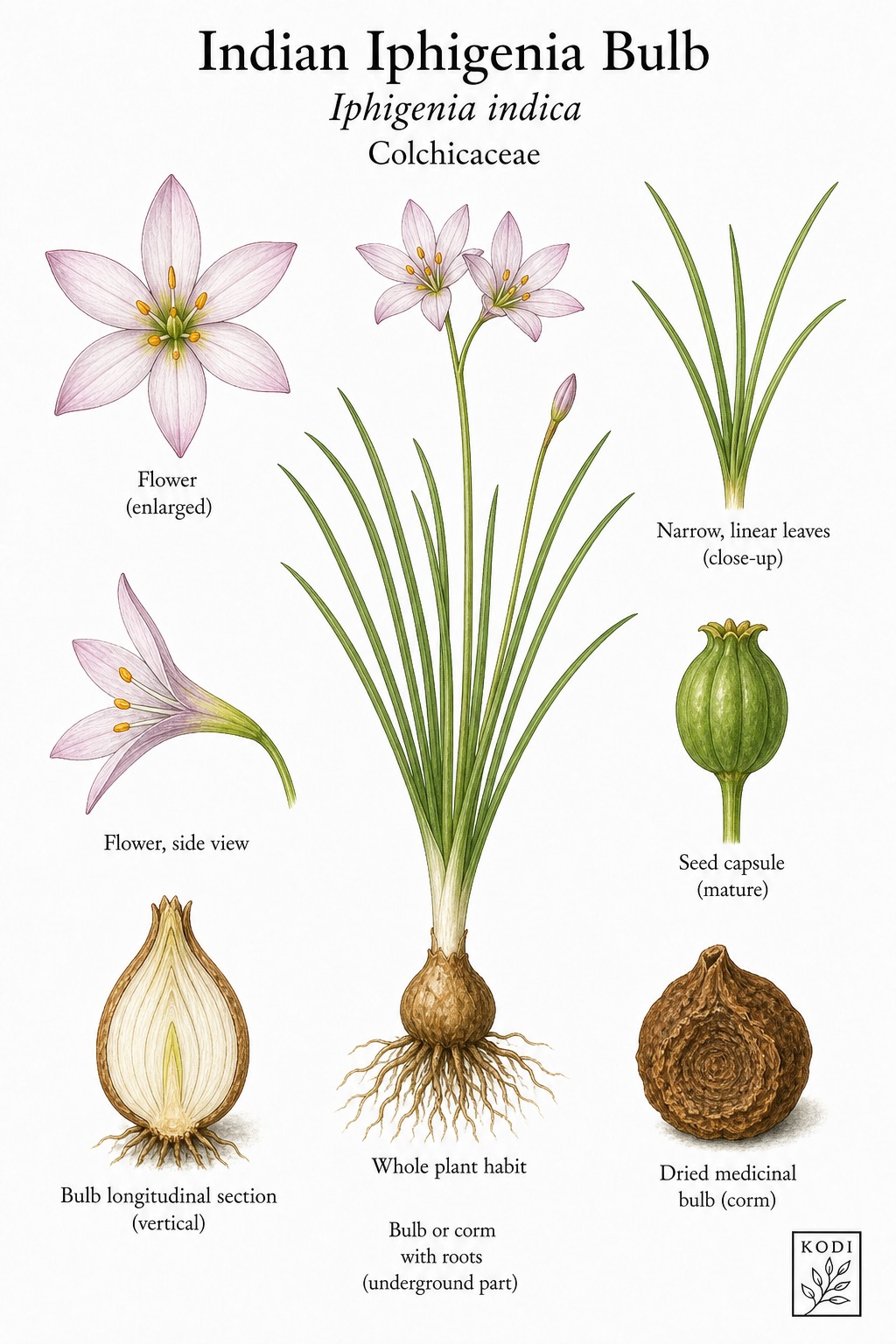
Known in TCM as Cao Bei Mu (草贝母), this bitter, warm herb enters the Liver and Lung. Traditionally, it transforms phlegm, stops cough, and relieves wheezing - used in southwest-Chinese and regional folk practice for chronic bronchitis, asthma, stubborn phlegm, and obstructed Lung Qi when a stronger, more toxic bulb is chosen, most often applied for bronchitis, asthma, and phlegm accumulation. Modern research has identified Colchicine among its active constituents.
Part used: Bulb
Also Known As
Latin: Bulbus Iphigeniae Indicae | Pinyin: Cao Bei Mu | Chinese: 草贝母
TCM Properties
- Taste
- bitter
- Temperature
- warm
- Channels
- Liver, Lung
Traditional Use
Primary Actions
- Transforms phlegm, stops cough, and relieves wheezing - used in southwest-Chinese and regional folk practice for chronic bronchitis, asthma, stubborn phlegm, and obstructed Lung Qi when a stronger, more toxic bulb is chosen.
- Softens hardness and disperses nodules - applied to scrofula, breast or thyroid masses, and phlegm-toxin lumps where the bulb's toxic, dispersing nature is intended to break fixed accumulations.
- Resolves toxin, reduces swelling, and alleviates pain - extended to abscesses, skin infection, snakebite, and painful swollen lesions, sometimes with external use.
- Shows a 'fighting poison with poison' profile - traditional oncology and mass-dispersing usage relies on the herb's toxicity and should not be treated like the gentler fritillary bulbs.
Secondary Actions
- Regional literature sometimes cross-links Cao Bei Mu with names such as Shan Ci Gu or other 'earth fritillary' aliases, but this library keeps it distinct from the separate Cremastra/Pleione Shan Ci Gu entry already in the dataset.
- Despite the 'Bei Mu' name, Cao Bei Mu does not behave like Chuan Bei Mu or Zhe Bei Mu; it is warmer, toxic, and more focused on hard masses, pain, and toxin than on gentle moistening of the Lung.
Classic Formulas
- Cao Bei Mu with Jie Geng and Xing Ren - regional cough prescriptions use this combination for phlegm-obstruction cough, wheezing, and stubborn bronchitic congestion.
- Cao Bei Mu with Xia Ku Cao and oyster shell - folk mass-dispersing combinations for scrofula, thyroid swelling, or hard phlegm nodules.
- Cao Bei Mu with detoxifying topical herbs - external powders or pastes are used for swollen toxic lesions, abscesses, or snakebite in local practice.
Classical References
- Dictionary-style materia medica lists translate Cao Bei Mu / Bulbus Iphigeniae Indicae as Indian Iphigenia bulb and describe it chiefly as a phlegm-dissolving herb of regional practice rather than a mainstream national pharmacopoeia staple.
- Regional herb references describe it as bitter, warm, Lung- and Liver-entering, toxic, and used for bronchitis, asthma, scrofula, and snakebite, which matches its stronger mass-dispersing profile.
- Modern plant-genome and ethnomedicine papers note that Iphigenia indica is used in southwest China for asthma, bronchitis, gout, and cancer, confirming that its medicinal reputation remains geographically specific.
Modern Research
Active Compounds
- Colchicine (phenethylisoquinoline alkaloid) - the best-known toxic spindle poison associated with Iphigenia and the main reason the herb demands caution
- Colchiceinamide and related colchicine-type alkaloids - structurally related cytotoxic constituents reported for Iphigenia materials
- Beta-sitosterol and stigmasterol - phytosterols proposed in newer extract and network-pharmacology studies of Iphigenia indica
- Phenanthrene and phenolic compounds - candidate cytotoxic or anti-inflammatory constituents under current investigation
Studied Effects
- A current English-language in vitro study reported that Iphigenia indica extract inhibited colorectal-cancer cell growth and promoted apoptosis through PIK3CD and AKT/mTOR-related mechanisms, aligning with the herb's traditional mass-dispersing reputation (2026 Journal of Radiation Research and Applied Sciences study; not yet confirmed in PubMed at time of review).
- Formula-based oncology research continues to include Bulbus Iphigeniae Indicae as a candidate antitumor component in approved Chinese patent medicines and anticancer TCM combinations (PMID 28099904; PMID 38870606).
- Because the herb belongs to a colchicine-bearing lineage, much of its mechanistic plausibility comes from colchicine alkaloid pharmacology: antimitotic, anti-inflammatory, and narrow-therapeutic-index toxicology (PMID 32432867).
PubMed References
- Colchicine Alkaloids and Synthetic Analogues: Current Progress and Perspectives (2020)
- Tianfoshen oral liquid: a CFDA approved clinical traditional Chinese medicine, normalizes major cellular pathways disordered during colorectal carcinogenesis (2017)
- 28-day repeated-dose toxicity of orally administered Jinmao Jiedu granule in Sprague-Dawley rats (2024)
Safety & Interactions
Contraindications
- Pregnancy
- Weak patients without phlegm, toxin, nodules, or fixed masses
- Spleen and Stomach deficiency with loose stools or poor appetite
Cautions
- Cao Bei Mu is a toxic regional bulb and should not be equated with the gentle, food-grade, or moistening fritillarys sold as Chuan Bei Mu or Bai He.
- Reported toxicity concern centers on colchicine-type alkaloids, which can irritate the GI tract and in excess injure neuromuscular, marrow, hepatic, or renal function.
- Alias confusion is common in regional markets; distinguish this herb from the separate Shan Ci Gu / Cremastra-Pleione entry and from non-toxic edible lily bulbs.
- MSK page not found - interaction guidance is inferred from colchicine pharmacology and related toxic-bulb literature rather than a dedicated clinical monograph.
Drug Interactions
- (High) Source: Colchicine pharmacology literature applied to Iphigenia indica alkaloid risk
- (High) Source: Colchicine pharmacology literature applied to Iphigenia indica alkaloid risk
- (Moderate) Source: Colchicine pharmacology literature applied to Iphigenia indica alkaloid risk
Conditions
- Bronchitis Traditional ★★★☆☆ JSON
- Asthma Traditional ★★★☆☆ JSON
- Phlegm Accumulation Traditional ★★★☆☆ JSON
- Thyroid Nodule Traditional ★★☆☆☆ JSON
- Cancer Research ★☆☆☆☆ JSON
Frequently Asked Questions
What is Indian Iphigenia Bulb used for?
Indian Iphigenia Bulb is traditionally used to Transforms phlegm, stops cough, and relieves wheezing - used in southwest-Chinese and regional folk practice for chronic bronchitis, asthma, stubborn phlegm, and obstructed Lung Qi when a stronger, more toxic bulb is chosen., Softens hardness and disperses nodules - applied to scrofula, breast or thyroid masses, and phlegm-toxin lumps where the bulb's toxic, dispersing nature is intended to break fixed accumulations., Resolves toxin, reduces swelling, and alleviates pain - extended to abscesses, skin infection, snakebite, and painful swollen lesions, sometimes with external use., Shows a 'fighting poison with poison' profile - traditional oncology and mass-dispersing usage relies on the herb's toxicity and should not be treated like the gentler fritillary bulbs.. Research has investigated its effects on: A current English-language in vitro study reported that Iphigenia indica extract inhibited colorectal-cancer cell growth and promoted apoptosis through PIK3CD and AKT/mTOR-related mechanisms, aligning with the herb's traditional mass-dispersing reputation (2026 Journal of Radiation Research and Applied Sciences study; not yet confirmed in PubMed at time of review).; Formula-based oncology research continues to include Bulbus Iphigeniae Indicae as a candidate antitumor component in approved Chinese patent medicines and anticancer TCM combinations (PMID 28099904; PMID 38870606)..
What are other names for Indian Iphigenia Bulb?
Indian Iphigenia Bulb is also known as Iphigenia. In TCM: 草贝母 (Cao Bei Mu); Bulbus Iphigeniae Indicae.
Is Indian Iphigenia Bulb safe during pregnancy?
Indian Iphigenia Bulb is not recommended during pregnancy.
What are the contraindications for Indian Iphigenia Bulb?
Indian Iphigenia Bulb should not be used in: Pregnancy; Weak patients without phlegm, toxin, nodules, or fixed masses; Spleen and Stomach deficiency with loose stools or poor appetite. Consult a qualified healthcare provider before use.
Does Indian Iphigenia Bulb interact with any medications?
Indian Iphigenia Bulb may interact with: (High severity); (High severity); (Moderate severity). Always inform your healthcare provider of any herbal supplements you are taking.