Sichuan Lily Bulb
- Chinese
- 川百合
- Pinyin
- Chuan Bai He
- Latin
- Bulbus Lilii
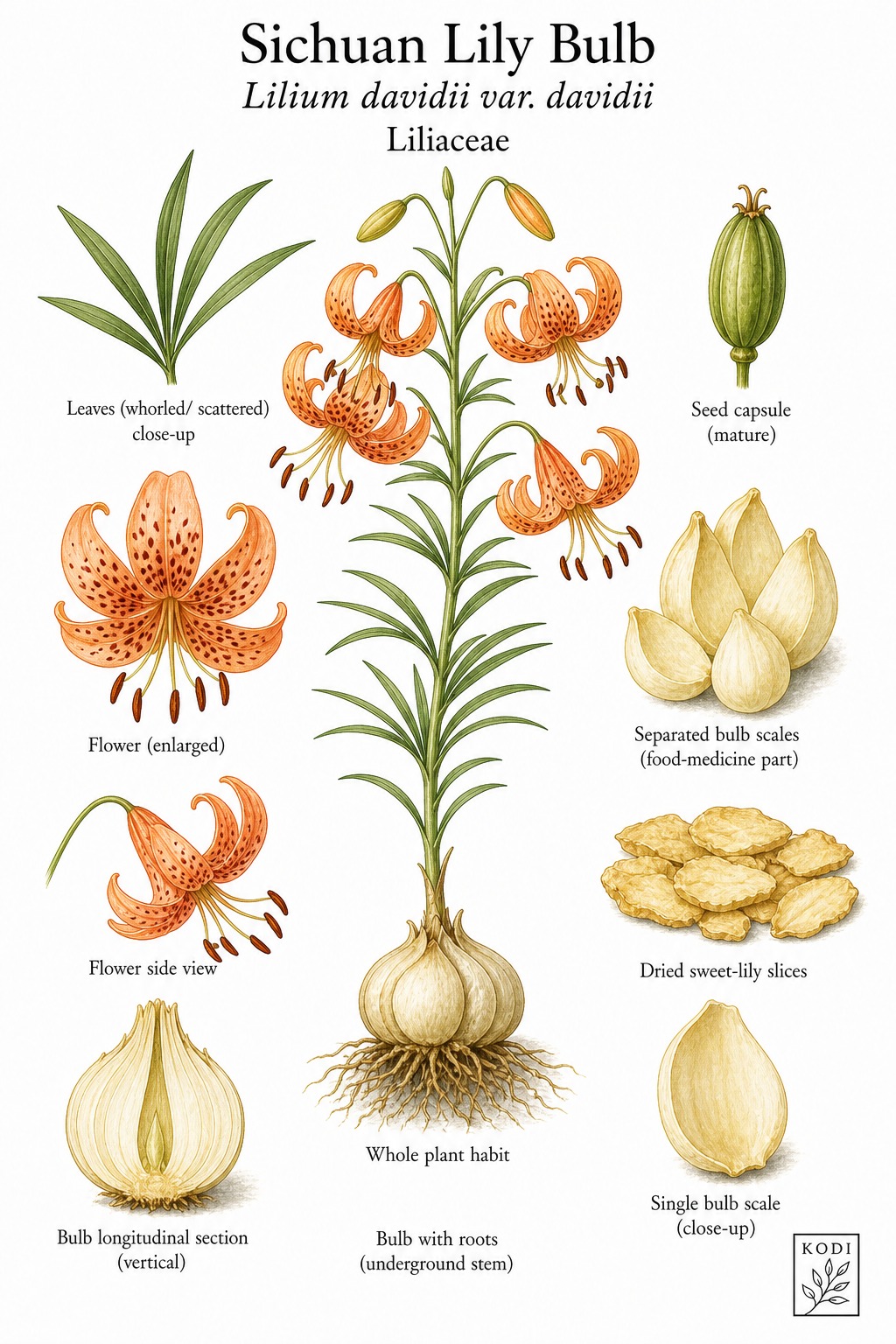
Known in TCM as Chuan Bai He (川百合), this sweet and bitter, cool herb enters the Heart and Lung. Traditionally, it moistens the Lung and relieves dry irritative cough - regional sweet-lily material used in the same general sphere as Bai He for dryness, post-illness throat irritation, and mild blood-streaked or sticky sputum, most often applied for dry cough, insomnia, and anxiety. Modern research has identified Lilium among its active constituents.
Part used: Bulb
Also Known As
Latin: Bulbus Lilii | Pinyin: Chuan Bai He | Chinese: 川百合
TCM Properties
- Taste
- sweet, bitter
- Temperature
- cool
- Channels
- Heart, Lung
Traditional Use
Primary Actions
- Moistens the Lung and relieves dry irritative cough - regional sweet-lily material used in the same general sphere as Bai He for dryness, post-illness throat irritation, and mild blood-streaked or sticky sputum.
- Nourishes Yin and quiets restlessness - often taken as a soup or food-medicine ingredient when recovery, sleep, or emotional calm is the goal rather than forceful clearing or transformation.
- Supports convalescence and depleted fluids - especially when poor recovery after illness, dryness, and mild fatigue coexist and a gentler edible lily is preferred over harsher medicinals.
- Acts as a local substitute or culinary analogue to Bai He - preserving much of the same Lung-and-Heart nourishing direction while leaning more obviously toward food use.
Secondary Actions
- Chuan Bai He usually refers to regional sweet lily materials associated with Lilium davidii and especially the Lanzhou sweet-lily line, so its trade identity is less standardized than pharmacopeial Bai He.
- Because the bulbs are sweeter and less bitter than core medicinal Bai He, clinicians often view Chuan Bai He as gentler and more food-oriented even when the overall action profile remains Lung/Heart Yin support.
Classic Formulas
- Bai He Gu Jin Tang (百合固金汤) - when Chuan Bai He is used in place of generic Bai He, the emphasis stays on moistening Lung Yin, easing chronic dry cough, and relieving blood-streaked sputum.
- Bai He Di Huang Tang (百合地黄汤) - regional cooks and practitioners may use sweeter Chuan Bai He material when treating the restless, post-febrile Bai He Bing sphere through food-like preparation.
- Bai He Zhi Mu Tang (百合知母汤) - demonstrates the same Yin-restoring, deficiency-heat clearing direction that Chuan Bai He inherits when treated as a local Bai He substitute.
- Sweet lily soups with Sha Shen, Mai Men Dong, and Chuan Bei Mu - common convalescent pairings that highlight the gentler respiratory use of regional lily bulbs even outside highly formal prescriptions.
Classical References
- Me & Qi's Bai He identity section notes that Lanzhou lily and other sweet edible lilies are not the main pharmacopoeial medicinal source, which helps explain why Chuan Bai He sits in a gray zone between food ingredient, regional substitute, and medicinal lily bulb.
- Botanical and horticultural references commonly associate 川百合 with Lilium davidii and related western-China sweet-lily cultivars, distinguishing it from the more bitter medicinal Long Ya Bai He line.
- This library keeps Chuan Bai He as a separate regional record rather than collapsing it fully into Bai He because the source dataset imported both names and modern trade usage often differentiates them.
Modern Research
Active Compounds
- Lilium davidii polysaccharides (glucomannan-rich heteropolysaccharides) - dominant sweet-lily macromolecules characterized across bulb extracts
- O-acetyl glucomannan - a named polysaccharide fraction studied for antioxidant and anti-aging effects
- Selenylated lily polysaccharides - modified research fractions with stronger immunoregulatory activity in vitro and in vivo
- Phenolic and flavonoid compounds - supportive antioxidant constituents found in edible lily research
- Starch and soluble sugars - unusually prominent nutritional components that explain the bulb's sweet food-medicine identity
Studied Effects
- Lilium davidii var. unicolor polysaccharide studies repeatedly show antioxidant and antibacterial activity, giving modern support to its use as a restorative edible bulb rather than a harsh medicinal (PMID 30986468; PMID 32608519).
- Chemical characterization work identified major non-starch polysaccharide fractions in the sweet bulbs, helping define Chuan Bai He's food-medicine chemistry (PMID 20221942).
- Modified polysaccharide research found immunoregulatory activity for selenylated Lilium davidii fractions in vitro and in vivo (PMID 33592405).
- Root-derived O-acetyl glucomannan prolonged lifespan and improved stress resistance in C. elegans models, adding to the bulb's modern longevity and nutraceutical framing (PMID 32229205).
PubMed References
- Chemical characterisation of polysaccharides from Lilium davidii (2010)
- Structural characterization, antioxidant and antibacterial activities of two heteropolysaccharides purified from the bulbs of Lilium davidii var. unicolor Cotton (2019)
- Structural characterization of Lanzhou lily (Lilium davidii var. unicolor) polysaccharides and determination of their associated antioxidant activity (2020)
- Immunoregulatory activities of the selenylated polysaccharides of Lilium davidii var. unicolor Salisb in vitro and in vivo (2021)
- Anti-aging effects on Caenorhabditis elegans of a polysaccharide, O-acetyl glucomannan, from roots of Lilium davidii var. unicolor Cotton (2020)
Safety & Interactions
Contraindications
- Wind-Cold cough with copious thin sputum
- Spleen and Stomach deficiency-cold with loose stools or diarrhea
- Marked phlegm-damp congestion without dryness
Cautions
- Chuan Bai He is often eaten as a food, but large medicinal amounts are still cool and moistening enough to burden weak digestion
- Trade identity is less standardized than core Bai He; regional sweet lily cultivars may be sold under the name, so sourcing determines whether the material is truly medicinal or mainly culinary
- Use caution in pregnancy at medicinal doses because species-level safety data are limited even though culinary use is widespread
- MSK page not found - drug interaction data not available from Memorial Sloan Kettering integrative medicine database
Conditions
Frequently Asked Questions
What is Sichuan Lily Bulb used for?
Sichuan Lily Bulb is traditionally used to Moistens the Lung and relieves dry irritative cough - regional sweet-lily material used in the same general sphere as Bai He for dryness, post-illness throat irritation, and mild blood-streaked or sticky sputum., Nourishes Yin and quiets restlessness - often taken as a soup or food-medicine ingredient when recovery, sleep, or emotional calm is the goal rather than forceful clearing or transformation., Supports convalescence and depleted fluids - especially when poor recovery after illness, dryness, and mild fatigue coexist and a gentler edible lily is preferred over harsher medicinals., Acts as a local substitute or culinary analogue to Bai He - preserving much of the same Lung-and-Heart nourishing direction while leaning more obviously toward food use.. Research has investigated its effects on: Lilium davidii var. unicolor polysaccharide studies repeatedly show antioxidant and antibacterial activity, giving modern support to its use as a restorative edible bulb rather than a harsh medicinal (PMID 30986468; PMID 32608519).; Chemical characterization work identified major non-starch polysaccharide fractions in the sweet bulbs, helping define Chuan Bai He's food-medicine chemistry (PMID 20221942)..
What are other names for Sichuan Lily Bulb?
Sichuan Lily Bulb is also known as Lilium. In TCM: 川百合 (Chuan Bai He); Bulbus Lilii.
Is Sichuan Lily Bulb safe during pregnancy?
The safety of Sichuan Lily Bulb during pregnancy has not been established. Consult a qualified healthcare provider before use.
What are the contraindications for Sichuan Lily Bulb?
Sichuan Lily Bulb should not be used in: Wind-Cold cough with copious thin sputum; Spleen and Stomach deficiency-cold with loose stools or diarrhea; Marked phlegm-damp congestion without dryness. Consult a qualified healthcare provider before use.