Fritillary Bulb (Bei Mu)
- Chinese
- 贝母
- Pinyin
- Bei Mu
- Latin
- Bulbus Fritillariae
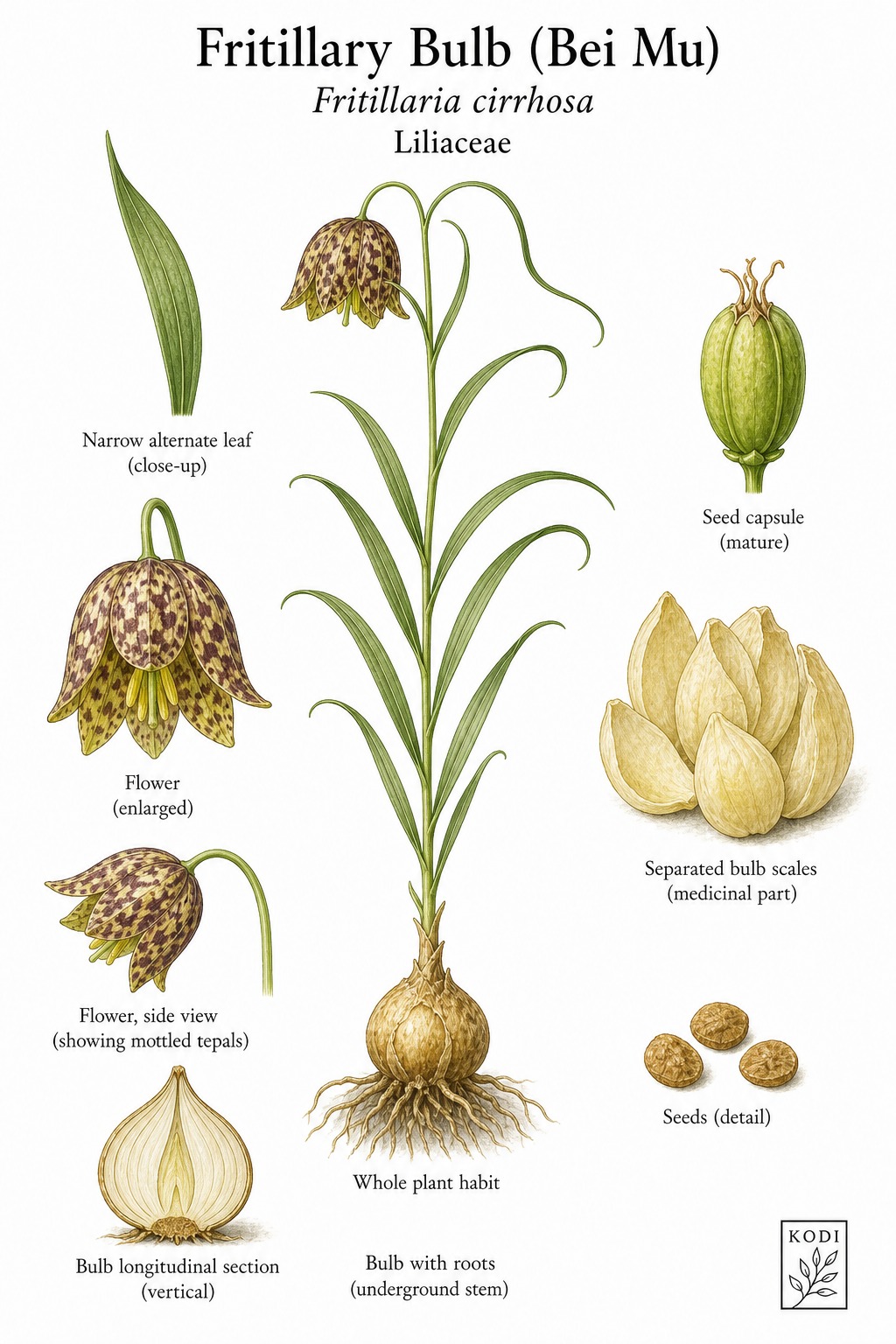
Known in TCM as Bei Mu (贝母), this bitter and sweet, cool herb enters the Heart and Lung. Traditionally, it clears Lung Heat, transforms phlegm, and stops cough - used for dry or difficult cough with heat signs, scant sticky sputum, blood-streaked sputum, and chronic cough that reflects heat damaging Lung fluids, most often applied for dry cough, cough, and productive cough. Modern research has identified Imperialine among its active constituents.
Part used: Bulb
Also Known As
Latin: Bulbus Fritillariae | Pinyin: Bei Mu | Chinese: 贝母
TCM Properties
- Taste
- bitter, sweet
- Temperature
- cool
- Channels
- Heart, Lung
Traditional Use
Primary Actions
- Clears Lung Heat, transforms phlegm, and stops cough - used for dry or difficult cough with heat signs, scant sticky sputum, blood-streaked sputum, and chronic cough that reflects heat damaging Lung fluids.
- Moistens the Lungs while resolving phlegm - especially useful when both dryness and phlegm are present, making it gentler than colder bitter phlegm-draining substances that clear heat but do not protect fluids.
- Clears Heat and disperses nodules - classically used for scrofula, goiter, breast or Lung abscesses, and phlegm-fire masses that require both cooling and softening action.
- Relieves constrained phlegm with some upper-burner Qi stagnation - older formula traditions also use Bei Mu when coughing or throat obstruction is accompanied by chest or epigastric stifling.
Secondary Actions
- This record preserves the historical umbrella name Bei Mu rather than collapsing it into one later regional species, because classical texts often used the generic term before Chuan Bei Mu and Zhe Bei Mu were formally distinguished.
- In modern practice, generic Bei Mu prescriptions are usually clarified into species-specific materials, with sweeter Chuan Bei Mu favored for chronic dry cough and colder Zhe Bei Mu favored for hotter phlegm and harder nodules.
Classic Formulas
- Bei Mu Gua Lou San (贝母瓜蒌散) - classical dryness-phlegm formula in which Bei Mu moistens the Lung, transforms sticky phlegm, and helps stop cough with chest constraint and difficult expectoration.
- Bai He Gu Jin Tang (百合固金汤) - nourishes Lung and Kidney Yin while using Bei Mu to transform phlegm and stop chronic dry cough with heat signs or blood-streaked sputum.
- Yang Yin Qing Fei Tang (养阴清肺汤) - uses Bei Mu in throat and Lung-dryness disorders with cough, sore throat, and residual heat damaging fluids.
- Qi Ge San (七隔散) - includes Bei Mu for upper-burner phlegm and constraint affecting swallowing and the chest.
Classical References
- HISTORICAL IDENTITY NOTE: Me & Qi's historical review of Zhe Bei Mu explains that the earliest classical texts simply referred to Bei Mu without distinguishing Chuan Bei Mu and Zhe Bei Mu; the formal split emerged later in the Ming and Qing periods.
- The same Me & Qi historical summary notes that Zhe Bei Mu later came to be recognized as more bitter, colder, and stronger at clearing heat and dispersing nodules, while Chuan Bei Mu was considered sweeter, milder, and better for moistening the Lung and treating chronic dry cough.
- Because modern generic web references for 'fritillary bulb' redirect toward Chuan Bei Mu, the respiratory and moistening aspects in this record lean toward the classical shared core that modern sources now preserve most clearly in Chuan Bei Mu literature.
Modern Research
Active Compounds
- Imperialine (isosteroidal alkaloid) - a major bioactive antitussive marker compound in Chuan Bei Mu-oriented Fritillaria research
- Peimisine (isosteroidal alkaloid) - one of the repeatedly identified alkaloids in Fritillaria cirrhosa total-alkaloid studies
- Peimine or verticine (isosteroidal alkaloid) - a characteristic fritillary alkaloid associated with expectorant and anti-inflammatory activity
- Peiminine or verticinone (isosteroidal alkaloid) - a key companion alkaloid with anti-inflammatory and respiratory research relevance
- Imperialine-3-beta-D-glucoside (alkaloid glycoside) - a quantified constituent in modern Fritillaria cirrhosa alkaloid analyses
Studied Effects
- Systematic review literature on Fritillariae Cirrhosae Bulbus describes antitussive, expectorant, analgesic, anti-inflammatory, anticancer, and antioxidative activities, reflecting the modern research core behind the historical Bei Mu name (PMID 33273948)
- Anti-asthmatic and airway anti-inflammatory effects - Fritillaria cirrhosa reduced eosinophil accumulation, Th2 cytokines, IgE, and histamine in an ovalbumin asthma model, supporting its classic use for cough and phlegm-heat in the Lung (PMID 17309526)
- Pulmonary fibrosis and inflammation modulation - total alkaloids of Fritillaria cirrhosa reduced inflammatory factors and improved lung pathology through NF-kappaB and TGF-beta pathway regulation in rats (PMID 38187805)
- Imperialine characterization - pharmacokinetic work identified imperialine as a major bioactive antitussive component of Fritillaria cirrhosa, reinforcing its status as a key chemical marker of medicinal fritillary bulbs (PMID 10998280)
PubMed References
- A Systematic Review on Traditional Uses, Sources, Phytochemistry, Pharmacology, Pharmacokinetics, and Toxicity of Fritillariae Cirrhosae Bulbus (2020)
- Fritillaria cirrhosa, Anemarrhena asphodeloides, Lee-Mo-Tang and cyclosporine a inhibit ovalbumin-induced eosinophil accumulation and Th2-mediated bronchial hyperresponsiveness in a murine model of asthma (2007)
- Total alkaloids of bulbus of Fritillaria cirrhosa alleviate bleomycin-induced inflammation and pulmonary fibrosis in rats by inhibiting TGF-β and NF-κB signaling pathway (2023)
- Pharmacokinetic study and determination of imperialine, the major bioactive component in antitussive Fritillaria cirrhosa, in rat by high-performance liquid chromatography coupled with evaporative light-scattering detector (2000)
Safety & Interactions
Contraindications
- Cold-phlegm or damp-phlegm cough with thin clear sputum
- Spleen and Stomach deficiency-cold with weak digestion and loose stools
- Concurrent use with aconite-family substances such as Fu Zi, Chuan Wu, or Cao Wu
Cautions
- Because the historical name Bei Mu covers more than one medicinal Fritillaria lineage, modern prescribing should clarify whether a moistening Chuan Bei Mu pattern or a colder Zhe Bei Mu pattern is actually intended
- Sacred Lotus notes that raw unprocessed Chuan-style fritillary should not be taken internally; processed medicinal material is the standard clinical form
- MSK page not found - drug interaction data not available from Memorial Sloan Kettering integrative medicine database
Conditions
- Dry Cough Traditional ★★★★★ JSON
- Cough Traditional ★★★★☆ JSON
- Productive Cough Traditional ★★★☆☆ JSON
- Pneumonia Traditional ★★★☆☆ JSON
- Thyroid Nodule Traditional ★★★☆☆ JSON
Frequently Asked Questions
What is Fritillary Bulb (Bei Mu) used for?
Fritillary Bulb (Bei Mu) is traditionally used to Clears Lung Heat, transforms phlegm, and stops cough - used for dry or difficult cough with heat signs, scant sticky sputum, blood-streaked sputum, and chronic cough that reflects heat damaging Lung fluids., Moistens the Lungs while resolving phlegm - especially useful when both dryness and phlegm are present, making it gentler than colder bitter phlegm-draining substances that clear heat but do not protect fluids., Clears Heat and disperses nodules - classically used for scrofula, goiter, breast or Lung abscesses, and phlegm-fire masses that require both cooling and softening action., Relieves constrained phlegm with some upper-burner Qi stagnation - older formula traditions also use Bei Mu when coughing or throat obstruction is accompanied by chest or epigastric stifling.. Research has investigated its effects on: Systematic review literature on Fritillariae Cirrhosae Bulbus describes antitussive, expectorant, analgesic, anti-inflammatory, anticancer, and antioxidative activities, reflecting the modern research core behind the historical Bei Mu name (PMID 33273948); Anti-asthmatic and airway anti-inflammatory effects - Fritillaria cirrhosa reduced eosinophil accumulation, Th2 cytokines, IgE, and histamine in an ovalbumin asthma model, supporting its classic use for cough and phlegm-heat in the Lung (PMID 17309526).
What are other names for Fritillary Bulb (Bei Mu)?
Fritillary Bulb (Bei Mu) is also known as Fritillaria. In TCM: 贝母 (Bei Mu); Bulbus Fritillariae.
Is Fritillary Bulb (Bei Mu) safe during pregnancy?
The safety of Fritillary Bulb (Bei Mu) during pregnancy has not been established. Consult a qualified healthcare provider before use.
What are the contraindications for Fritillary Bulb (Bei Mu)?
Fritillary Bulb (Bei Mu) should not be used in: Cold-phlegm or damp-phlegm cough with thin clear sputum; Spleen and Stomach deficiency-cold with weak digestion and loose stools; Concurrent use with aconite-family substances such as Fu Zi, Chuan Wu, or Cao Wu. Consult a qualified healthcare provider before use.