Chinese Buckeye Seed
- Chinese
- 娑罗子
- Pinyin
- Suo Luo Zi
- Latin
- Semen Aesculi
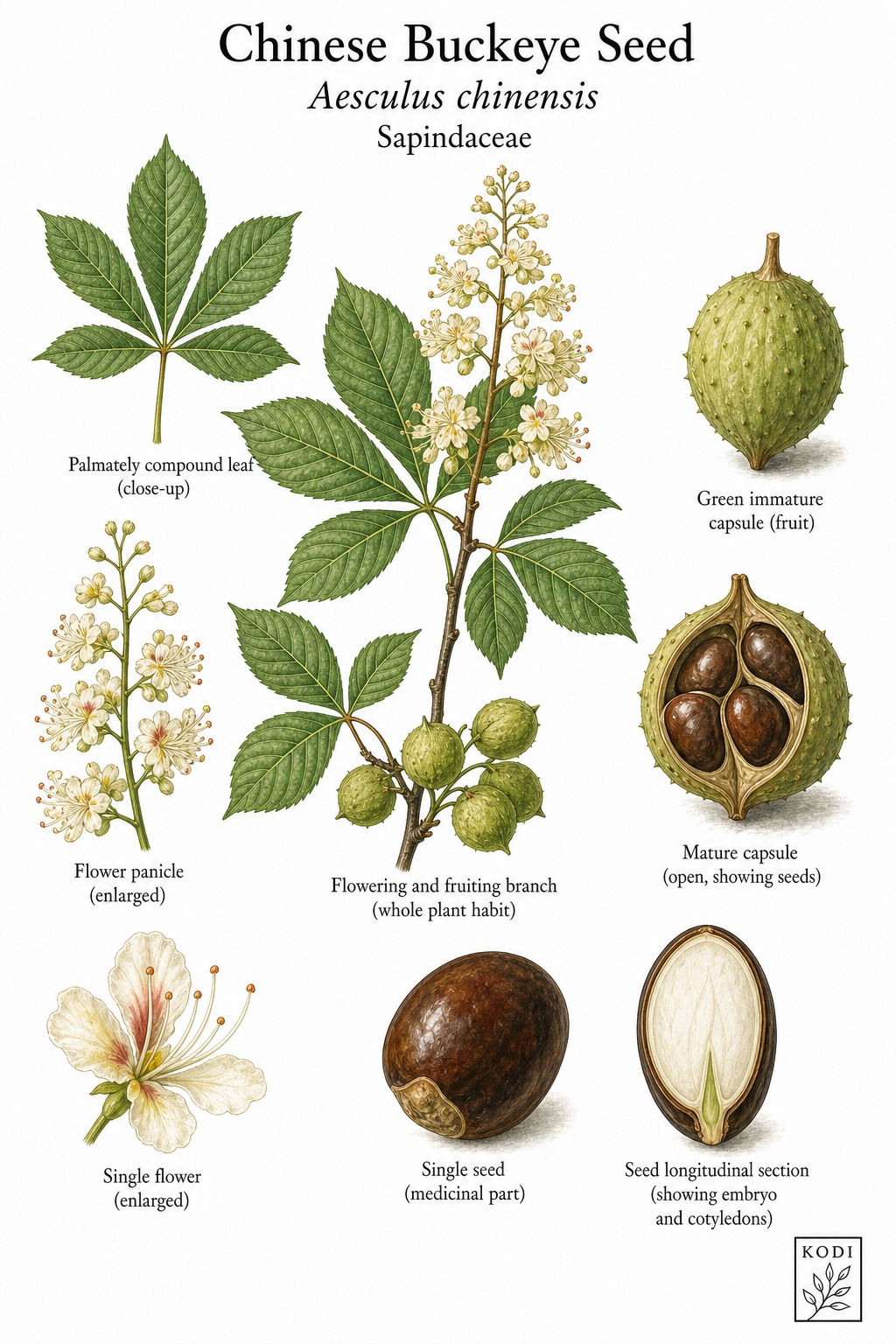
Known in TCM as Suo Luo Zi (娑罗子), this sweet, warm herb enters the Liver and Stomach. Traditionally, it regulates Liver and Stomach Qi while soothing the Middle Burner - used for epigastric pain, abdominal distention, chest oppression, and hypochondriac discomfort when constrained Liver Qi attacks the Stomach, most often applied for abdominal pain, chest pain, and intestinal parasites. Modern research has identified Escin among its active constituents.
Part used: Seed
Also Known As
Latin: Semen Aesculi | Pinyin: Suo Luo Zi | Chinese: 娑罗子
TCM Properties
- Taste
- sweet
- Temperature
- warm
- Channels
- Liver, Stomach
Traditional Use
Primary Actions
- Regulates Liver and Stomach Qi while soothing the Middle Burner - used for epigastric pain, abdominal distention, chest oppression, and hypochondriac discomfort when constrained Liver Qi attacks the Stomach.
- Harmonizes the Stomach and alleviates pain - a small but reliable qi-regulating seed for chronic stomachache, poor digestion, and a stifling sensation in the upper abdomen that improves when stagnant Qi begins to descend.
- Relieves chest and breast distention from constrained Qi - especially applied when emotional or premenstrual Liver Qi stagnation produces flank tension, breast fullness, or diaphragmatic tightness.
- Kills intestinal parasites - a lesser but still recorded traditional use when abdominal discomfort, malnutrition, or intestinal irritation is linked with parasitic infestation.
Secondary Actions
- Materia medica sources describe Suo Luo Zi as particularly good for stubborn Stomach pain, which sets it apart from more commonly used citrus qi regulators that are broader but sometimes less focused on epigastric pain.
- Its clinical profile sits between qi-regulating fruit and seed medicine: it moves constrained Qi, eases pain, and supports the Middle Burner without the stronger drying or dispersing action of harsher aromatic regulators.
Classic Formulas
- Suo Luo Zi with Fo Shou and Ba Yue Zha - a traditional qi-regulating combination for chest, hypochondriac, and epigastric distention from Liver-Stomach disharmony, especially when appetite is reduced and pain is worsened by emotional constraint.
- Suo Luo Zi with Lu Lu Tong, Yu Jin, and Xiang Fu - used in materia medica pairing traditions for premenstrual breast distention and painful constrained Liver Qi with concurrent upper abdominal stagnation.
Classical References
- American Dragon records Suo Luo Zi as sweet and warm, entering the Liver and Stomach to regulate Qi, relieve the Middle Jiao, descend rebellious Qi, and stop epigastric pain while also retaining a classical antiparasitic use.
- TCM Wiki lists the seed under 娑罗子 / 娑羅子 and summarizes the traditional actions as harmonizing the Stomach, regulating Qi, alleviating pain, and killing parasites, with qi and yin deficiency as the main constitutional caution.
- Modern herb-genomics work on Aesculus wilsonii notes that the 2020 Pharmacopoeia of the People's Republic of China recognizes the seeds of Aesculus wilsonii, Aesculus chinensis, and Aesculus chekiangensis as medicinal sources of Semen Aesculi (Suo Luo Zi), used for dyspnea, abdominal distention, and epigastralgia.
Modern Research
Active Compounds
- Escin or aescin (triterpenoid saponin mixture) - the best known anti-inflammatory and anti-edematous constituent class shared across medicinal Aesculus seeds
- Aesculin (coumarin glycoside) - a seed constituent relevant to both pharmacology and bleeding-risk discussions in related horse chestnut literature
- Aesculetin (coumarin aglycone) - a related phenolic compound with anti-inflammatory and vascular research interest
- Aeswilosides I-IV (triterpenoid glycosides) - newly described seed constituents from Aesculus wilsonii investigated for nitric-oxide-suppressing activity
- Quercetin and kaempferol glycosides (flavonoids) - supportive antioxidant and anti-inflammatory constituents reported in Semen Aesculi chemistry summaries
Studied Effects
- Seed-specific anti-inflammatory screening - compounds isolated from Aesculus wilsonii, explicitly identified as Suo Luo Zi, showed concentration-dependent inhibition of nitric oxide release in LPS-stimulated RAW264.7 macrophages (PMID 38474647)
- Acute anti-inflammatory and intestinal protection - oral escin reduced acute inflammation and lessened intestinal mucosal injury in animal models, providing a modern correlate to the herb's abdominal and Middle Burner applications (PMID 26199634)
- Gastroprotective activity - Aesculus hippocastanum seed extract ameliorated experimentally induced gastric ulcer in rats, improving oxidative stress markers and mucosal injury, which supports broader Aesculus seed research relevant to epigastric pain patterns (PMID 37079159)
- Mechanistic review work - escin has been summarized as exerting glucocorticoid-like anti-inflammatory and anti-edematous effects without classic steroid adverse-event patterns in the review literature (PMID 33658760)
PubMed References
- Potential Anti-Inflammatory Constituents from Aesculus wilsonii Seeds (2024)
- Oral Administration of Escin Inhibits Acute Inflammation and Reduces Intestinal Mucosal Injury in Animal Models (2015)
- Phytochemical Estimation and Therapeutic Amelioration of Aesculus hippocastanum L. Seeds Ethanolic Extract in Gastric Ulcer in Rats Possibly by Inhibiting Prostaglandin Synthesis (2023)
- Glucocorticoid-Like Activity of Escin: A New Mechanism for an Old Drug (2021)
Safety & Interactions
Contraindications
- Qi deficiency without significant stagnation
- Yin deficiency with dryness, irritability, or depleted fluids
Cautions
- Raw or improperly prepared Aesculus seeds can be irritating and toxic; medicinal use depends on correct identification and processing rather than casual food-style consumption
- Patients with compromised renal or hepatic function should avoid unsupervised use of related Aesculus seed extracts
- SAFETY NOTE: no exact Memorial Sloan Kettering monograph for Suo Luo Zi was found; the cautions below use MSK's horse chestnut monograph as the closest seed-level Aesculus reference and should be interpreted as related-species guidance rather than exact species-confirmed Suo Luo Zi data
Drug Interactions
- Anticoagulants and antiplatelet drugs … Related horse chestnut seed products that contain aesculin may have additive anticoagulant effects and increase bleeding risk (Moderate) Source: Memorial Sloan Kettering Integrative Medicine - Horse Chestnut (Aesculus hippocastanum), used as the closest related Aesculus seed reference
- CYP1A2, CYP2C9, CYP3A4, and other CYP450 substrate drugs … Aescin both inhibited and induced multiple CYP enzymes in animal studies and may alter intracellular concentrations or side-effect risk of affected drugs (Moderate) Source: Memorial Sloan Kettering Integrative Medicine - Horse Chestnut (Aesculus hippocastanum), used as the closest related Aesculus seed reference
Conditions
- Abdominal Pain Traditional ★★★★☆ JSON
- Chest Pain Traditional ★★★☆☆ JSON
- Intestinal Parasites Traditional ★★☆☆☆ JSON
- Gastric Ulcer Preclinical ★★☆☆☆ JSON
- Gastroenteritis Traditional ★☆☆☆☆ JSON
Frequently Asked Questions
What is Chinese Buckeye Seed used for?
Chinese Buckeye Seed is traditionally used to Regulates Liver and Stomach Qi while soothing the Middle Burner - used for epigastric pain, abdominal distention, chest oppression, and hypochondriac discomfort when constrained Liver Qi attacks the Stomach., Harmonizes the Stomach and alleviates pain - a small but reliable qi-regulating seed for chronic stomachache, poor digestion, and a stifling sensation in the upper abdomen that improves when stagnant Qi begins to descend., Relieves chest and breast distention from constrained Qi - especially applied when emotional or premenstrual Liver Qi stagnation produces flank tension, breast fullness, or diaphragmatic tightness., Kills intestinal parasites - a lesser but still recorded traditional use when abdominal discomfort, malnutrition, or intestinal irritation is linked with parasitic infestation.. Research has investigated its effects on: Seed-specific anti-inflammatory screening - compounds isolated from Aesculus wilsonii, explicitly identified as Suo Luo Zi, showed concentration-dependent inhibition of nitric oxide release in LPS-stimulated RAW264.7 macrophages (PMID 38474647); Acute anti-inflammatory and intestinal protection - oral escin reduced acute inflammation and lessened intestinal mucosal injury in animal models, providing a modern correlate to the herb's abdominal and Middle Burner applications (PMID 26199634).
What are other names for Chinese Buckeye Seed?
Chinese Buckeye Seed is also known as Aesculi. In TCM: 娑罗子 (Suo Luo Zi); Semen Aesculi.
Is Chinese Buckeye Seed safe during pregnancy?
The safety of Chinese Buckeye Seed during pregnancy has not been established. Consult a qualified healthcare provider before use.
What are the contraindications for Chinese Buckeye Seed?
Chinese Buckeye Seed should not be used in: Qi deficiency without significant stagnation; Yin deficiency with dryness, irritability, or depleted fluids. Consult a qualified healthcare provider before use.
Does Chinese Buckeye Seed interact with any medications?
Chinese Buckeye Seed may interact with: Anticoagulants and antiplatelet drugs - Related horse chestnut seed products that contain aesculin may have additive anticoagulant effects and increase bleeding risk - (Moderate severity); CYP1A2, CYP2C9, CYP3A4, and other CYP450 substrate drugs - Aescin both inhibited and induced multiple CYP enzymes in animal studies and may alter intracellular concentrations or side-effect risk of affected drugs - (Moderate severity). Always inform your healthcare provider of any herbal supplements you are taking.