Borneol
- Chinese
- 冰片
- Pinyin
- Bing Pian
- Latin
- Borneolum Syntheticum
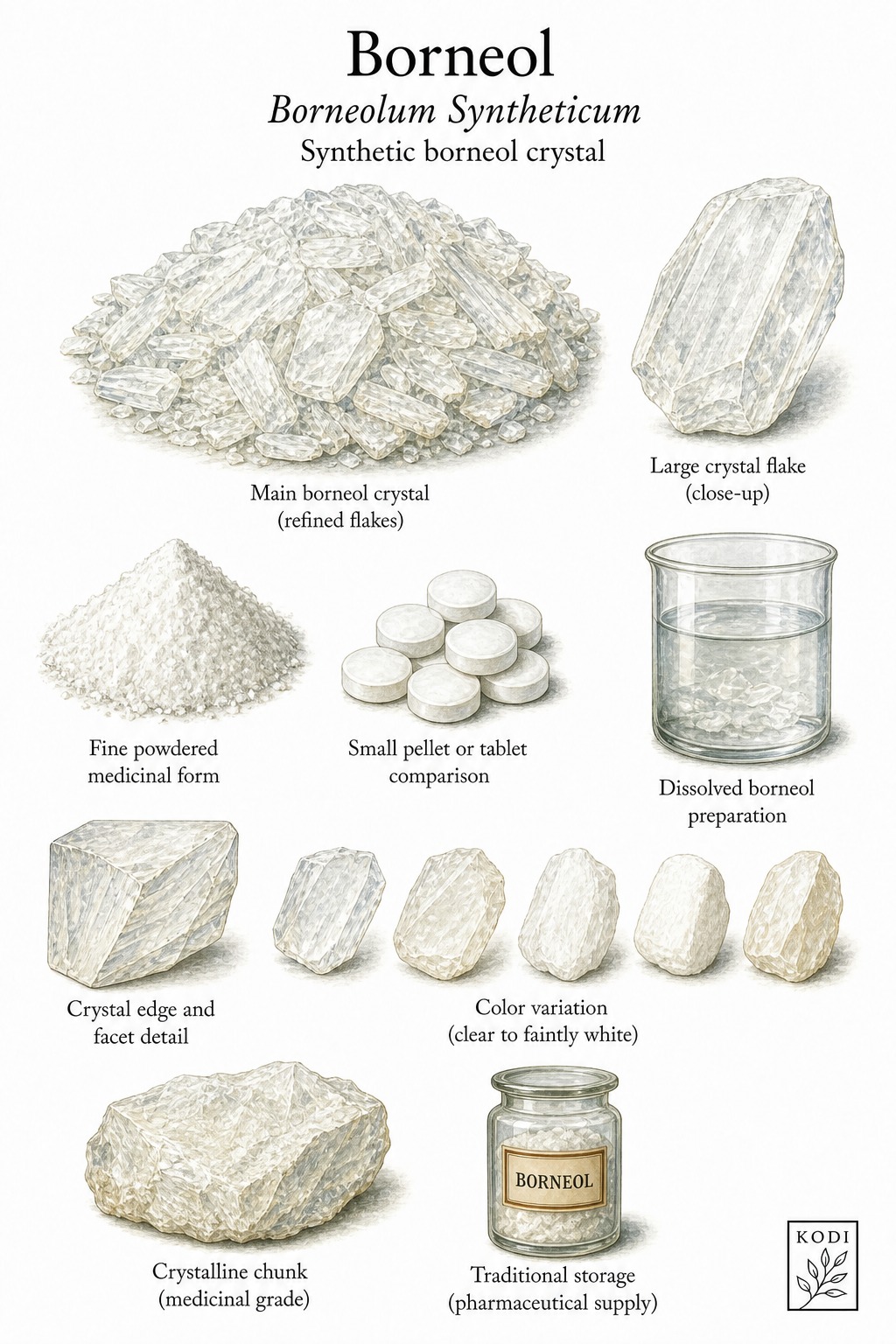
Known in TCM as Bing Pian (冰片), this acrid and bitter, cool herb enters the Heart, Lung, and Spleen. Traditionally, it opens the orifices and revives consciousness - classically used in closed heat patterns with stroke, sudden collapse, delirium, convulsions, or high fever when turbid heat or phlegm blocks the Heart orifices, most often applied for stroke, pharyngitis, and mouth sores. Modern research has identified (+)-Borneol among its active constituents.
Part used: Borneol crystal
Also Known As
Latin: Borneolum Syntheticum | Pinyin: Bing Pian | Chinese: 冰片
TCM Properties
- Taste
- acrid, bitter
- Temperature
- cool
- Channels
- Heart, Lung, Spleen
Traditional Use
Primary Actions
- Opens the orifices and revives consciousness - classically used in closed heat patterns with stroke, sudden collapse, delirium, convulsions, or high fever when turbid heat or phlegm blocks the Heart orifices.
- Clears Heat and resolves toxicity - applied for sore throat, mouth ulcers, swollen gums, and painful oral lesions where direct cooling, aromatic penetration, and pain relief are needed.
- Brightens the eyes and removes superficial visual obstruction - used in powders or topical preparations for red painful eyes, corneal haze, and heat-type eye inflammation.
- Reduces swelling, alleviates pain, and promotes tissue regeneration - extended to skin sores, burns, suppurative lesions, and other external disorders where rapid topical penetration is valuable.
Secondary Actions
- Bing Pian is used in extremely small doses and is not decocted because its volatile aromatic constituents would be lost with prolonged boiling.
- In many formulas it acts as a guide substance, helping the actions of companion medicinals reach the brain, throat, eyes, or diseased surface tissue more efficiently.
Classic Formulas
- An Gong Niu Huang Wan (安宫牛黄丸) - classic heat-closing emergency formula in which Bing Pian helps open the orifices and restore consciousness in high-fever delirium, stroke, and severe phlegm-heat obstruction.
- Su He Xiang Wan (苏合香丸) - classic cold-closing orifice-opening formula where Bing Pian contributes aromatic penetration and revival of consciousness despite the formula's warmer overall profile.
- Bing Peng San (冰硼散) - topical borneol-borax powder from Wai Ke Zheng Zong for sore throat, oral ulcers, gum pain, and heat-toxic lesions of the mouth and throat.
- Zhi Bao Dan (至宝丹) - one of the major orifice-opening emergency pills, using Bing Pian to help clear heat, disperse turbidity, and restore sensory function in closed patterns.
Classical References
- Sacred Lotus and Me & Qi agree that Bing Pian is acrid, bitter, and cool, entering the Heart, Lung, and Spleen channels with a core role in opening the orifices and relieving topical heat pain.
- FORM NOTE: historical and modern materia medica distinguish natural borneol, l-borneol, and synthetic borneol; this record retains the commonly traded synthetic form named in the source file while describing the broader Bing Pian therapeutic tradition.
- Traditional preparation notes emphasize that Bing Pian is added to pills, powders, and topical preparations rather than long decoctions because the aromatic crystals are volatile.
Modern Research
Active Compounds
- (+)-Borneol (monoterpene alcohol) - the principal aromatic constituent responsible for much of Bing Pian's classic cooling and analgesic activity
- Isoborneol (monoterpene isomer) - a companion constituent especially relevant to synthetic borneol preparations and systemic metabolism studies
- L-borneol (stereochemical form) - one of the clinically discussed natural borneol forms with distinct pharmacologic comparisons in review literature
- D-borneol (stereochemical form) - another recognized clinical form included in modern safety and activity comparisons
- Circulating borneol metabolites (phase I and conjugated metabolites) - increasingly recognized as important systemic mediators after oral use of Bing Pian
Studied Effects
- Topical analgesia - a randomized clinical and mechanistic study found that topical borneol produced greater postoperative pain relief than placebo and acted largely through TRPM8-linked pathways (PMID 28396565)
- Neuroprotection in ischemia models - (+)-borneol reduced inflammatory cytokine production and protected against permanent cerebral ischemic injury in rats, supporting the herb's long association with acute closed disorders (PMID 28808202)
- Blood-brain barrier modulation - preclinical review literature found borneol can regulate blood-brain barrier permeability in experimental ischemic stroke, helping explain its long-standing role as a messenger or guide substance (PMID 30863478)
- Stereochemical safety and pharmacology review - modern review work compares l-borneol, d-borneol, and synthetic borneol, concluding that different forms show overlapping but non-identical activity and safety profiles in clinical use (PMID 37321057)
PubMed References
- A clinical and mechanistic study of topical borneol-induced analgesia (2017)
- (+)-Borneol is neuroprotective against permanent cerebral ischemia in rats by suppressing production of proinflammatory cytokines (2017)
- Borneol for Regulating the Permeability of the Blood-Brain Barrier in Experimental Ischemic Stroke: Preclinical Evidence and Possible Mechanism (2019)
- Comparison of pharmacological activity and safety of different stereochemical configurations of borneol: L-borneol, D-borneol, and synthetic borneol (2023)
Safety & Interactions
Contraindications
- Pregnancy
- Use without a true closed-obstruction, heat-toxic, or topical excess pattern
Cautions
- Bing Pian is used only in very small internal doses because toxicity can appear at relatively low multiples of the clinical dose
- Do not decoct it in boiling formulas because the volatile aromatic fraction will be lost
- Topical overuse can irritate delicate mucosa, eyes, or broken skin despite its pain-relieving reputation
- MSK page not found - drug interaction data not available from Memorial Sloan Kettering integrative medicine database
Conditions
- Stroke Traditional ★★★★☆ JSON
- Pharyngitis Traditional ★★★★☆ JSON
- Mouth Sores Traditional ★★★☆☆ JSON
- Conjunctivitis Traditional ★★★☆☆ JSON
- Epilepsy Traditional ★★★☆☆ JSON
Frequently Asked Questions
What is Borneol used for?
Borneol is traditionally used to Opens the orifices and revives consciousness - classically used in closed heat patterns with stroke, sudden collapse, delirium, convulsions, or high fever when turbid heat or phlegm blocks the Heart orifices., Clears Heat and resolves toxicity - applied for sore throat, mouth ulcers, swollen gums, and painful oral lesions where direct cooling, aromatic penetration, and pain relief are needed., Brightens the eyes and removes superficial visual obstruction - used in powders or topical preparations for red painful eyes, corneal haze, and heat-type eye inflammation., Reduces swelling, alleviates pain, and promotes tissue regeneration - extended to skin sores, burns, suppurative lesions, and other external disorders where rapid topical penetration is valuable.. Research has investigated its effects on: Topical analgesia - a randomized clinical and mechanistic study found that topical borneol produced greater postoperative pain relief than placebo and acted largely through TRPM8-linked pathways (PMID 28396565); Neuroprotection in ischemia models - (+)-borneol reduced inflammatory cytokine production and protected against permanent cerebral ischemic injury in rats, supporting the herb's long association with acute closed disorders (PMID 28808202).
What are other names for Borneol?
Borneol is also known as Syntheticum. In TCM: 冰片 (Bing Pian); Borneolum Syntheticum.
Is Borneol safe during pregnancy?
Borneol is not recommended during pregnancy.
What are the contraindications for Borneol?
Borneol should not be used in: Pregnancy; Use without a true closed-obstruction, heat-toxic, or topical excess pattern. Consult a qualified healthcare provider before use.