Borax
- Chinese
- 硼砂
- Pinyin
- Peng Sha
- Latin
- Borax
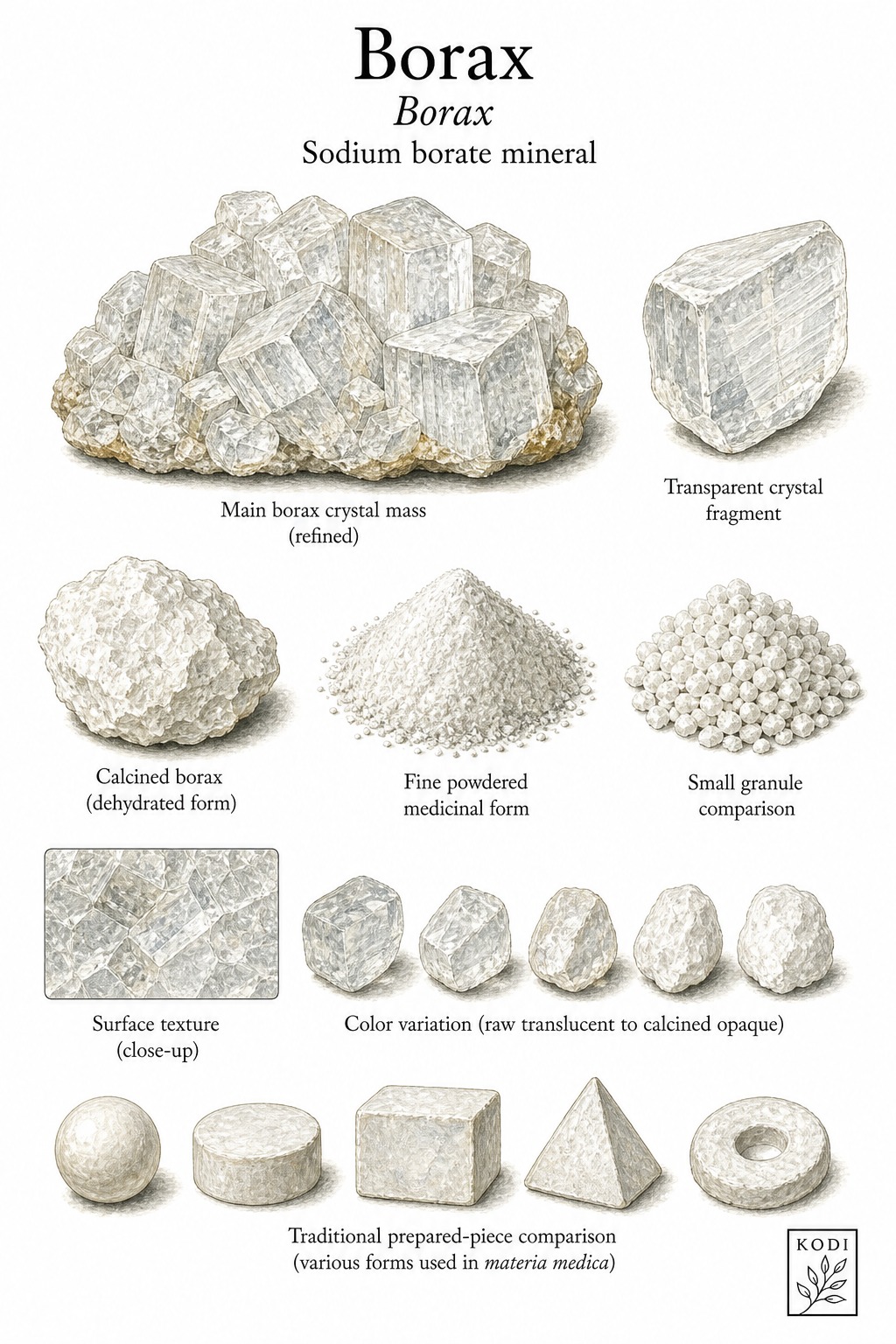
Known in TCM as Peng Sha (硼砂), this sweet and salty, cool herb enters the Lung and Stomach. Traditionally, it clears Heat and resolves toxicity for external use - classically applied to sore throat, swollen painful tonsils, aphthous ulcers, gum erosion, and oral lesions where heat toxin and swelling are prominent, most often applied for mouth sores, pharyngitis, and tonsillitis. Modern research has identified Sodium among its active constituents.
Part used: Borax
TCM Properties
- Taste
- sweet, salty
- Temperature
- cool
- Channels
- Lung, Stomach
Traditional Use
Primary Actions
- Clears Heat and resolves toxicity for external use - classically applied to sore throat, swollen painful tonsils, aphthous ulcers, gum erosion, and oral lesions where heat toxin and swelling are prominent.
- Promotes tissue regeneration and prevents putrefaction - especially in calcined form for chronic sores, ulcerated tissue, and lesions that need both antiseptic drying and healing support.
- Clears Lung Heat and transforms phlegm - a secondary internal use for productive cough with thick yellow sputum, especially when throat swelling or toxin-heat accompanies the phlegm.
- Brightens the eyes and removes superficial visual obstructions - used in eye washes or powders for red painful eyes, corneal nebulae, and heat-type conjunctival irritation.
Secondary Actions
- Raw Peng Sha emphasizes clearing heat-toxin and dissolving putrescence, while calcined Duan Peng Sha is more astringent and is preferred for drying weeping lesions and promoting closure.
- Modern practice overwhelmingly favors external application because internal use has a narrow safety window and cumulative toxicity.
Classic Formulas
- Bing Peng San (冰硼散) - from Wai Ke Zheng Zong, a classic topical powder with Bing Pian, Xuan Ming Fen, and traditionally Zhu Sha for sore throat, mouth ulcers, gum pain, and heat-toxic oral lesions.
- Yu Yao Shi (玉钥匙) - classical throat-opening powder traditions use Peng Sha as a leading ingredient for severe wind-heat throat obstruction, swelling, and phlegm blocking the throat.
- Bai Long Dan (白龙丹) - classical ophthalmic powder traditions combine Peng Sha with Bing Pian, Lu Gan Shi, and related eye-clearing substances for red swollen painful eyes and superficial corneal opacity.
Classical References
- IMPORT NOTE: the source XLSX used the distorted Latin 'Sal Sedatirum'. Sacred Lotus and Me & Qi both identify the medicinal substance straightforwardly as Borax, the refined borate mineral known in Chinese medicine as Peng Sha.
- Me & Qi preserves the classical saying 'raw form dissolves decay; calcined form regenerates tissue,' capturing the traditional distinction between unprocessed and calcined Peng Sha.
- Historical context recorded by Me & Qi places Peng Sha in the Ri Hua Zi Ben Cao tradition, with later materia medica expanding its use in throat, mouth, ophthalmic, and selected phlegm-heat disorders.
Modern Research
Active Compounds
- Sodium tetraborate decahydrate (hydrated sodium borate mineral) - the principal chemical identity of medicinal borax
- Borate ions (boron-containing inorganic species) - the reactive boron fraction underlying much of borax chemistry
- Boric acid (boron compound formed in aqueous and biologic contexts) - the most commonly studied topical boron species in modern biomedical literature relevant to Peng Sha
- Sodium ions (electrolyte component) - contribute to the mineral's chemical behavior and systemic load in internal exposure
Studied Effects
- Toxicology review literature emphasizes that boric acid, borax, and related boron compounds have clear dose-dependent toxicity, with reproductive and renal safety concerns dominating modern risk assessment rather than routine internal medicinal use (PMID 33485927)
- Periodontal anti-inflammatory activity - boric acid reduced alveolar bone loss while diminishing bone resorption and supporting osteoblast activity in rat periodontitis models, offering a modern correlate to Peng Sha's traditional use in inflamed oral tissues (PMID 33505614)
- Gingival inflammation modulation - boric acid reduced inflammatory signaling and oxidative stress responses in IL-1beta-stimulated human gingival fibroblasts, supporting continued research in oral inflammatory disease (PMID 38692230)
- Wound-healing review literature summarizes antimicrobial, anti-inflammatory, antioxidant, and tissue-regenerative actions across boron compounds, explaining why topical borate preparations continue to attract interest in chronic wound care (PMID 39539690)
PubMed References
- Toxicity of boric acid, borax and other boron containing compounds: A review (2021)
- Boric acid inhibits alveolar bone loss in rat experimental periodontitis through diminished bone resorption and enhanced osteoblast formation (2020)
- Boric acid alleviates periodontal inflammation induced by IL-1beta in human gingival fibroblasts (2024)
- Boron in wound healing: a comprehensive investigation of its diverse mechanisms (2024)
Safety & Interactions
Contraindications
- Pregnancy
- Breastfeeding when internal use is being considered
- Liver or kidney impairment
- Long-term internal use
- Yin deficiency with marked dryness or fluid depletion
Cautions
- Peng Sha is a slightly toxic borate mineral best reserved for external use or strictly supervised short-term internal use in powder or pill form only
- Reported adult toxic oral exposure begins in the low-gram range, and infant toxicity thresholds are much lower
- Only refined medicinal-grade borax should be used; industrial borax may carry impurity and heavy-metal risks
- No Memorial Sloan Kettering herb page was found, so this record does not assign herb-drug interactions beyond established toxicology concerns
Conditions
- Mouth Sores Traditional ★★★★★ JSON
- Pharyngitis Traditional ★★★★☆ JSON
- Tonsillitis Traditional ★★★★☆ JSON
- Conjunctivitis Traditional ★★★☆☆ JSON
- Productive Cough Traditional ★★☆☆☆ JSON
Frequently Asked Questions
What is Borax used for?
Borax is traditionally used to Clears Heat and resolves toxicity for external use - classically applied to sore throat, swollen painful tonsils, aphthous ulcers, gum erosion, and oral lesions where heat toxin and swelling are prominent., Promotes tissue regeneration and prevents putrefaction - especially in calcined form for chronic sores, ulcerated tissue, and lesions that need both antiseptic drying and healing support., Clears Lung Heat and transforms phlegm - a secondary internal use for productive cough with thick yellow sputum, especially when throat swelling or toxin-heat accompanies the phlegm., Brightens the eyes and removes superficial visual obstructions - used in eye washes or powders for red painful eyes, corneal nebulae, and heat-type conjunctival irritation.. Research has investigated its effects on: Toxicology review literature emphasizes that boric acid, borax, and related boron compounds have clear dose-dependent toxicity, with reproductive and renal safety concerns dominating modern risk assessment rather than routine internal medicinal use (PMID 33485927); Periodontal anti-inflammatory activity - boric acid reduced alveolar bone loss while diminishing bone resorption and supporting osteoblast activity in rat periodontitis models, offering a modern correlate to Peng Sha's traditional use in inflamed oral tissues (PMID 33505614).
Is Borax safe during pregnancy?
Borax is not recommended during pregnancy.
What are the contraindications for Borax?
Borax should not be used in: Pregnancy; Breastfeeding when internal use is being considered; Liver or kidney impairment; Long-term internal use; Yin deficiency with marked dryness or fluid depletion. Consult a qualified healthcare provider before use.