Boat-Fruited Sterculia Seed
- Chinese
- 胖大海
- Pinyin
- Pang Da Hai
- Latin
- Semen Sterculiae Lychnophorae
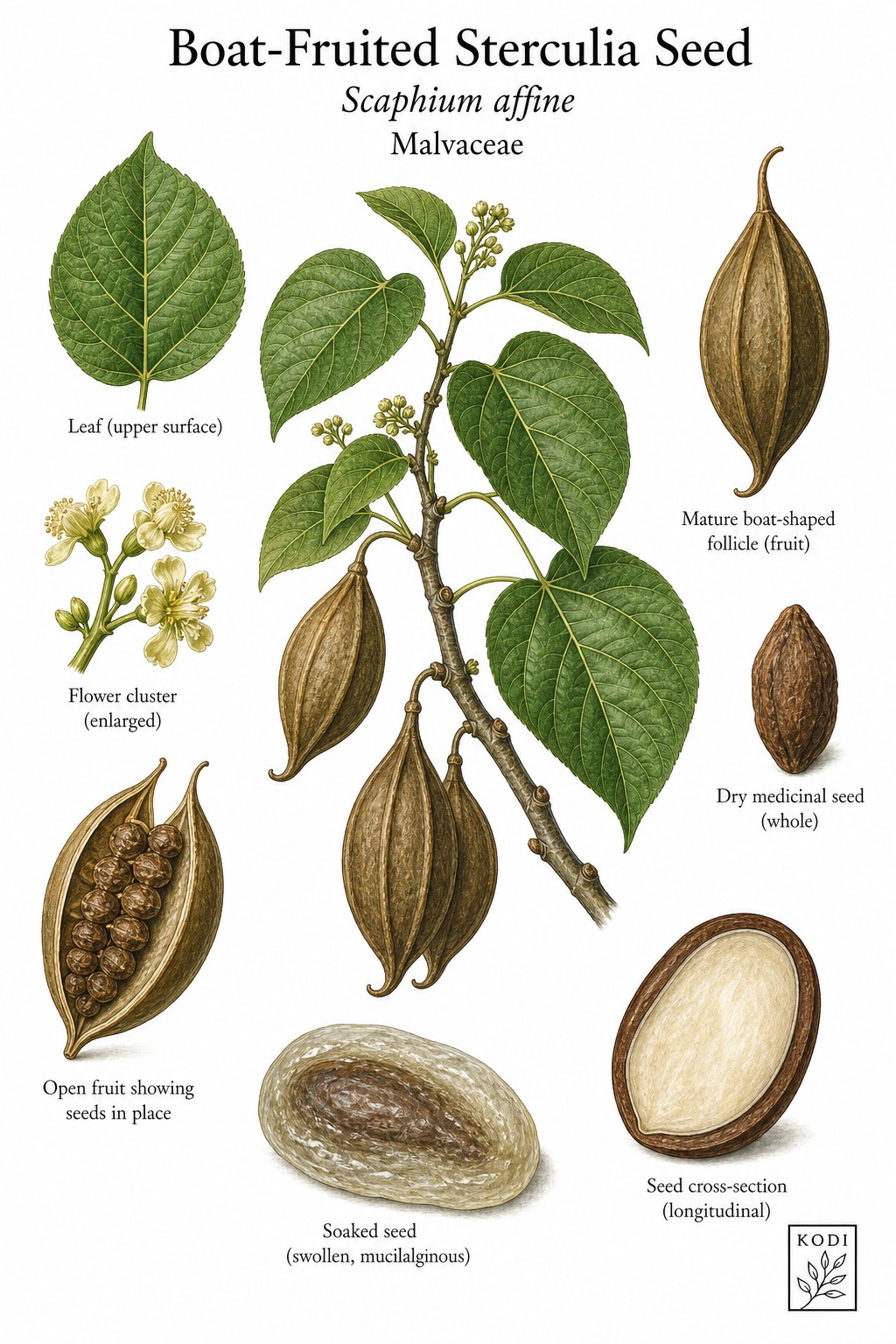
Known in TCM as Pang Da Hai (胖大海), this sweet, cold herb enters the Large Intestine and Lung. Traditionally, it clears Lung Heat and gently disseminates Lung Qi - classically used for sore throat, hoarseness, sudden voice loss, and cough when dry or constrained heat has scorched the throat and upper airway, most often applied for pharyngitis, tonsillitis, and constipation. Modern research has identified PPIII among its active constituents.
Part used: Seed
Also Known As
Latin: Semen Sterculiae Lychnophorae | Pinyin: Pang Da Hai | Chinese: 胖大海
TCM Properties
- Taste
- sweet
- Temperature
- cold
- Channels
- Large Intestine, Lung
Traditional Use
Primary Actions
- Clears Lung Heat and gently disseminates Lung Qi - classically used for sore throat, hoarseness, sudden voice loss, and cough when dry or constrained heat has scorched the throat and upper airway.
- Benefits the throat while moistening dryness - especially valued for singers, speakers, and post-febrile patients whose voice becomes rough, dry, or painful from Lung Heat or depleted throat fluids.
- Moistens the Intestines and unblocks the bowels - used for mild constipation with dry stool, headache, red eyes, or heat lodged in the Intestines when a lubricating seed is preferred over harsher purgatives.
- Encourages the full expression of rashes - occasionally applied as an external wash when venting the surface and relieving residual heat are both desired.
Secondary Actions
- Because the seed swells dramatically in hot water and releases a mucilaginous infusion, Pang Da Hai is often prepared as a simple soak or tea rather than as a major boiled decoction herb.
- It sits between throat herb and food-medicine item in modern use, which explains why it is commonly taken for acute voice strain even outside elaborate formula contexts.
Classic Formulas
- Qing Yan Li Ge Tang (清咽利膈汤) - classical throat-cooling formula traditions add Pang Da Hai when sore throat, hoarseness, and phlegm-heat congestion need stronger throat-opening and voice-restoring support.
- Throat-soothing infusion traditions often combine Pang Da Hai with Jie Geng and Xuan Shen for hoarseness, painful dryness, and voice loss after heat or excessive speaking, reflecting its long practical role even when not the chief herb of a major canonical decoction.
Classical References
- Sacred Lotus and Me & Qi agree that Pang Da Hai is sweet and cold, enters the Lung and Large Intestine, and is used chiefly for hoarseness, sore throat, dry cough, and mild heat constipation.
- Modern pharmacognosy sources note that older literature often records the drug under Sterculia lychnophora Hance, while more recent botanical usage also recognizes Scaphium affine as the accepted species name or synonym in trade references.
- Traditional practice commonly uses only a few seeds steeped in hot water, which helps explain why Pang Da Hai has a strong practical reputation for throat complaints despite a lighter standalone formula history than major classical cough herbs.
Modern Research
Active Compounds
- PPIII polysaccharide (mucilaginous polysaccharide) - a galactose, arabinose, and rhamnose-rich fraction that helps explain the seed's swelling, demulcent, and bowel-moistening behavior
- Sterculinine I (alkaloid) - one of the named alkaloids isolated from Pang Da Hai seed extract
- Sterculinine II (alkaloid) - companion alkaloid identified in ethanol extracts of the seeds
- Linoleic acid (polyunsaturated fatty acid) - the dominant reported fatty acid in seed GC-MS profiling
- Palmitic and oleic acids (fatty acids) - major lipid constituents that contribute to seed chemistry and nutritional pharmacognosy
Studied Effects
- Traditional-use review literature concluded that Pangdahai water decoctions rich in polar polysaccharides support the herb's long-standing use for pharyngitis, cough, constipation, and throat irritation, while organic extracts show anti-inflammatory, anti-ulcer, antimicrobial, and analgesic potential in preclinical work (PMID 30322606)
- Fatty acid synthase inhibition - Pangdahai extract inhibited FASN and reduced food intake and adipose accumulation in rat work, suggesting anti-obesity and metabolic research potential beyond its classical throat use (PMID 18380011)
- Polysaccharide characterization - aqueous extraction isolated the PPIII fraction composed mainly of galactose, arabinose, and rhamnose, providing a chemical basis for the seed's mucilaginous, soothing infusion profile (PMID 8703352)
- Constituent profiling - GC-MS analysis identified 21 fatty acids, with linoleic, palmitic, oleic, and stearic acids predominating, expanding the modern chemical map of the seed (PMID 15015334)
PubMed References
- Ethnopharmacology, phytochemistry, and pharmacology of Sterculia lychnophora Hance (Pangdahai) (2018)
- The novel inhibitory effect of Pangdahai on fatty acid synthase (2008)
- [Purification and properties of polysaccharide PPIII from Sterculia lychnophora Hance] (1996)
- Alkaloids from the seeds of Sterculia lychnophora (Pangdahai) (2003)
- [Analysis of fatty acids in the seeds of Sterculia lychnophora by GC-MS] (2003)
Safety & Interactions
Contraindications
- Diarrhea or loose stools
- Spleen deficiency with cold-damp digestive weakness
- Cold-pattern constipation without heat signs
Cautions
- Use with caution during pregnancy because its cold, slippery, laxative nature may aggravate intestinal movement and is not routinely self-prescribed during gestation
- Possible overdose symptoms reported in materia medica references include poor balance and respiratory depression
- Because the seed expands markedly after soaking, it is best used as a properly prepared infusion rather than swallowed in a dry or poorly hydrated form
- MSK page not found - drug interaction data not available from Memorial Sloan Kettering integrative medicine database
Conditions
- Pharyngitis Traditional ★★★★☆ JSON
- Tonsillitis Traditional ★★★☆☆ JSON
- Constipation Traditional ★★★★☆ JSON
- Dry Cough Traditional ★★★☆☆ JSON
- Cough Traditional ★★☆☆☆ JSON
Frequently Asked Questions
What is Boat-Fruited Sterculia Seed used for?
Boat-Fruited Sterculia Seed is traditionally used to Clears Lung Heat and gently disseminates Lung Qi - classically used for sore throat, hoarseness, sudden voice loss, and cough when dry or constrained heat has scorched the throat and upper airway., Benefits the throat while moistening dryness - especially valued for singers, speakers, and post-febrile patients whose voice becomes rough, dry, or painful from Lung Heat or depleted throat fluids., Moistens the Intestines and unblocks the bowels - used for mild constipation with dry stool, headache, red eyes, or heat lodged in the Intestines when a lubricating seed is preferred over harsher purgatives., Encourages the full expression of rashes - occasionally applied as an external wash when venting the surface and relieving residual heat are both desired.. Research has investigated its effects on: Traditional-use review literature concluded that Pangdahai water decoctions rich in polar polysaccharides support the herb's long-standing use for pharyngitis, cough, constipation, and throat irritation, while organic extracts show anti-inflammatory, anti-ulcer, antimicrobial, and analgesic potential in preclinical work (PMID 30322606); Fatty acid synthase inhibition - Pangdahai extract inhibited FASN and reduced food intake and adipose accumulation in rat work, suggesting anti-obesity and metabolic research potential beyond its classical throat use (PMID 18380011).
What are other names for Boat-Fruited Sterculia Seed?
Boat-Fruited Sterculia Seed is also known as Sterculia. In TCM: 胖大海 (Pang Da Hai); Semen Sterculiae Lychnophorae.
Is Boat-Fruited Sterculia Seed safe during pregnancy?
The safety of Boat-Fruited Sterculia Seed during pregnancy has not been established. Consult a qualified healthcare provider before use.
What are the contraindications for Boat-Fruited Sterculia Seed?
Boat-Fruited Sterculia Seed should not be used in: Diarrhea or loose stools; Spleen deficiency with cold-damp digestive weakness; Cold-pattern constipation without heat signs. Consult a qualified healthcare provider before use.