Blackend Swallowwort Root
- Chinese
- 白薇
- Pinyin
- Bai Wei
- Latin
- Cynanchi Atrati Radix et Rhizoma
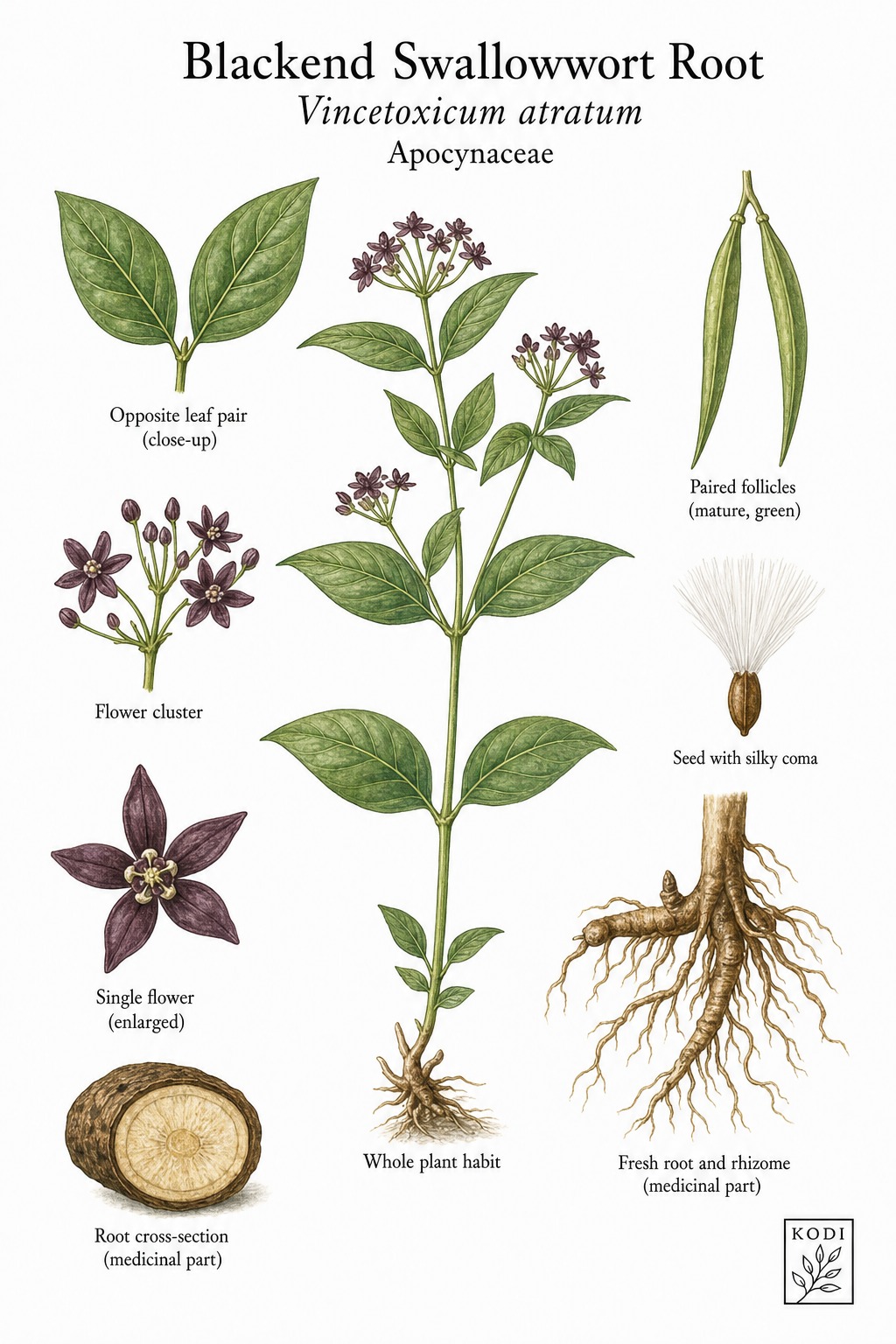
Known in TCM as Bai Wei (白薇), this bitter and salty, cold herb enters the Liver, Stomach, and Kidney. Traditionally, it clears deficiency heat and cools the Blood - classically used for lingering low-grade fever, postpartum or late-stage febrile disease, and steaming-bone or hidden heat patterns arising from yin-blood depletion, most often applied for fever, pharyngitis, and cough. Modern research has identified C21 among its active constituents.
Also Known As
Latin: Cynanchi Atrati Radix et Rhizoma | Pinyin: Bai Wei | Chinese: 白薇
TCM Properties
- Taste
- bitter, salty
- Temperature
- cold
- Channels
- Liver, Stomach, Kidney
Traditional Use
Primary Actions
- Clears deficiency heat and cools the Blood - classically used for lingering low-grade fever, postpartum or late-stage febrile disease, and steaming-bone or hidden heat patterns arising from yin-blood depletion.
- Clears heat from the nutritive level without trapping pathogens - especially valued after febrile disease when heat remains but the patient is already depleted and cannot tolerate harsh draining herbs.
- Promotes urination and unblocks painful urinary difficulty - extended to heat-type strangury or fluid obstruction when internal heat agitates the lower burner.
- Resolves toxin and benefits the throat - used for sore throat, carbuncles, and toxic swellings when heat toxin combines with blood-level irritation.
Secondary Actions
- Bai Wei has the unusual classical niche of treating both deficiency heat and unresolved pathogen patterns, making it useful when yin has been injured but lingering heat remains.
- This file keeps the imported English name, but the medicinal identity is the standard root and rhizome Bai Wei rather than a distinct herb called 'blackend swallowwort root.'
Classic Formulas
- Bai Wei Tang (白薇汤) - traditional formula lineage for postpartum or deficiency-complicated heat patterns, using Bai Wei to clear hidden heat without overly damaging the weakened patient.
- Qian Jin Wei Rui Tang (千金葳蕤汤) - from Qian Jin Fang, where Bai Wei helps address lingering heat and dryness after externally contracted illness in weakened patients.
Classical References
- Shen Nong Ben Cao Jing records Bai Wei for violent heat, body heat, and stubborn heat disorders, establishing its role in clearing hidden or chronic heat.
- Me and Qi and TCM Wiki describe Bai Wei as bitter, salty, and cold, entering the Liver, Stomach, and Kidney channels and treating deficiency heat, postpartum fever, painful urinary disorders, and toxic swellings.
- IMPORT NOTE: The English slug reflects an awkward spreadsheet translation, but the herb itself is the standard medicinal Bai Wei.
Modern Research
Active Compounds
- C21 steroidal glycosides such as cynatratosides (steroidal glycosides) - characteristic constituents repeatedly highlighted in Bai Wei phytochemistry
- Paeonol-like acetophenones and related phenolics (phenolics) - part of the root's anti-inflammatory and antioxidant chemistry
- Cynandione and related benzophenone derivatives (phenolic ketones) - bioactive components studied in Cynanchum atratum extracts
- Polysaccharides (polysaccharides) - contribute immunomodulatory and anti-inflammatory research interest
- Minor alkaloid and volatile constituents (mixed secondary metabolites) - broaden the modern pharmacologic picture beyond the glycoside fraction
Studied Effects
- A 2024 review summarized Bai Wei's phytochemistry, anti-inflammatory, hepatoprotective, antitumor, and immunomodulatory research while linking the data back to its traditional heat-clearing use (PMID 40374443)
- Broad pharmacology review work in 2021 similarly emphasized the anti-inflammatory, antioxidant, and fever-related relevance of Cynanchum atratum root constituents (PMID 34662666)
- Cynatratoside C inhibited inflammatory mediators in vitro and ameliorated experimental colitis in vivo, offering a mechanistic correlate for the herb's heat-clearing and toxin-resolving profile (PMID 29113806)
- Bai Wei extract reduced nonalcoholic fatty liver disease progression in a high-fat-diet model through AMPK activation and lipogenesis inhibition, expanding modern metabolic interest in the herb (PMID 35011585)
PubMed References
- Research Progress on the Quality Control, Phytochemistry, Pharmacology and Clinical Application of Cynanchi Atrati Radix et Rhizoma. (2024)
- A Review on Phytochemistry, Pharmacology, Toxicology, and Pharmacokinetics of Cynanchum atratum. (2021)
- Cynatratoside C from Cynanchum atratum inhibits LPS-induced inflammatory response via suppression of NF-κB and MAPKs and activation of Nrf2/HO-1 pathway in RAW264.7 cells and attenuates colitis in mice. (2017)
- Cynanchum atratum Alleviates Non-Alcoholic Fatty Liver by Balancing Lipogenesis and Fatty Acid Oxidation in a High-Fat, High-Fructose Diet Mice Model. (2022)
Safety & Interactions
Contraindications
- Cold from deficiency without Heat signs
- Loose stools or severe weakness of the middle burner not accompanied by lingering Heat
Cautions
- Because Bai Wei is cold and clears hidden heat, it should be matched to true heat or heat-toxin patterns rather than used generically for fatigue or postpartum weakness alone
- The herb is often chosen precisely because the patient is depleted, so dose and formula balance matter to avoid overcooling digestion
- MSK page not found - drug interaction data not available from Memorial Sloan Kettering integrative medicine database
Conditions
Frequently Asked Questions
What is Blackend Swallowwort Root used for?
Blackend Swallowwort Root is traditionally used to Clears deficiency heat and cools the Blood - classically used for lingering low-grade fever, postpartum or late-stage febrile disease, and steaming-bone or hidden heat patterns arising from yin-blood depletion., Clears heat from the nutritive level without trapping pathogens - especially valued after febrile disease when heat remains but the patient is already depleted and cannot tolerate harsh draining herbs., Promotes urination and unblocks painful urinary difficulty - extended to heat-type strangury or fluid obstruction when internal heat agitates the lower burner., Resolves toxin and benefits the throat - used for sore throat, carbuncles, and toxic swellings when heat toxin combines with blood-level irritation.. Research has investigated its effects on: A 2024 review summarized Bai Wei's phytochemistry, anti-inflammatory, hepatoprotective, antitumor, and immunomodulatory research while linking the data back to its traditional heat-clearing use (PMID 40374443); Broad pharmacology review work in 2021 similarly emphasized the anti-inflammatory, antioxidant, and fever-related relevance of Cynanchum atratum root constituents (PMID 34662666).
What are other names for Blackend Swallowwort Root?
Blackend Swallowwort Root is also known as Cynanchi. In TCM: 白薇 (Bai Wei); Cynanchi Atrati Radix et Rhizoma.
Is Blackend Swallowwort Root safe during pregnancy?
The safety of Blackend Swallowwort Root during pregnancy has not been established. Consult a qualified healthcare provider before use.
What are the contraindications for Blackend Swallowwort Root?
Blackend Swallowwort Root should not be used in: Cold from deficiency without Heat signs; Loose stools or severe weakness of the middle burner not accompanied by lingering Heat. Consult a qualified healthcare provider before use.