Black-Tail Snake
- Chinese
- 乌梢蛇
- Pinyin
- Wu Shao She
- Latin
- Zaocys
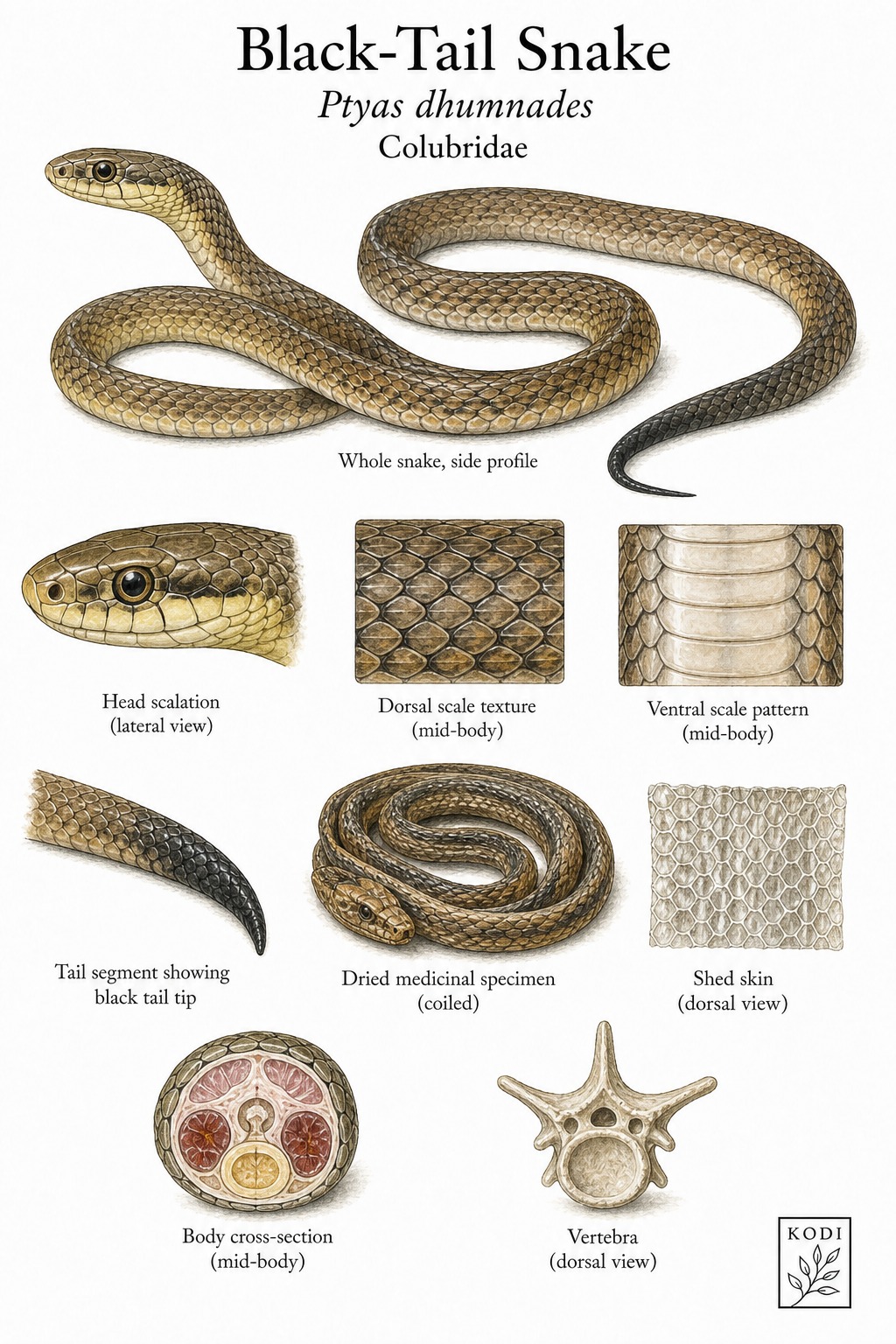
Known in TCM as Wu Shao She (乌梢蛇), this sweet, neutral herb enters the Liver. Traditionally, it dispels Wind-Damp and unblocks the collaterals - used for stubborn wind-damp arthralgia, numbness, spasms, and chronic weakness of the limbs when the channels need a penetrating animal medicinal, most often applied for joint pain, stroke, and eczema. Modern research has identified Collagen-rich among its active constituents.
Also Known As
Latin: Zaocys | Pinyin: Wu Shao She | Chinese: 乌梢蛇
TCM Properties
- Taste
- sweet
- Temperature
- neutral
- Channels
- Liver
Traditional Use
Primary Actions
- Dispels Wind-Damp and unblocks the collaterals - used for stubborn wind-damp arthralgia, numbness, spasms, and chronic weakness of the limbs when the channels need a penetrating animal medicinal.
- Extinguishes wind and stops convulsions - applied for childhood convulsions, tetanus, tremor, and post-stroke spasticity when internal wind lodges in the channels.
- Searches out wind to relieve itching - valued for rubella, pruritic skin disorders, and chronic itchy dermatoses that resist gentler wind-relieving herbs.
- Offers a milder snake-medicine option than toxic viper drugs - Wu Shao She is traditionally chosen when the practitioner wants the collateral-unblocking action of snake medicines without the stronger toxicity of Bai Hua She.
Secondary Actions
- Because it is neutral and non-toxic by classical comparison, Wu Shao She can be used more flexibly and for longer courses than more forceful venomous snake medicinals.
- It is often stir-baked with wine or made into powder to enhance channel-penetrating use in chronic Wind-Damp Bi and sequelae of windstroke.
Classic Formulas
- Da Huoluo Dan (大活络丹) - major wind-damp and stroke-sequelae formula in which Wu Shao She joins other animal and plant medicinals to dredge collaterals, alleviate pain, and calm internal wind.
- Classical snake-pair prescriptions combining Wu Shao She with Bai Hua She or Wu Gong - used when deeper channel wind, spasms, or resistant skin disease require stronger search-out action than plant medicinals alone.
Classical References
- TCM Wiki and Me and Qi describe Wu Shao She as sweet and neutral, entering the Liver channel and dispelling wind-damp, unblocking collaterals, stopping convulsions, and relieving itching.
- TCM Wiki specifically notes its use for long-standing wind-damp arthralgia, hemiplegia after windstroke, childhood convulsions, tetanus, and pruritic skin disease.
- Me and Qi contrasts Wu Shao She with more toxic snake medicinals and presents it as the gentler non-toxic snake option within the wind-damp category.
Modern Research
Active Compounds
- Collagen-rich structural proteins (animal proteins) - part of the dried-body matrix that underlies the powder and decoction material
- Bioactive peptides and amino acids (protein-derived constituents) - likely contributors to broad modern biochemical interest in animal medicinal substances
- Phospholipids and fatty acids (lipid fraction) - part of the whole-body nutrient and membrane matrix of the prepared snake material
- Trace minerals and connective-tissue matrix components (animal tissue matrix) - contribute to the complex profile of the dried-body medicinal
Studied Effects
- Modern PubMed literature on Wu Shao She is weighted more toward authentication and quality control than toward direct pharmacology; a PCR-based assay was developed specifically to verify Zaocys dhumnades in the medicinal trade (PMID 28035866)
- Conservation and sourcing have become increasingly important research themes - a 2023 barcoding study of Chinese snakes highlighted hidden diversity and the need for accurate species-level identification in medicinal use (PMID 36924341)
- Safety-oriented zoological research found very high Spirometra spargana prevalence in wild Zaocys dhumnades populations, underscoring why proper sourcing and processing matter for this animal medicinal (PMID 32103785)
PubMed References
- Development and evaluation of a PCR-based assay kit for authentication of Zaocys dhumnades in traditional Chinese medicine (2018)
- DNA barcoding of Chinese snakes reveals hidden diversity and conservation needs (2023)
- Prevalence and molecular characterization of Spirometra erinaceieuropaei spargana in snakes in Hunan Province, China (2020)
Safety & Interactions
Contraindications
- Severe Qi and Blood deficiency without concurrent Wind-Damp, spasm, or itching pathology
- Cases where a non-animal wind-damp herb would adequately address the presentation
Cautions
- Although Wu Shao She is considered non-toxic by traditional comparison, animal-derived material still requires careful sourcing, cleaning, and processing
- Wild-caught snakes may harbor parasites, so only properly processed medicinal-grade material should be used
- MSK page not found - drug interaction data not available from Memorial Sloan Kettering integrative medicine database
Conditions
Frequently Asked Questions
What is Black-Tail Snake used for?
Black-Tail Snake is traditionally used to Dispels Wind-Damp and unblocks the collaterals - used for stubborn wind-damp arthralgia, numbness, spasms, and chronic weakness of the limbs when the channels need a penetrating animal medicinal., Extinguishes wind and stops convulsions - applied for childhood convulsions, tetanus, tremor, and post-stroke spasticity when internal wind lodges in the channels., Searches out wind to relieve itching - valued for rubella, pruritic skin disorders, and chronic itchy dermatoses that resist gentler wind-relieving herbs., Offers a milder snake-medicine option than toxic viper drugs - Wu Shao She is traditionally chosen when the practitioner wants the collateral-unblocking action of snake medicines without the stronger toxicity of Bai Hua She.. Research has investigated its effects on: Modern PubMed literature on Wu Shao She is weighted more toward authentication and quality control than toward direct pharmacology; a PCR-based assay was developed specifically to verify Zaocys dhumnades in the medicinal trade (PMID 28035866); Conservation and sourcing have become increasingly important research themes - a 2023 barcoding study of Chinese snakes highlighted hidden diversity and the need for accurate species-level identification in medicinal use (PMID 36924341).
What are other names for Black-Tail Snake?
Black-Tail Snake is also known as Zaocys. In TCM: 乌梢蛇 (Wu Shao She); Zaocys.
Is Black-Tail Snake safe during pregnancy?
The safety of Black-Tail Snake during pregnancy has not been established. Consult a qualified healthcare provider before use.
What are the contraindications for Black-Tail Snake?
Black-Tail Snake should not be used in: Severe Qi and Blood deficiency without concurrent Wind-Damp, spasm, or itching pathology; Cases where a non-animal wind-damp herb would adequately address the presentation. Consult a qualified healthcare provider before use.