Magnetite
- Chinese
- 黑磁石
- Pinyin
- Hei Ci Shi
- Latin
- Magnetitum
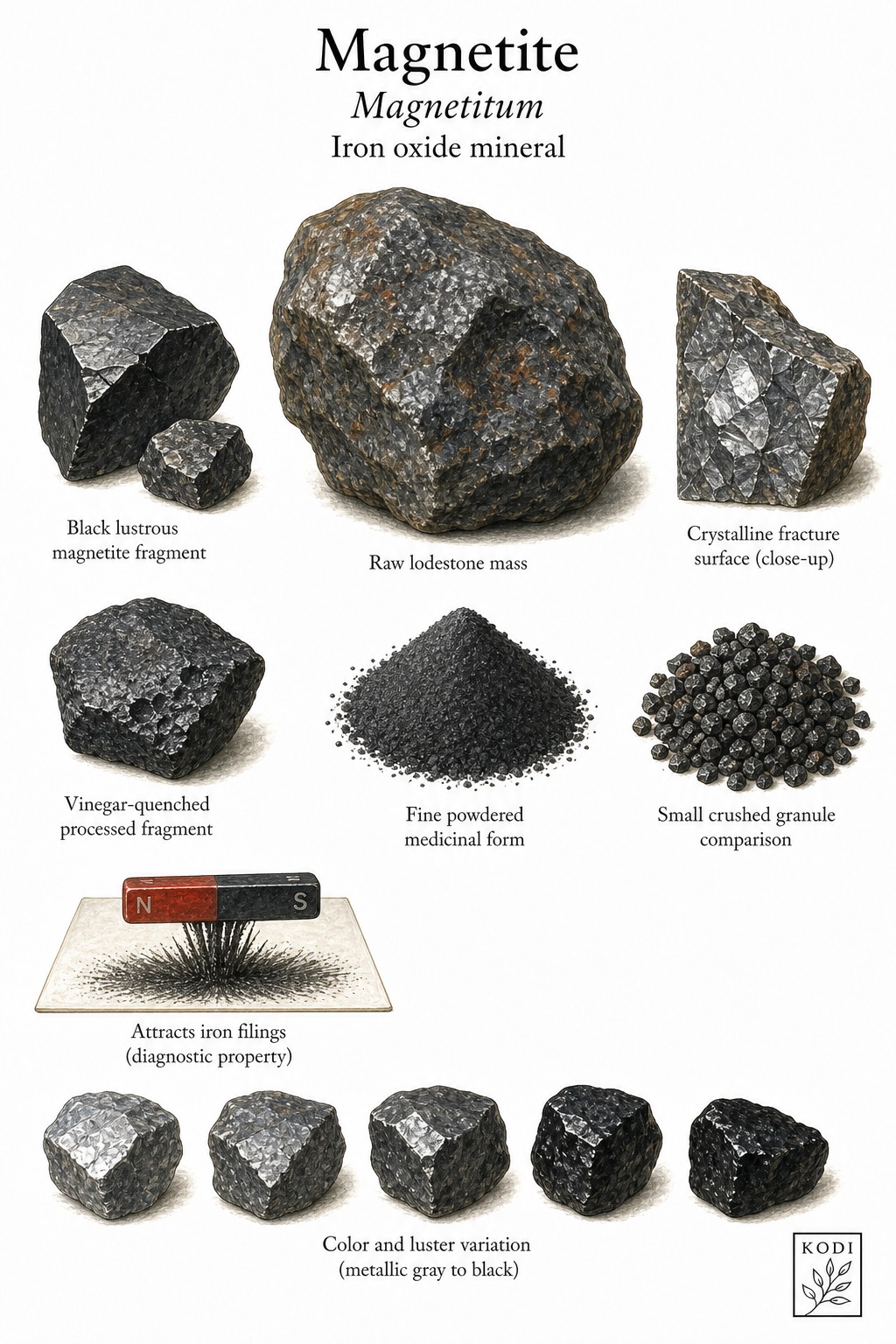
Known in TCM as Hei Ci Shi (黑磁石), this salty, cold herb enters the Heart, Liver, and Kidney. Traditionally, it anchors floating Yang and calms the spirit - used for irritability, insomnia, fright palpitations, and restlessness when Kidney deficiency or ascendant Liver Yang disturbs the Heart-mind, most often applied for tinnitus, dizziness, and insomnia. Modern research has identified Magnetite among its active constituents.
Part used: Magnetite
TCM Properties
- Taste
- salty
- Temperature
- cold
- Channels
- Heart, Liver, Kidney
Traditional Use
Primary Actions
- Anchors floating Yang and calms the spirit - used for irritability, insomnia, fright palpitations, and restlessness when Kidney deficiency or ascendant Liver Yang disturbs the Heart-mind.
- Benefits the ears and eyes - classically prescribed for tinnitus, deafness, blurred vision, and dizzy vision associated with Liver-Kidney deficiency failing to nourish the upper orifices.
- Assists the Kidneys in grasping Qi - used for dyspnea and chronic wheezing when the Kidneys fail to receive descending Lung Qi and the breath rises upward.
- Acts as a heavy settling mineral within deficiency formulas - especially useful when weakness at the root produces branch symptoms of upward agitation, sensory disturbance, or shallow breathing.
Secondary Actions
- Hei Ci Shi is best understood as an import-variant name for the standard medicinal Ci Shi rather than a distinct mineral from magnetite itself.
- Like many heavy mineral medicinals, it is usually vinegar-quenched, crushed, and decocted first so its weighty settling action can be used more safely and effectively.
Classic Formulas
- Ci Zhu Wan (磁朱丸) - from Bei Ji Qian Jin Yao Fang, pairing Ci Shi with Zhu Sha to settle the spirit, clear phlegm-fire agitation, and address tinnitus, insomnia, epilepsy, or visual disturbance.
- Er Long Zuo Ci Wan (耳聋左慈丸) - a later modification of Liu Wei Di Huang Wan that adds Ci Shi and Chai Hu to nourish the Kidneys while anchoring tinnitus and hearing loss.
Classical References
- Shen Nong Ben Cao Jing and later TCM Wiki summaries describe Ci Shi as salty and cold, entering the Heart, Liver, and Kidney channels to tranquilize, subdue Yang, improve hearing and vision, and assist reception of Qi.
- TCM Wiki notes that the best quality magnetite is black and lustrous, which likely explains the imported variant name Hei Ci Shi in this file.
- IMPORT NOTE: This record shares its therapeutic identity with herb #559 (`magnetite` / Ci Shi) and is preserved because the spreadsheet imported the black-quality descriptor as a separate slug.
Modern Research
Active Compounds
- Magnetite (ferroferric oxide, Fe3O4) - the core iron-oxide mineral matrix that defines the medicinal substance
- Ferrous and ferric iron species (iron oxides) - the chemically relevant redox forms within the magnetite structure
- Trace silicate and gangue minerals (mineral impurities) - naturally variable matrix components that make source verification and processing important
- Vinegar-processed surface salts (processing-derived mineral modifications) - formed during quenching and crushing steps that alter preparation behavior
Studied Effects
- PubMed literature on mineral Chinese medicinals emphasizes composition, spectroscopy, processing, and quality-control research more than direct herb-specific pharmacology; Ci Shi is part of that broader mineral-medicine discussion (PMID 24761628; PMID 28925144)
- Because medicinal magnetite is a largely inorganic iron-oxide mineral, modern clinical rationale still rests mainly on traditional pattern use rather than isolated small-molecule pharmacology.
PubMed References
Safety & Interactions
Contraindications
- Middle-burner weakness or poor digestion unable to tolerate heavy mineral medicinals
- Patterns without floating Yang, spirit disturbance, sensory orifice deficiency, or Kidney failing to grasp Qi
Cautions
- This mineral should be crushed and decocted first, and is often vinegar-quenched before use to improve preparation and reduce harshness
- Long-term unsupervised use of heavy mineral substances is not appropriate even when the herb is not classified among the most toxic mineral medicinals
- MSK page not found - drug interaction data not available from Memorial Sloan Kettering integrative medicine database
Conditions
Frequently Asked Questions
What is Magnetite used for?
Magnetite is traditionally used to Anchors floating Yang and calms the spirit - used for irritability, insomnia, fright palpitations, and restlessness when Kidney deficiency or ascendant Liver Yang disturbs the Heart-mind., Benefits the ears and eyes - classically prescribed for tinnitus, deafness, blurred vision, and dizzy vision associated with Liver-Kidney deficiency failing to nourish the upper orifices., Assists the Kidneys in grasping Qi - used for dyspnea and chronic wheezing when the Kidneys fail to receive descending Lung Qi and the breath rises upward., Acts as a heavy settling mineral within deficiency formulas - especially useful when weakness at the root produces branch symptoms of upward agitation, sensory disturbance, or shallow breathing.. Research has investigated its effects on: PubMed literature on mineral Chinese medicinals emphasizes composition, spectroscopy, processing, and quality-control research more than direct herb-specific pharmacology; Ci Shi is part of that broader mineral-medicine discussion (PMID 24761628; PMID 28925144); Because medicinal magnetite is a largely inorganic iron-oxide mineral, modern clinical rationale still rests mainly on traditional pattern use rather than isolated small-molecule pharmacology..
Is Magnetite safe during pregnancy?
The safety of Magnetite during pregnancy has not been established. Consult a qualified healthcare provider before use.
What are the contraindications for Magnetite?
Magnetite should not be used in: Middle-burner weakness or poor digestion unable to tolerate heavy mineral medicinals; Patterns without floating Yang, spirit disturbance, sensory orifice deficiency, or Kidney failing to grasp Qi. Consult a qualified healthcare provider before use.