Black Catechu
- Chinese
- 儿茶
- Pinyin
- Er Cha
- Latin
- Catechu
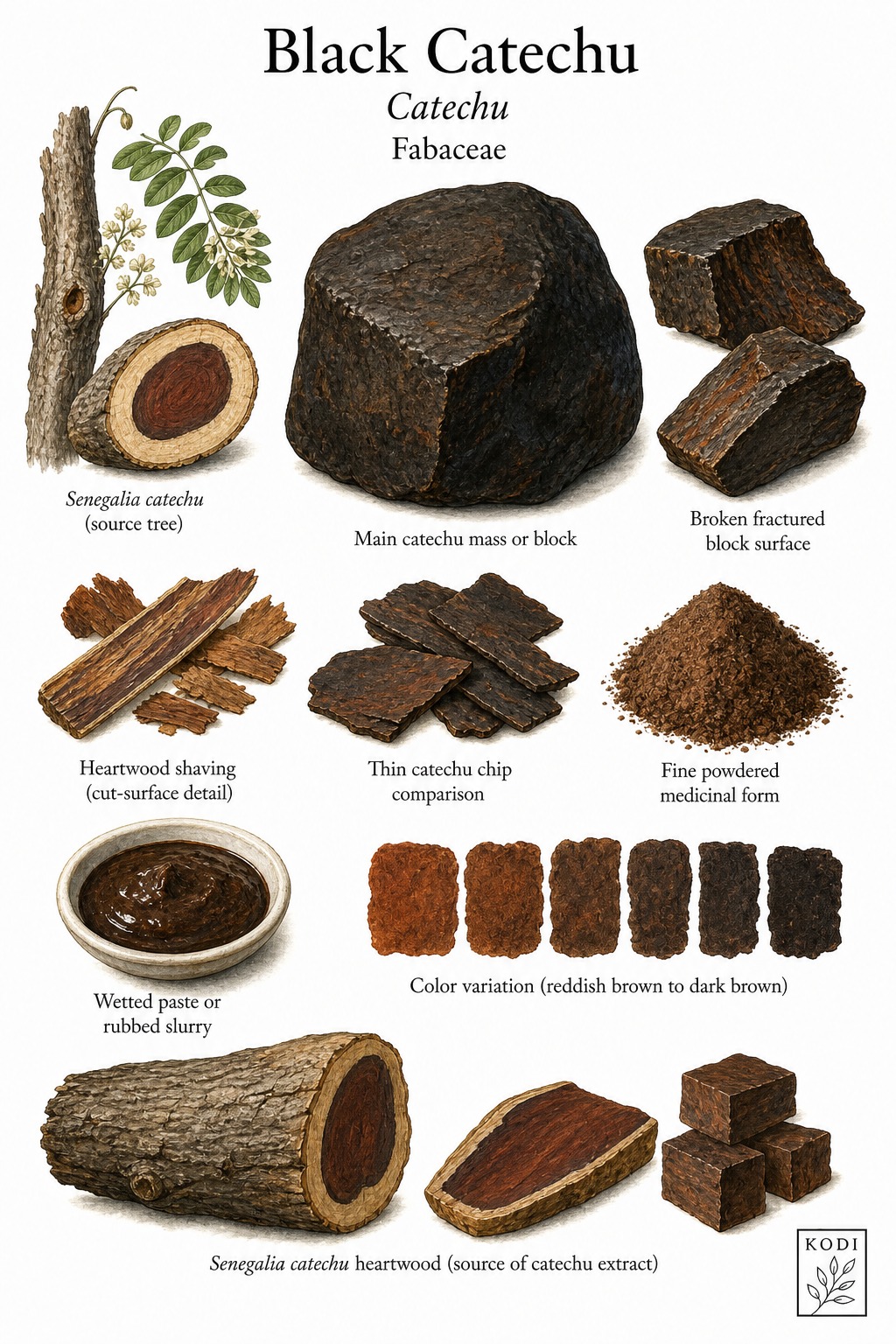
Known in TCM as Er Cha (儿茶), this bitter and salty, cool herb enters the Heart and Lung. Traditionally, it stops bleeding while promoting tissue regeneration - classically valued for bleeding traumatic wounds, ulcerated sores, and lesions that need both hemostasis and new flesh generation, most often applied for traumatic injury, eczema, and oral ulcers. Modern research has identified Catechin among its active constituents.
Part used: Catechu extract
TCM Properties
- Taste
- bitter, salty
- Temperature
- cool
- Channels
- Heart, Lung
Traditional Use
Primary Actions
- Stops bleeding while promoting tissue regeneration - classically valued for bleeding traumatic wounds, ulcerated sores, and lesions that need both hemostasis and new flesh generation.
- Astringes sores and dries damp ooze - used externally for eczema, weeping skin lesions, oral ulceration, and chronic ulcers with seepage or delayed closure.
- Invigorates Blood and reduces trauma swelling - applied in powders and trauma formulas when bruising, swelling, and local injury coexist with active oozing or slow healing.
- Can clear phlegm-heat and relieve mouth-throat irritation in small internal doses - a lesser but recognized use when its cool astringent nature is matched appropriately.
Secondary Actions
- Er Cha is a concentrated extract product rather than a raw bulk botanical, so it is usually used in powders, pills, or topical preparations rather than long decoction.
- Modern sourcing discussions stress that authentic pharmacopoeial black catechu derives from Acacia catechu and should not be confused casually with gambir or other catechu-like blocks in trade.
Classic Formulas
- Qi Li San (七厘散) - classic trauma powder in which Er Cha helps stop bleeding and promote tissue repair alongside stronger Blood-moving medicinals.
- Long Gu Er Cha San (龙骨儿茶散) - external powder tradition for damp weeping eczema and ulcerative skin lesions, using the astringent drying and healing actions of Er Cha.
Classical References
- TCM Wiki lists Er Cha as bitter, astringent, and lightly cold, with the core actions of treating trauma, stopping bleeding, promoting regeneration, and healing wounds.
- Me and Qi notes that the Chinese Pharmacopoeia source is black catechu from Acacia catechu, while also warning that other trade materials called catechu are not identical.
- The herb is often used interchangeably in trade under names such as Hai Er Cha or Hei Er Cha, but this file keeps the core pharmacopeial name Er Cha.
Modern Research
Active Compounds
- Catechin (flavan-3-ol) - the signature phenolic constituent responsible for much of catechu's astringent and antioxidant profile
- Epicatechin (flavan-3-ol) - major companion polyphenol with anti-inflammatory and redox relevance
- Epigallocatechin and epicatechin gallate derivatives (polyphenols) - part of the richer phenolic matrix identified in Acacia catechu reviews
- Gallic acid and protocatechuic acid (phenolic acids) - associated with antioxidant and antimicrobial activity
- Condensed tannins and procyanidins (tannins) - likely contributors to the strong astringent wound-drying traditional effect
Studied Effects
- Modern review literature highlights antimicrobial, anti-inflammatory, antioxidant, antiulcer, and wound-healing potential across Acacia catechu extracts, providing a strong species-level correlate for Er Cha's traditional external uses (PMID 36432824)
- Antimicrobial activity - methanolic Acacia catechu extract inhibited multiple bacterial and fungal organisms in vitro, supporting the traditional use on infected or vulnerable lesions (PMID 22282602)
- Wound-healing potential - Acacia catechu demonstrated significant diabetic-wound healing benefit in experimental models, matching the classical tissue-regeneration indication of catechu preparations (PMID 37693096)
- Phytochemistry-centered review work continues to emphasize catechin-rich phenolics as plausible drivers of antiproliferative, antioxidant, and inflammatory-pathway effects (PMID 40981159)
PubMed References
- Acacia catechu (L.f.) Willd.: A Review on Bioactive Compounds and Their Health Promoting Functionalities. (2022)
- In Vitro Antimicrobial Activity of Acacia catechu and Its Phytochemical Analysis. (2011)
- Wound healing potential of Acacia catechu in streptozotocin-induced diabetic mice using in vivo and in silico approach. (2023)
- A Systematic Review Exploring the Phytochemical Composition and Anticancer Activities of Acacia catechu. (2025)
Safety & Interactions
Contraindications
- Cold-damp diarrhea or weak digestion without bleeding, ulceration, or damp weeping lesions
- Dry heat injury without dampness or tissue seepage needing an astringent medicinal
Cautions
- Because this is a concentrated astringent extract, internal doses are small and prolonged unsupervised use may impede digestion or trap unresolved pathogens
- Product identity matters because catechu-like trade materials can come from different botanical sources with overlapping but non-identical chemistry
- MSK page not found - drug interaction data not available from Memorial Sloan Kettering integrative medicine database
Conditions
- Traumatic Injury Traditional ★★★☆☆ JSON
- Eczema Traditional ★★★☆☆ JSON
- Oral Ulcers Traditional ★★★☆☆ JSON
Frequently Asked Questions
What is Black Catechu used for?
Black Catechu is traditionally used to Stops bleeding while promoting tissue regeneration - classically valued for bleeding traumatic wounds, ulcerated sores, and lesions that need both hemostasis and new flesh generation., Astringes sores and dries damp ooze - used externally for eczema, weeping skin lesions, oral ulceration, and chronic ulcers with seepage or delayed closure., Invigorates Blood and reduces trauma swelling - applied in powders and trauma formulas when bruising, swelling, and local injury coexist with active oozing or slow healing., Can clear phlegm-heat and relieve mouth-throat irritation in small internal doses - a lesser but recognized use when its cool astringent nature is matched appropriately.. Research has investigated its effects on: Modern review literature highlights antimicrobial, anti-inflammatory, antioxidant, antiulcer, and wound-healing potential across Acacia catechu extracts, providing a strong species-level correlate for Er Cha's traditional external uses (PMID 36432824); Antimicrobial activity - methanolic Acacia catechu extract inhibited multiple bacterial and fungal organisms in vitro, supporting the traditional use on infected or vulnerable lesions (PMID 22282602).
Is Black Catechu safe during pregnancy?
The safety of Black Catechu during pregnancy has not been established. Consult a qualified healthcare provider before use.
What are the contraindications for Black Catechu?
Black Catechu should not be used in: Cold-damp diarrhea or weak digestion without bleeding, ulceration, or damp weeping lesions; Dry heat injury without dampness or tissue seepage needing an astringent medicinal. Consult a qualified healthcare provider before use.