Bitter Apricot Seed
- Chinese
- 苦杏仁
- Pinyin
- Ku Xing Ren
- Latin
- Semen Armeniacae Amarum
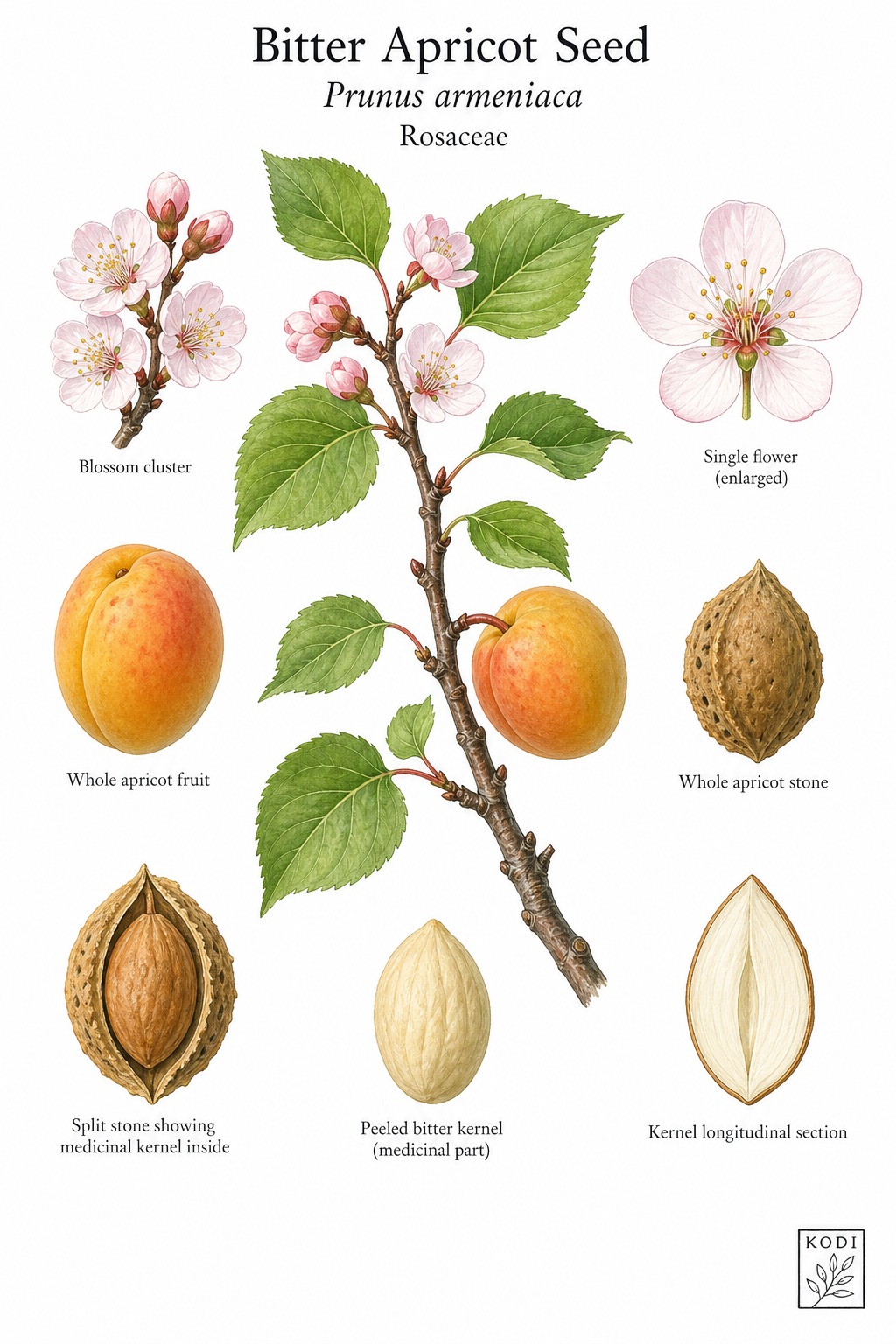
Known in TCM as Ku Xing Ren (苦杏仁), this bitter, warm herb enters the Lung and Large Intestine. Traditionally, it stops cough and calms wheezing by directing rebellious Lung Qi downward - the key classical use for acute or chronic cough, dyspnea, asthma, and phlegm-obstructed Lung patterns across cold, heat, or dryness presentations when paired appropriately, most often applied for asthma, cough, and constipation. Modern research has identified Amygdalin among its active constituents.
Part used: Seed
Also Known As
Latin: Semen Armeniacae Amarum | Pinyin: Ku Xing Ren | Chinese: 苦杏仁
TCM Properties
- Taste
- bitter
- Temperature
- warm
- Channels
- Lung, Large Intestine
Traditional Use
Primary Actions
- Stops cough and calms wheezing by directing rebellious Lung Qi downward - the key classical use for acute or chronic cough, dyspnea, asthma, and phlegm-obstructed Lung patterns across cold, heat, or dryness presentations when paired appropriately.
- Moistens the intestines and unblocks the bowels - the oily kernel is used for constipation from intestinal dryness, especially when Lung dryness and bowel dryness coexist.
- Balances dispersing and descending strategy in Lung formulas - Ku Xing Ren is often combined with releasing herbs, heat-clearing herbs, or moistening herbs depending on whether the cough is from wind-cold, lung heat, or dryness.
- Requires processing to harness benefit safely - the classical therapeutic effect depends on using properly prepared kernels in measured doses rather than raw apricot pits.
Secondary Actions
- Li Dongyuan's classic distinction is that Xing Ren treats the Qi aspect by descending Lung Qi, while Tao Ren treats the Blood aspect by moving Blood.
- The herb appears in numerous foundational cough formulas because it is adaptable across many Lung patterns once the companion herbs are changed.
Classic Formulas
- Ma Huang Tang (麻黄汤) - from Shang Han Lun, where Ku Xing Ren assists Ma Huang in disseminating and descending Lung Qi for wind-cold exterior excess with wheezing.
- Ma Xing Shi Gan Tang (麻杏石甘汤) - from Shang Han Lun, pairing Ku Xing Ren with Ma Huang and Shi Gao for Lung-heat wheezing, cough, and labored breathing.
- Wu Ren Wan (五仁丸) - moistening-constipation formula using Xing Ren alongside other oily seeds to lubricate the intestines and relieve dry stools.
Classical References
- Shen Nong Ben Cao Jing records Xing Ren for cough with rebellious upbearing Qi and highlights its descending action, showing its very early place in Chinese respiratory medicine.
- Ben Cao Gang Mu summarizes Xing Ren as able to scatter and descend, thereby resolving wind, descending Qi, moistening dryness, and dispersing accumulations, while also warning that its toxicity can cause serious reactions if overused.
- Me and Qi preserves Li Dongyuan's influential distinction that Xing Ren treats Qi while Tao Ren treats Blood, a classical teaching still used to differentiate the two kernels in practice.
Modern Research
Active Compounds
- Amygdalin (cyanogenic glycoside) - the signature constituent responsible for both the kernel's antitussive reputation and its cyanide-related toxicity risk
- Prunasin (cyanogenic glycoside intermediate) - metabolically linked to amygdalin breakdown on the path toward cyanide release
- Benzaldehyde (aromatic hydrolysis product) - contributes the characteristic bitter-almond aroma released when the kernel is crushed with water
- Oleic and linoleic acid-rich fixed oil (fatty oil fraction) - helps explain the intestine-moistening effect of the seed
- Beta-glucosidase or emulsin-related enzymatic activity (hydrolytic enzyme system) - participates in hydrolysis of amygdalin toward cyanogenic products
Studied Effects
- Pharmacology-and-toxicity review - amygdalin literature summarizes anti-inflammatory, analgesic, and respiratory relevance while emphasizing cyanide generation as the central toxicologic concern (PMID 32114166)
- Detoxification by herb pairing - stereoselective metabolism research in the Ma Huang-Ku Xing Ren herb pair suggested ephedra may facilitate amygdalin detoxification, providing a modern lens on why the pair became classical (PMID 26719286)
- Lung-protective anti-inflammatory activity - amygdalin reduced inflammatory and oxidative injury in a multidrug-resistant Staphylococcus aureus lung epithelial model (PMID 39283878)
- Broader contemporary review - recent surveys continue to document antioxidant, anti-inflammatory, and antifibrotic interest in amygdalin while confirming that toxicity remains the main practical limiter (PMID 36291723)
PubMed References
- Amygdalin - A pharmacological and toxicological review. (2020)
- Stereoselective metabolism of amygdalin-based study of detoxification of Semen Armeniacae Amarum in the Herba Ephedrae-Semen Armeniacae Amarum herb pair. (2016)
- Amygdalin prevents multidrug-resistant Staphylococcus aureus-induced lung epithelial cell injury by regulating inflammation and oxidative stress. (2024)
- Amygdalin: A Review on Its Characteristics, Antioxidant Potential, Gastrointestinal Microbiota Intervention, Anticancer Therapeutic and Mechanisms, Toxicity, and Encapsulation. (2022)
Safety & Interactions
Contraindications
- Raw or unprocessed internal use
- Overdose or unsupervised use in children
- Loose stools or diarrhea
- Yin-deficiency dry cough without an appropriate moistening formula context
Cautions
- Bitter apricot seed contains amygdalin, which can release hydrogen cyanide; raw kernels and overdoses can cause respiratory failure, coma, and death
- Proper processing by scalding, removing the skin and tip, and adequate decoction substantially reduces toxicity and is essential for safe use
- Pregnancy and breastfeeding require special caution because cyanogenic toxicity would pose fetal or infant risk even though the herb is not universally classed as a strict pregnancy taboo in the classical literature
Drug Interactions
- High-dose vitamin C … Concurrent use with amygdalin or apricot kernels has been associated with increased cyanide toxicity (Major) Source: Memorial Sloan Kettering Integrative Medicine - Amygdalin
Conditions
- Asthma Traditional ★★★★☆ JSON
- Cough Traditional ★★★★☆ JSON
- Constipation Traditional ★★★☆☆ JSON
- Bronchitis Research ★★☆☆☆ JSON
Frequently Asked Questions
What is Bitter Apricot Seed used for?
Bitter Apricot Seed is traditionally used to Stops cough and calms wheezing by directing rebellious Lung Qi downward - the key classical use for acute or chronic cough, dyspnea, asthma, and phlegm-obstructed Lung patterns across cold, heat, or dryness presentations when paired appropriately., Moistens the intestines and unblocks the bowels - the oily kernel is used for constipation from intestinal dryness, especially when Lung dryness and bowel dryness coexist., Balances dispersing and descending strategy in Lung formulas - Ku Xing Ren is often combined with releasing herbs, heat-clearing herbs, or moistening herbs depending on whether the cough is from wind-cold, lung heat, or dryness., Requires processing to harness benefit safely - the classical therapeutic effect depends on using properly prepared kernels in measured doses rather than raw apricot pits.. Research has investigated its effects on: Pharmacology-and-toxicity review - amygdalin literature summarizes anti-inflammatory, analgesic, and respiratory relevance while emphasizing cyanide generation as the central toxicologic concern (PMID 32114166); Detoxification by herb pairing - stereoselective metabolism research in the Ma Huang-Ku Xing Ren herb pair suggested ephedra may facilitate amygdalin detoxification, providing a modern lens on why the pair became classical (PMID 26719286).
What are other names for Bitter Apricot Seed?
Bitter Apricot Seed is also known as Armeniaca. In TCM: 苦杏仁 (Ku Xing Ren); Semen Armeniacae Amarum.
Is Bitter Apricot Seed safe during pregnancy?
The safety of Bitter Apricot Seed during pregnancy has not been established. Consult a qualified healthcare provider before use.
What are the contraindications for Bitter Apricot Seed?
Bitter Apricot Seed should not be used in: Raw or unprocessed internal use; Overdose or unsupervised use in children; Loose stools or diarrhea; Yin-deficiency dry cough without an appropriate moistening formula context. Consult a qualified healthcare provider before use.
Does Bitter Apricot Seed interact with any medications?
Bitter Apricot Seed may interact with: High-dose vitamin C - Concurrent use with amygdalin or apricot kernels has been associated with increased cyanide toxicity - (Major severity). Always inform your healthcare provider of any herbal supplements you are taking.