Bark of Silktree Albizzia
- Chinese
- 合欢皮
- Pinyin
- He Huan Pi
- Latin
- Cortex Albiziae
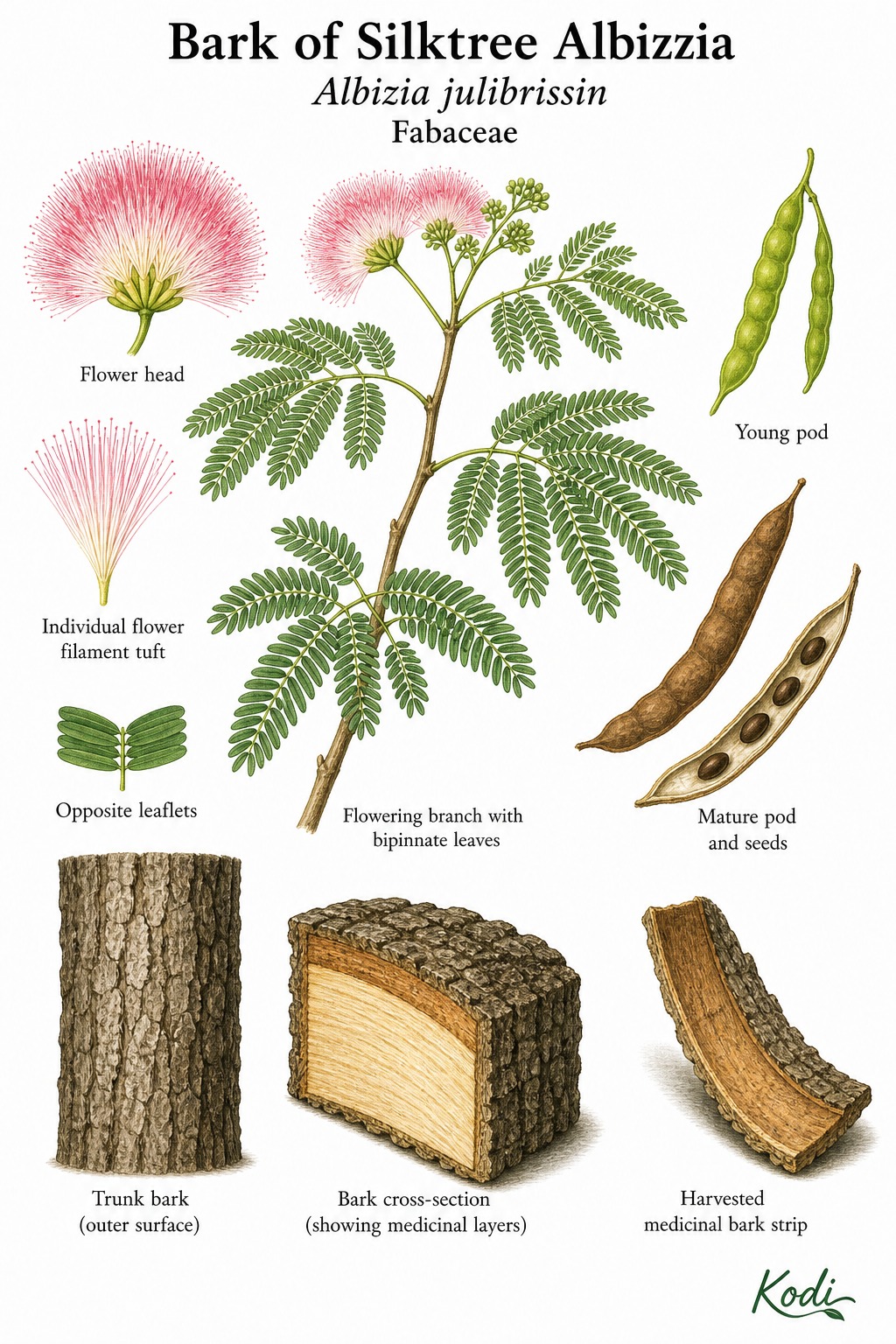
Known in TCM as He Huan Pi (合欢皮), this sweet, neutral herb enters the Heart, Liver, and Lung. Traditionally, it calms the spirit and relieves emotional constraint - the signature bark herb for depression, anxiety, insomnia, irritability, grief, and constrained Liver-Heart disharmony when the Shen cannot rest, most often applied for insomnia, anxiety, and depression. Modern research has identified Julibroside among its active constituents.
Part used: Bark
Also Known As
Latin: Cortex Albiziae | Pinyin: He Huan Pi | Chinese: 合欢皮
TCM Properties
- Taste
- sweet
- Temperature
- neutral
- Channels
- Heart, Liver, Lung
Traditional Use
Primary Actions
- Calms the spirit and relieves emotional constraint - the signature bark herb for depression, anxiety, insomnia, irritability, grief, and constrained Liver-Heart disharmony when the Shen cannot rest.
- Invigorates Blood and reduces swelling - used for traumatic injury, pain from bruising or fracture, and localized swelling where emotional trauma and physical trauma may coexist.
- Unblocks the collaterals and promotes healing - later tradition extends He Huan Pi to sinew and bone recovery when tenderness, pain, and constrained circulation slow repair.
- Relieves constraint gently rather than heavily sedating - especially valued when emotional symptoms are driven by stagnation, rumination, or sadness rather than strong heat or phlegm-fire excess.
Secondary Actions
- May be used for Lung abscess and suppurative chest conditions in later formula traditions, reflecting its ability to relieve constraint while moving Blood and reducing swelling.
- Because it is sweet and neutral, it is often integrated into longer emotional-support formulas more easily than strongly bitter sedative herbs.
Classic Formulas
- Huang Hun Tang (黄昏汤) - a classical single-herb or bark-centered use of He Huan Pi recorded in Qian Jin Fang for Lung abscess and internal suppurative heat.
- Modified Xiao Yao San-type prescriptions (逍遥散加减) - later clinical tradition often adds He Huan Pi when Liver constraint presents with depression, insomnia, or persistent emotional agitation.
- Trauma and swelling formulas may combine He Huan Pi with Ru Xiang, Mo Yao, and other blood-moving herbs when emotional upset accompanies bruising or injury.
Classical References
- Shen Nong Ben Cao Jing records He Huan Pi as bringing joy and easing constraint, the classical root of its enduring use for sadness, worry, and disturbed sleep.
- Ben Cao Yan Yi Bu Yi and related later texts describe He Huan Pi as treating injury from falls, reconnecting sinews and bones, and reducing swelling after trauma.
- Modern Me & Qi teaching materials preserve both sides of the tradition: He Huan Pi for emotional disorders and for physical injury with swelling or pain.
Modern Research
Active Compounds
- Julibroside C1 and related julibrosides (triterpenoid saponins) - the best-known bark constituents linked with anxiolytic, antidepressant, and cytotoxic research
- Quercitrin and related flavonoids (flavonoids) - contribute antioxidant and neuroprotective effects
- Syringaresinol glycosides (lignan glycosides) - implicated in central nervous system activity and serotonin-related mechanisms
- Pinoresinol-type lignans (lignans) - support anti-inflammatory and neuroactive research
- Phenolic glycosides and polysaccharide fractions - broaden the bark's antioxidant and immunomodulatory profile
Studied Effects
- Bark extracts showed anxiolytic-like effects in the elevated plus-maze in rats, and the response was linked to serotonergic signaling through 5-HT1A mechanisms (PMID 15464830)
- A recent Hehuan flower-versus-bark review summarized traditional use, phytochemistry, antidepressant, anxiolytic, anti-inflammatory, and tissue-repair pharmacology for He Huan Pi specifically as the trauma-calming bark drug (PMID 36509253)
- Albizia julibrissin preparations ameliorated insomnia-associated memory loss and modulated gut-microbiota and inflammatory pathways in experimental models, consistent with the herb's traditional sleep-calming reputation (PMID 31057652)
- Broader species-level review literature also connects Albizia julibrissin to depression treatment through monoaminergic, BDNF, and HPA-axis regulation, aligning with the bark's traditional Shen-calming role.
PubMed References
- Anxiolytic-like effects of extracts from Albizzia julibrissin bark in the elevated plus-maze in rats (2004)
- A comparison review of Hehuan flowers and Hehuan bark on the traditional applications, phytochemistry and pharmacological effects (2023)
- Albizia julibrissin Ameliorates Memory Loss Induced by Insomnia in Drosophila (2019)
Safety & Interactions
Cautions
- Potential additive drowsiness is plausible when He Huan Pi is combined with sedative medications or other strong Shen-calming herbs, so monitor sensitive patients carefully
- Use with caution in pregnancy when high doses are employed chiefly for trauma or blood-moving purposes rather than gentle emotional support
- MSK page not found - drug interaction data not available from Memorial Sloan Kettering integrative medicine database
Classic formulas that use Bark of Silktree Albizzia
Herbs are rarely taken alone in Chinese medicine. These formula pages show what this herb does inside a classic prescription and which pattern that prescription is chosen for.
Conditions
- Insomnia Research ★★★☆☆ JSON
- Anxiety Research ★★★☆☆ JSON
- Depression Research ★★★☆☆ JSON
- Traumatic Injury Traditional ★★★☆☆ JSON
Frequently Asked Questions
What is Bark of Silktree Albizzia used for?
Bark of Silktree Albizzia is traditionally used to Calms the spirit and relieves emotional constraint - the signature bark herb for depression, anxiety, insomnia, irritability, grief, and constrained Liver-Heart disharmony when the Shen cannot rest., Invigorates Blood and reduces swelling - used for traumatic injury, pain from bruising or fracture, and localized swelling where emotional trauma and physical trauma may coexist., Unblocks the collaterals and promotes healing - later tradition extends He Huan Pi to sinew and bone recovery when tenderness, pain, and constrained circulation slow repair., Relieves constraint gently rather than heavily sedating - especially valued when emotional symptoms are driven by stagnation, rumination, or sadness rather than strong heat or phlegm-fire excess.. Research has investigated its effects on: Bark extracts showed anxiolytic-like effects in the elevated plus-maze in rats, and the response was linked to serotonergic signaling through 5-HT1A mechanisms (PMID 15464830); A recent Hehuan flower-versus-bark review summarized traditional use, phytochemistry, antidepressant, anxiolytic, anti-inflammatory, and tissue-repair pharmacology for He Huan Pi specifically as the trauma-calming bark drug (PMID 36509253).
What are other names for Bark of Silktree Albizzia?
Bark of Silktree Albizzia is also known as Albizia. In TCM: 合欢皮 (He Huan Pi); Cortex Albiziae.
Is Bark of Silktree Albizzia safe during pregnancy?
The safety of Bark of Silktree Albizzia during pregnancy has not been established. Consult a qualified healthcare provider before use.