Bark of Oriental Variegated Coralbean
- Chinese
- 海桐皮
- Pinyin
- Hai Tong Pi
- Latin
- Cortex Erythrinae
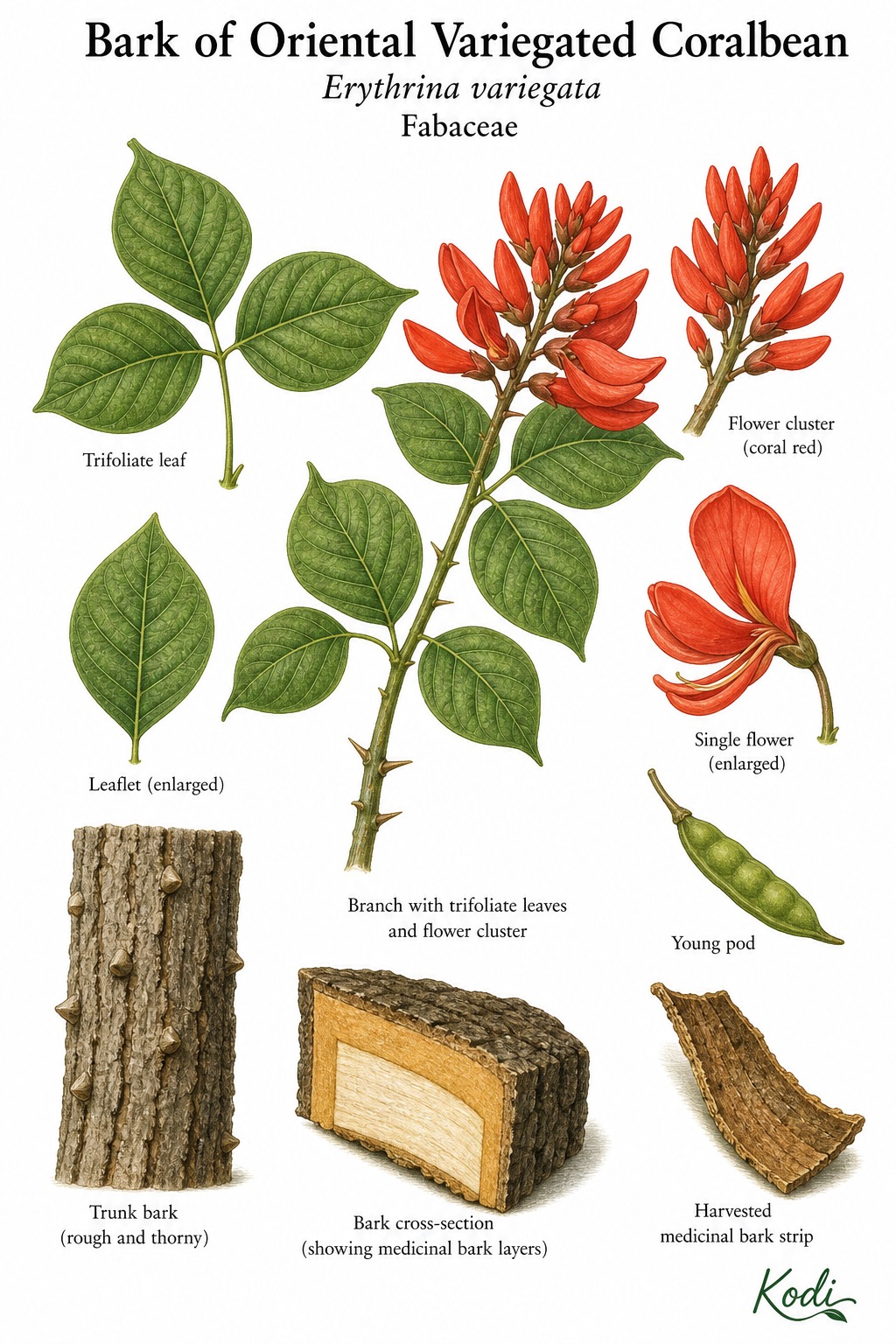
Known in TCM as Hai Tong Pi (海桐皮), this bitter and acrid, neutral herb enters the Liver, Spleen, and Kidney. Traditionally, it dispels wind-damp and unblocks the channels - a classic bark for painful obstruction affecting the low back, knees, joints, and sinews when chronic dampness and wind lodge in the collaterals, most often applied for joint pain, rheumatism, and low back pain. Modern research has identified Erycristagallin among its active constituents.
Part used: Bark
Also Known As
Latin: Cortex Erythrinae | Pinyin: Hai Tong Pi | Chinese: 海桐皮
TCM Properties
- Taste
- bitter, acrid
- Temperature
- neutral
- Channels
- Liver, Spleen, Kidney
Traditional Use
Primary Actions
- Dispels wind-damp and unblocks the channels - a classic bark for painful obstruction affecting the low back, knees, joints, and sinews when chronic dampness and wind lodge in the collaterals.
- Relieves pain and reduces swelling - used when bi syndrome is complicated by edema, heaviness, or painful weakness of the lower extremities rather than sharp acute heat alone.
- Kills parasites and relieves itching externally - traditional washes and powders apply Hai Tong Pi to scabies, fungal lesions, and damp-itching skin disorders.
- Supports lower-body strength in chronic wind-damp patterns - especially when lumbar aching, weak knees, and difficulty walking suggest long-standing obstruction in the Liver-Kidney channel network.
Secondary Actions
- Often combined with Wu Jia Pi, Sang Zhi, Qin Jiao, or Du Huo when the treatment goal is to open channels while also nourishing or supporting the lower limbs.
- Its external antiparasitic use makes it a bridge herb between internal bi-syndrome treatment and topical damp-itching management.
Classic Formulas
- Hai Tong Pi Jiu (海桐皮酒) - traditional medicated wine preparations centered on Hai Tong Pi for chronic wind-damp painful obstruction, lower-back soreness, and weakness of the legs and knees.
- Hai Tong Pi San (海桐皮散) - later wind-damp pain formulas using the bark as a chief or deputy herb for aching joints, numbness, and channel obstruction.
- Classical external wash and powder preparations use Hai Tong Pi for scabies, damp itching, and fungal-type skin lesions when internal wind-damp and surface parasite conditions overlap.
Classical References
- Sacred Lotus records Hai Tong Pi as bitter, acrid, and neutral, entering the Spleen, Liver, and Kidney to dispel wind-damp, kill parasites, and stop itching.
- Later materia medica traditions emphasize its special usefulness for lower-body wind-damp pain with weakness, especially when chronic dampness has settled into the back, knees, and joints.
- Because it is neither strongly hot nor strongly cold, Hai Tong Pi is often chosen for chronic bi syndrome where movement and unblocking are needed without harsh temperature bias.
Modern Research
Active Compounds
- Erycristagallin (prenylated isoflavonoid) - a characteristic Erythrina constituent associated with anti-inflammatory and neuroactive research
- Wighteone (prenylated flavonoid) - contributes antimicrobial and anti-inflammatory potential
- Erysodine and erysotrine (erythrinan alkaloids) - neuroactive alkaloids associated with sedative and receptor-modulating effects in the genus
- Alpinumisoflavone and related isoflavonoids - linked with antioxidant and antiproliferative activity
- Oleanolic acid and related triterpenoids - contribute anti-inflammatory and tissue-protective effects in bark extracts
Studied Effects
- Ethanolic bark extract demonstrated anti-inflammatory and analgesic activity in experimental models, supporting the traditional use of Hai Tong Pi in painful obstructive conditions (PMID 29926696)
- Colored dimeric erythrina alkaloids isolated from the bark showed neuroprotective activity, indicating pharmacology that extends beyond musculoskeletal use (PMID 34546728)
- Bark extract also showed antidepressant-like effects through enhancement of central monoamines in animal models, suggesting a broader neuroactive profile within the bark constituents (PMID 31600560)
- These findings fit a broader Erythrina literature in which flavonoids and alkaloids repeatedly account for anti-inflammatory, analgesic, and CNS-modulating effects.
PubMed References
- Anti-inflammatory Activities of Erythrina variegata Bark Ethanolic Extract (2018)
- Colored Dimeric Erythrina Alkaloids from Erythrina variegata Bark and Their Neuroprotective Activities (2021)
- Antidepressant-like effect of Erythrina variegata bark extract via enhancement of central monoamines in mice (2019)
Safety & Interactions
Contraindications
- Absence of wind-damp painful obstruction or damp-itching patterns
- Marked blood deficiency or yin deficiency dryness without obstructive pain
Cautions
- Concentrated bark extracts contain erythrina alkaloids with central nervous system activity, so very high doses may be more sedating than traditional decoction use suggests
- Use with care in frail patients when weakness reflects deficiency alone rather than actual channel obstruction from wind-damp
- MSK page not found - drug interaction data not available from Memorial Sloan Kettering integrative medicine database
Conditions
- Joint Pain Traditional ★★★★★ JSON
- Rheumatism Traditional ★★★★☆ JSON
- Low Back Pain Traditional ★★★★☆ JSON
- Fungal Infection Traditional ★★☆☆☆ JSON
- Edema Traditional ★★☆☆☆ JSON
Frequently Asked Questions
What is Bark of Oriental Variegated Coralbean used for?
Bark of Oriental Variegated Coralbean is traditionally used to Dispels wind-damp and unblocks the channels - a classic bark for painful obstruction affecting the low back, knees, joints, and sinews when chronic dampness and wind lodge in the collaterals., Relieves pain and reduces swelling - used when bi syndrome is complicated by edema, heaviness, or painful weakness of the lower extremities rather than sharp acute heat alone., Kills parasites and relieves itching externally - traditional washes and powders apply Hai Tong Pi to scabies, fungal lesions, and damp-itching skin disorders., Supports lower-body strength in chronic wind-damp patterns - especially when lumbar aching, weak knees, and difficulty walking suggest long-standing obstruction in the Liver-Kidney channel network.. Research has investigated its effects on: Ethanolic bark extract demonstrated anti-inflammatory and analgesic activity in experimental models, supporting the traditional use of Hai Tong Pi in painful obstructive conditions (PMID 29926696); Colored dimeric erythrina alkaloids isolated from the bark showed neuroprotective activity, indicating pharmacology that extends beyond musculoskeletal use (PMID 34546728).
What are other names for Bark of Oriental Variegated Coralbean?
Bark of Oriental Variegated Coralbean is also known as Erythrina. In TCM: 海桐皮 (Hai Tong Pi); Cortex Erythrinae.
Is Bark of Oriental Variegated Coralbean safe during pregnancy?
The safety of Bark of Oriental Variegated Coralbean during pregnancy has not been established. Consult a qualified healthcare provider before use.
What are the contraindications for Bark of Oriental Variegated Coralbean?
Bark of Oriental Variegated Coralbean should not be used in: Absence of wind-damp painful obstruction or damp-itching patterns; Marked blood deficiency or yin deficiency dryness without obstructive pain. Consult a qualified healthcare provider before use.