Bamboo Shavings
- Chinese
- 竹茹
- Pinyin
- Zhu Ru
- Latin
- Caulis Bambusae in Taeniam
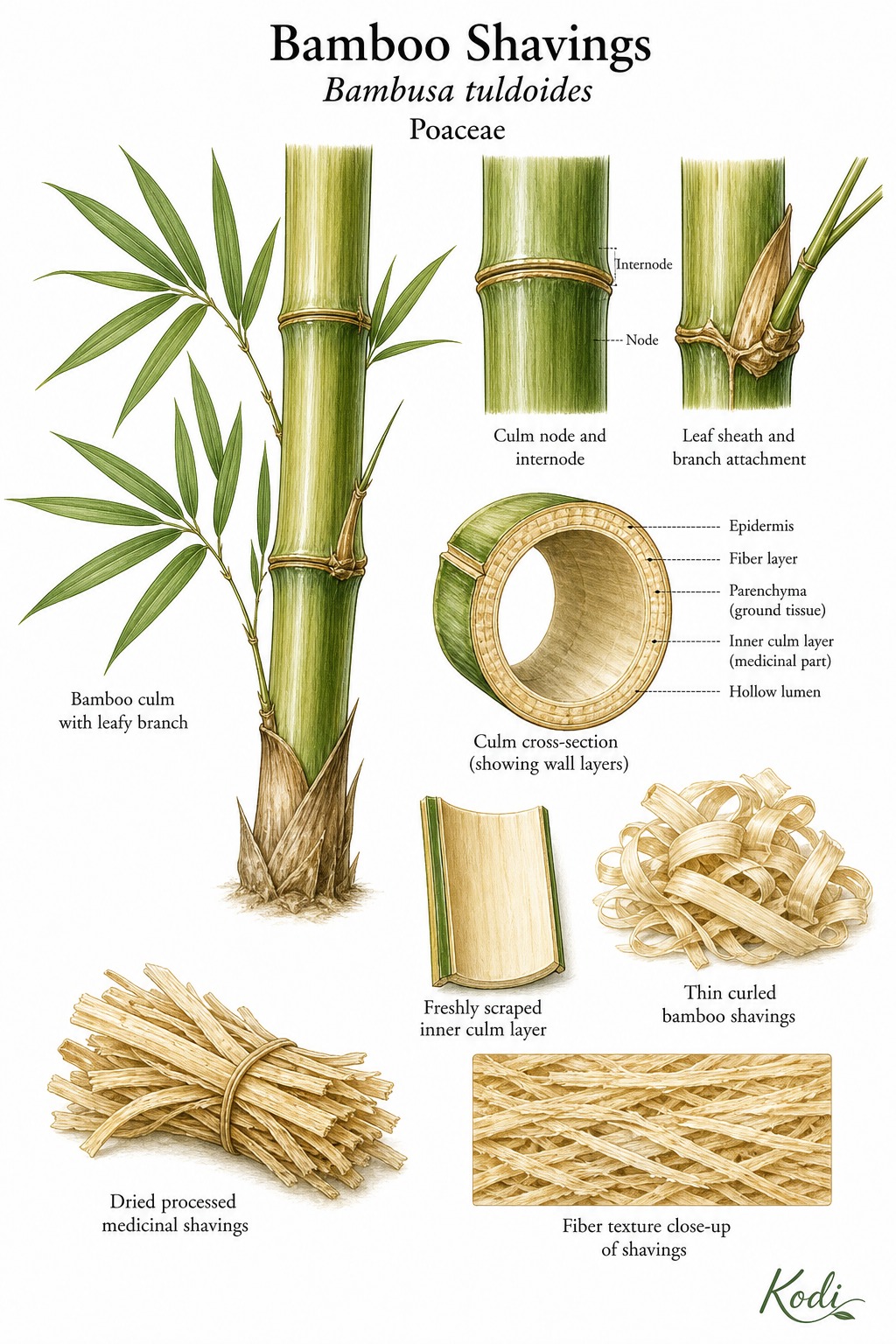
Known in TCM as Zhu Ru (竹茹), this sweet, cool herb enters the Lung, Stomach, Heart, and Gallbladder. Traditionally, it clears Phlegm-Heat from the Lung and Gallbladder while opening constrained Qi - used for cough with thick yellow sputum, chest oppression, bitter taste in the mouth, and phlegm-heat disturbing the upper burner, especially when Wen Dan Tang-style Gallbladder-Stomach disharmony is present, most often applied for nausea, nausea pregnancy, and phlegm accumulation. Modern research has identified 4-hydroxybenzaldehyde among its active constituents.
Part used: Stem
Also Known As
Latin: Caulis Bambusae in Taeniam | Pinyin: Zhu Ru | Chinese: 竹茹
TCM Properties
- Taste
- sweet
- Temperature
- cool
- Channels
- Lung, Stomach, Heart, Gallbladder
Traditional Use
Primary Actions
- Clears Phlegm-Heat from the Lung and Gallbladder while opening constrained Qi - used for cough with thick yellow sputum, chest oppression, bitter taste in the mouth, and phlegm-heat disturbing the upper burner, especially when Wen Dan Tang-style Gallbladder-Stomach disharmony is present.
- Clears Stomach Heat and redirects rebellious Qi downward - a classic herb for nausea, vomiting, retching, and hiccup when Heat rather than cold or deficiency is driving the Stomach upward, especially in Ju Pi Zhu Ru Tang-type patterns.
- Eliminates irritability and settles restlessness - used when phlegm-heat harasses the Heart and Gallbladder, producing insomnia, disturbing dreams, palpitations, anxiety, or post-febrile vexation with an inability to settle.
- Gently cools without harshly draining - favored in patients who need antiemetic and phlegm-clearing support but are weakened after febrile disease, postpartum, or constitutionally sensitive to colder bitter herbs.
Secondary Actions
- Can cool Blood and assist in stopping minor Heat-type bleeding presentations, although this is secondary to its better-known antiemetic and phlegm-transforming roles.
- Ginger-processed Jiang Zhu Ru is traditionally preferred when stopping vomiting is the chief goal, especially in pregnancy or mixed cold-heat digestive patterns where raw Zhu Ru may be too cooling.
Classic Formulas
- Ju Pi Zhu Ru Tang (橘皮竹茹汤) - from Jin Gui Yao Lue, pairing Zhu Ru with Chen Pi, Sheng Jiang, Ren Shen, Gan Cao, and Da Zao for hiccup, retching, and vomiting from Stomach deficiency with residual Heat and rebellious Qi.
- Wen Dan Tang (温胆汤) - the classic formula for Gallbladder-Stomach disharmony with phlegm-heat, nausea, insomnia, palpitations, and mental restlessness; Zhu Ru serves as the cooling, phlegm-clearing deputy herb.
- Hao Qin Qing Dan Tang (蒿芩清胆汤) - warm-disease formula in which Zhu Ru clears Gallbladder heat, transforms phlegm, and helps relieve bitter taste, chest oppression, nausea, and Shaoyang damp-heat agitation.
Classical References
- Jin Gui Yao Lue anchors Zhu Ru in Ju Pi Zhu Ru Tang for stubborn hiccup, vomiting, and rebellious Stomach Qi with deficiency complicated by residual Heat.
- Later materia medica texts repeatedly describe Zhu Ru as sweet and slightly cooling, entering the Stomach and Lung to stop vomiting while also relieving vexation and phlegm-heat restlessness.
- Modern Me & Qi teaching materials preserve the classical distinction that Zhu Ru is milder than Zhu Li: better for moderate phlegm-heat with nausea and insomnia, while Zhu Li is reserved for heavier phlegm obstruction.
Modern Research
Active Compounds
- 4-hydroxybenzaldehyde (phenolic aldehyde) - a repeatedly studied bamboo constituent associated with metabolic and anti-inflammatory signaling
- Orientin (flavone C-glycoside) - contributes antioxidant and cell-protective effects in bamboo-derived extracts
- Isoorientin (flavone C-glycoside) - linked with anti-inflammatory and tissue-protective activity
- Chlorogenic acid (phenolic acid) - supports antioxidant and metabolic regulatory effects in Phyllostachys-derived preparations
- Bamboo polysaccharides and related phenolics - contribute immune-modulating and inflammation-regulating effects in whole-extract studies
Studied Effects
- Anti-inflammatory activity - Bambusae Caulis in Taeniam induced heme oxygenase-1 and modulated Nrf2 and p38 MAPK signaling in activated macrophages, supporting the herb's traditional use for heat and inflammatory states (PMID 22683523)
- Airway and allergic inflammation modulation - extract reduced ovalbumin-induced airway inflammation, eosinophilic infiltration, and Th2 responses in mice, providing a preclinical bridge to its phlegm-heat respiratory use (PMID 20079411)
- Antimetastatic activity - aqueous extract suppressed PMA-induced tumor cell invasion and pulmonary metastasis through ROS and NF-kappaB-related signaling pathways in experimental models (PMID 24205091)
- Hypolipidemic and metabolic effects - methanol extract lowered lipid parameters in hyperlipidemic rat models, suggesting wider metabolic activity beyond its classical antiemetic role (PMID 19267283)
PubMed References
- Anti-inflammatory activity of Bambusae Caulis in Taeniam through heme oxygenase-1 expression via Nrf-2 and p38 MAPK signaling in macrophages (2012)
- Bambusae Caulis in Taeniam extract reduces ovalbumin-induced airway inflammation and T helper 2 responses in mice (2010)
- Aqueous extract of Bambusae Caulis in Taeniam inhibits PMA-induced tumor cell invasion and pulmonary metastasis: suppression of NF-κB activation through ROS signaling (2013)
- Hypolipidemic effect of MeOH extract of Bambusae Caulis in Taeniam in hyperlipidemia induced by Triton WR-1339 and high cholesterol diet in rats (2009)
Safety & Interactions
Contraindications
- Cold-phlegm or vomiting from Stomach cold rather than Heat
- Loose stools from Spleen deficiency-cold without phlegm-heat signs
Cautions
- Although comparatively gentle, larger raw doses may chill a weak Stomach or worsen chronic loose stools in constitutionally cold patients
- Use the ginger-processed form when the clinical goal is primarily stopping vomiting in fragile digestive patients
- MSK page not found - drug interaction data not available from Memorial Sloan Kettering integrative medicine database
Classic formulas that use Bamboo Shavings
Herbs are rarely taken alone in Chinese medicine. These formula pages show what this herb does inside a classic prescription and which pattern that prescription is chosen for.
Conditions
- Nausea Traditional ★★★★★ JSON
- Nausea Pregnancy Traditional ★★★★☆ JSON
- Phlegm Accumulation Traditional ★★★★☆ JSON
- Productive Cough Traditional ★★★☆☆ JSON
- Acid Reflux Traditional ★★★☆☆ JSON
Frequently Asked Questions
What is Bamboo Shavings used for?
Bamboo Shavings is traditionally used to Clears Phlegm-Heat from the Lung and Gallbladder while opening constrained Qi - used for cough with thick yellow sputum, chest oppression, bitter taste in the mouth, and phlegm-heat disturbing the upper burner, especially when Wen Dan Tang-style Gallbladder-Stomach disharmony is present., Clears Stomach Heat and redirects rebellious Qi downward - a classic herb for nausea, vomiting, retching, and hiccup when Heat rather than cold or deficiency is driving the Stomach upward, especially in Ju Pi Zhu Ru Tang-type patterns., Eliminates irritability and settles restlessness - used when phlegm-heat harasses the Heart and Gallbladder, producing insomnia, disturbing dreams, palpitations, anxiety, or post-febrile vexation with an inability to settle., Gently cools without harshly draining - favored in patients who need antiemetic and phlegm-clearing support but are weakened after febrile disease, postpartum, or constitutionally sensitive to colder bitter herbs.. Research has investigated its effects on: Anti-inflammatory activity - Bambusae Caulis in Taeniam induced heme oxygenase-1 and modulated Nrf2 and p38 MAPK signaling in activated macrophages, supporting the herb's traditional use for heat and inflammatory states (PMID 22683523); Airway and allergic inflammation modulation - extract reduced ovalbumin-induced airway inflammation, eosinophilic infiltration, and Th2 responses in mice, providing a preclinical bridge to its phlegm-heat respiratory use (PMID 20079411).
What are other names for Bamboo Shavings?
Bamboo Shavings is also known as Bambusa. In TCM: 竹茹 (Zhu Ru); Caulis Bambusae in Taeniam.
Is Bamboo Shavings safe during pregnancy?
Bamboo Shavings is generally considered safe during pregnancy in normal amounts. Therapeutic or concentrated doses should be discussed with a qualified healthcare provider before use.
What are the contraindications for Bamboo Shavings?
Bamboo Shavings should not be used in: Cold-phlegm or vomiting from Stomach cold rather than Heat; Loose stools from Spleen deficiency-cold without phlegm-heat signs. Consult a qualified healthcare provider before use.