Aurantium Oil (Orange Peel Essential Oil)
- Chinese
- 橘子香精
- Pinyin
- Ju Zi Xiang Jing
- Latin
- Oleum Aurantii
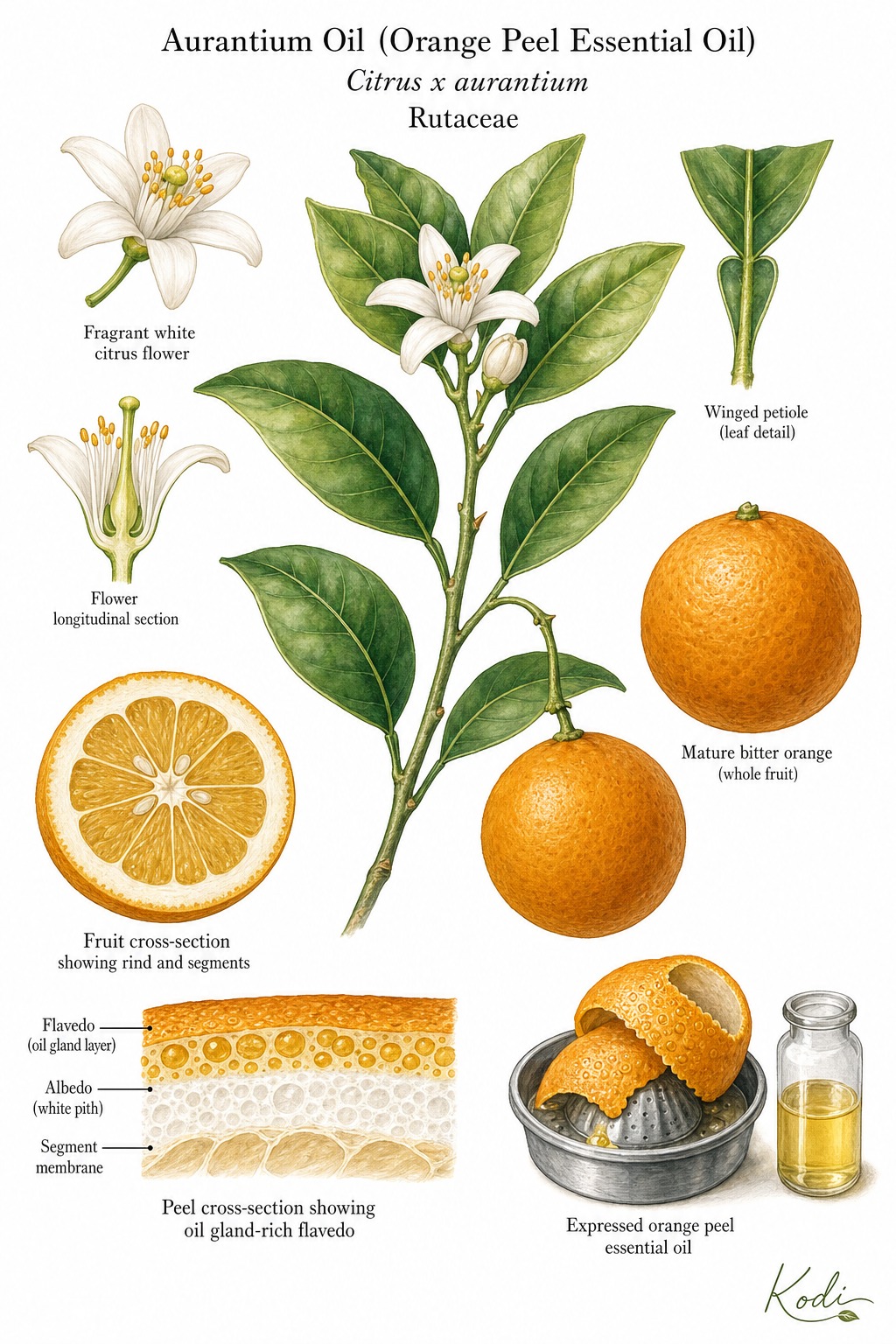
Known in TCM as Ju Zi Xiang Jing (橘子香精), this acrid and bitter, warm herb enters the Lung, Spleen, and Stomach. Traditionally, it aromatically regulates Qi and harmonizes the Middle Burner - used for nausea, poor appetite, belching, and epigastric fullness when the volatile peel fraction is the main active portion and the presentation resembles the Chen Pi citrus-peel pattern, most often applied for nausea, phlegm accumulation, and productive cough. Modern research has identified d-Limonene among its active constituents.
Part used: Oil
Also Known As
Latin: Oleum Aurantii | Pinyin: Ju Zi Xiang Jing | Chinese: 橘子香精
TCM Properties
- Taste
- acrid, bitter
- Temperature
- warm
- Channels
- Lung, Spleen, Stomach
Traditional Use
Primary Actions
- Aromatically regulates Qi and harmonizes the Middle Burner - used for nausea, poor appetite, belching, and epigastric fullness when the volatile peel fraction is the main active portion and the presentation resembles the Chen Pi citrus-peel pattern.
- Transforms Dampness and resolves phlegm - used as a light peel-derived adjunct for productive cough, chest congestion, and phlegm accumulation that arise when Spleen dysfunction generates damp-phlegm for the Lungs.
- Freshens and opens the Lung Qi aspect of citrus formulas - employed more as an aromatic essence or external inhalant than as a major standalone decoction herb when heaviness, foul turbidity, or stale phlegm sensations predominate.
- Helps prevent cloying stagnation in rich foods or tonifying combinations - the concentrated citrus volatile fraction keeps movement in the upper digestive tract and supports downward movement of rebellious Stomach Qi.
Secondary Actions
- May be used in external aromatic preparations for emotional tension or sensory heaviness, reflecting the modern crossover between food essence, aromatherapy, and peel-derived medicinal use.
- Functions more like a concentrated derivative of orange peel than a fully independent classical crude drug, so it is best understood within the broader citrus-peel lineage of Qi-regulating medicinals.
Classic Formulas
- Er Chen Tang (二陈汤) - although the classical formula uses Chen Pi rather than isolated orange oil, it is the closest peel-lineage reference for drying Dampness, transforming phlegm, and rectifying Qi in cough with copious sputum.
- Wen Dan Tang (温胆汤) - uses citrus peel to harmonize the Stomach and Gallbladder, descend rebellious Qi, and resolve phlegm-heat with nausea, vexation, and chest oppression; it is the clearest formula analogue for the aromatic orange-peel profile.
- Ju Pi Zhu Ru Tang (橘皮竹茹汤) - from Jin Gui Yao Lue, this citrus-peel formula redirects rebellious Stomach Qi for nausea, retching, and hiccup, offering the closest classical digestive reference for Ju Zi Xiang Jing.
Classical References
- IMPORT NOTE: Ju Zi Xiang Jing (橘子香精) / Oleum Aurantii appears in general materia medica lists as orange essence or orange peel oil rather than as a major standalone decoction herb. The TCM action profile in this record is therefore inferred from the orange-peel lineage headed by Ju Pi / Chen Pi.
- DRUG PART NOTE: Historical pharmacognosy sources describe Oleum Aurantii and Oleum Aurantii Corticis as orange oil expressed from the fresh peel, confirming peel rather than pulp or seed as the relevant medicinal source material.
- Chen Pi references in Sacred Lotus and Me & Qi describe the nearest classical analogue as warm, acrid-bitter, Lung-Spleen-Stomach regulating, Damp-drying, and phlegm-transforming; those properties are used here transparently because an independent classical monograph for the oil itself is sparse.
Modern Research
Active Compounds
- d-Limonene (monoterpene) - dominant citrus peel volatile associated with anti-inflammatory, aromatic, and digestive effects
- Linalool (monoterpene alcohol) - contributes calming fragrance activity and may participate in anxiolytic signaling
- Myrcene (monoterpene) - supports the oil's anti-inflammatory and sensory-relaxant profile
- Alpha-pinene and beta-pinene (monoterpenes) - minor volatiles with antimicrobial and airway-support research interest
- Linalyl acetate and related terpene esters - contribute aroma persistence and part of the essential-oil neurosensory profile
Studied Effects
- Anxiolytic-like activity - Citrus aurantium essential oil increased exploratory behavior in anxiety models through a mechanism linked to 5-HT1A receptors and also lowered cholesterol after repeated oral treatment in mice (PMID 23432968)
- Sedative and anticonvulsant support - peel essential oil prolonged barbiturate sleep time and delayed seizure onset in experimental models, supporting central nervous system activity of the volatile fraction (PMID 12499653)
- Clinical anxiety reduction - inhaled Citrus aurantium essential oil reduced anxiety in patients undergoing coronary angiography in a single-blind randomized controlled trial (PMID 32572778)
- Anti-inflammatory activity - essential oil from Citrus aurantium var. amara showed measurable anti-inflammatory effects in experimental work, supporting the oil's modern topical and aromatherapeutic use (PMID 28906110)
PubMed References
- Citrus aurantium L. essential oil exhibits anxiolytic-like activity mediated by 5-HT(1A)-receptors and reduces cholesterol after repeated oral treatment (2013)
- Anxiolytic and sedative effects of extracts and essential oil from Citrus aurantium L (2002)
- Essential Oil from Citrus aurantium Alleviates Anxiety of Patients Undergoing Coronary Angiography: A Single-Blind, Randomized Controlled Trial (2021)
- Anti-inflammatory Effect of Essential Oil from Citrus aurantium L. var. amara Engl (2017)
Safety & Interactions
Contraindications
- Yin deficiency with dry cough or fluid depletion
- Internal heat patterns with marked dryness or irritability
- Active gastric irritation, reflux, or ulcer tendency aggravated by concentrated citrus volatiles
Cautions
- Concentrated essential oil is more irritating than whole orange peel and should not be dosed as though it were interchangeable with the crude Chen Pi herb
- Internal use may aggravate reflux, gastric burning, or nausea in sensitive patients even when small doses are tolerated aromatically
- MSK page not found - drug interaction data not available from Memorial Sloan Kettering integrative medicine database
Conditions
- Nausea Traditional ★★★☆☆ JSON
- Phlegm Accumulation Traditional ★★★☆☆ JSON
- Productive Cough Traditional ★★☆☆☆ JSON
- Anxiety Clinical ★★☆☆☆ JSON
- High Cholesterol Preclinical ★☆☆☆☆ JSON
Frequently Asked Questions
What is Aurantium Oil (Orange Peel Essential Oil) used for?
Aurantium Oil (Orange Peel Essential Oil) is traditionally used to Aromatically regulates Qi and harmonizes the Middle Burner - used for nausea, poor appetite, belching, and epigastric fullness when the volatile peel fraction is the main active portion and the presentation resembles the Chen Pi citrus-peel pattern., Transforms Dampness and resolves phlegm - used as a light peel-derived adjunct for productive cough, chest congestion, and phlegm accumulation that arise when Spleen dysfunction generates damp-phlegm for the Lungs., Freshens and opens the Lung Qi aspect of citrus formulas - employed more as an aromatic essence or external inhalant than as a major standalone decoction herb when heaviness, foul turbidity, or stale phlegm sensations predominate., Helps prevent cloying stagnation in rich foods or tonifying combinations - the concentrated citrus volatile fraction keeps movement in the upper digestive tract and supports downward movement of rebellious Stomach Qi.. Research has investigated its effects on: Anxiolytic-like activity - Citrus aurantium essential oil increased exploratory behavior in anxiety models through a mechanism linked to 5-HT1A receptors and also lowered cholesterol after repeated oral treatment in mice (PMID 23432968); Sedative and anticonvulsant support - peel essential oil prolonged barbiturate sleep time and delayed seizure onset in experimental models, supporting central nervous system activity of the volatile fraction (PMID 12499653).
What are other names for Aurantium Oil (Orange Peel Essential Oil)?
Aurantium Oil (Orange Peel Essential Oil) is also known as Aurantium. In TCM: 橘子香精 (Ju Zi Xiang Jing); Oleum Aurantii.
Is Aurantium Oil (Orange Peel Essential Oil) safe during pregnancy?
The safety of Aurantium Oil (Orange Peel Essential Oil) during pregnancy has not been established. Consult a qualified healthcare provider before use.
What are the contraindications for Aurantium Oil (Orange Peel Essential Oil)?
Aurantium Oil (Orange Peel Essential Oil) should not be used in: Yin deficiency with dry cough or fluid depletion; Internal heat patterns with marked dryness or irritability; Active gastric irritation, reflux, or ulcer tendency aggravated by concentrated citrus volatiles. Consult a qualified healthcare provider before use.