Asparagus Root
- Chinese
- 天门冬
- Pinyin
- Tian Men Dong
- Latin
- Radix Asparagi
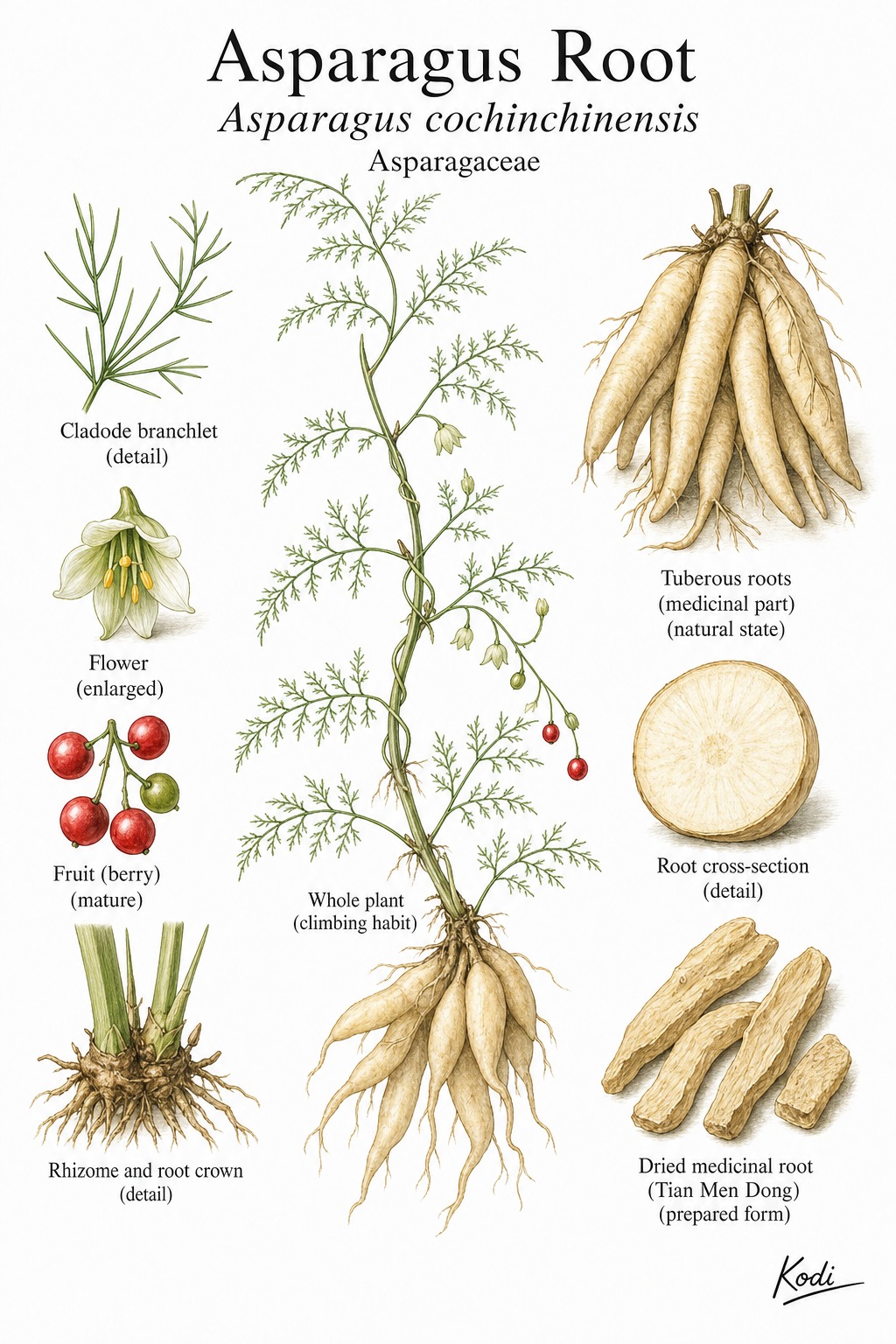
Known in TCM as Tian Men Dong (天门冬), this sweet and bitter, cold herb enters the Lung and Kidney. Traditionally, it nourishes Yin and moistens dryness, most often applied for dry cough, constipation, and diabetes. Modern research has identified Steroidal among its active constituents.
Part used: Root
Also Known As
Latin: Radix Asparagi | Pinyin: Tian Men Dong | Chinese: 天门冬
TCM Properties
- Taste
- sweet, bitter
- Temperature
- cold
- Channels
- Lung, Kidney
Traditional Use
Primary Actions
- Nourishes Yin and moistens dryness … used for chronic dryness, dry throat, and depletion of body fluids after prolonged illness
- Clears Lung Heat and generates fluids … treats dry cough, sticky sputum, blood-streaked sputum, and wasting-thirst with intense thirst
- Clears Lung Heat and descends Lung Fire … addresses sore throat, painful swallowing, and heat-aggravated cough
- Moistens the Intestines and unblocks the bowels … relieves constipation from intestinal dryness and Yin depletion
- Nourishes Kidney Yin … used for night sweats, tinnitus, hot palms and soles, and lower-jiao Yin deficiency
Secondary Actions
- Supports dual Lung-Kidney Yin deficiency patterns where dryness and deficiency heat occur together
- Honey-processed forms are favored when the main goal is chronic cough relief with added moistening
Classic Formulas
- Tian Wang Bu Xin Dan (天王补心丹) … Tian Men Dong serves as a deputy Yin tonic for Heart-Kidney disharmony with insomnia, palpitations, and restlessness
- Er Dong Tang (二冬汤) … pairs Tian Men Dong with Mai Men Dong for wasting-thirst and severe Lung-Yin dryness with thirst and cough
- San Cai Tang (三才汤) … combines Tian Men Dong with Ren Shen and Di Huang for combined Qi and Yin deficiency after chronic illness
Classical References
- Shen Nong Ben Cao Jing (Divine Husbandman's Classic of the Materia Medica) … records Tian Men Dong as a superior herb suitable for long-term use and longevity support.
- Ben Cao Gang Mu (Compendium of Materia Medica, Li Shizhen, 1578) … describes Tian Men Dong as moistening dryness, nourishing Yin, descending Fire, and clearing diseases of Lung and Kidney Heat.
- Medical traditions surrounding Er Dong preparations and Tian Wang Bu Xin Dan emphasize Tian Men Dong's ability to nourish Lung and Kidney Yin while calming deficiency-heat agitation.
Modern Research
Active Compounds
- Steroidal saponins (including dioscin and methyl protodioscin)
- Polysaccharides
- Lignans
- Amino acids
- C21-steroidal constituents
Studied Effects
- Broad anti-inflammatory, anti-asthmatic, antioxidant, neuroprotective, and gut-health potential summarized in a recent pharmacology review (PMID 36532772)
- Airway anti-inflammatory activity … methyl protodioscin reduced IL-6, TNF-alpha, IL-1beta, and inflammatory cell infiltration in acute lung-injury models (PMID 26379748)
- Cutaneous anti-inflammatory effects … Asparagus cochinchinensis extract reduced acute and chronic skin inflammation in experimental models (PMID 18691647)
PubMed References
- Asparagus cochinchinensis: A review of its botany, traditional uses, phytochemistry, pharmacology, and applications (2022)
- Methyl Protodioscin from the Roots of Asparagus cochinchinensis Attenuates Airway Inflammation by Inhibiting Cytokine Production (2015)
- Anti-inflammatory effects of Asparagus cochinchinensis extract in acute and chronic cutaneous inflammation (2009)
Safety & Interactions
Contraindications
- Spleen and Stomach deficiency-cold with loose stools or diarrhea
Cautions
- Its cold, cloying nature may impair appetite or worsen loose stools in patients with weak digestion
- Pregnancy use is traditionally approached cautiously; employ only under qualified practitioner supervision when clearly indicated
Drug Interactions
- CYP2E1 and CYP1A2 substrate drugs … Animal studies suggest Chinese asparagus may induce CYP2E1 and CYP1A2 and alter metabolism of substrate drugs (Moderate) Source: Memorial Sloan Kettering Integrative Medicine … Chinese Asparagus
Classic formulas that use Asparagus Root
Herbs are rarely taken alone in Chinese medicine. These formula pages show what this herb does inside a classic prescription and which pattern that prescription is chosen for.
Conditions
Frequently Asked Questions
What is Asparagus Root used for?
Asparagus Root is traditionally used to Nourishes Yin and moistens dryness … used for chronic dryness, dry throat, and depletion of body fluids after prolonged illness, Clears Lung Heat and generates fluids … treats dry cough, sticky sputum, blood-streaked sputum, and wasting-thirst with intense thirst, Clears Lung Heat and descends Lung Fire … addresses sore throat, painful swallowing, and heat-aggravated cough, Moistens the Intestines and unblocks the bowels … relieves constipation from intestinal dryness and Yin depletion. Research has investigated its effects on: Broad anti-inflammatory, anti-asthmatic, antioxidant, neuroprotective, and gut-health potential summarized in a recent pharmacology review (PMID 36532772); Airway anti-inflammatory activity … methyl protodioscin reduced IL-6, TNF-alpha, IL-1beta, and inflammatory cell infiltration in acute lung-injury models (PMID 26379748).
What are other names for Asparagus Root?
Asparagus Root is also known as Asparagi. In TCM: 天门冬 (Tian Men Dong); Radix Asparagi.
Is Asparagus Root safe during pregnancy?
The safety of Asparagus Root during pregnancy has not been established. Consult a qualified healthcare provider before use.
What are the contraindications for Asparagus Root?
Asparagus Root should not be used in: Spleen and Stomach deficiency-cold with loose stools or diarrhea. Consult a qualified healthcare provider before use.
Does Asparagus Root interact with any medications?
Asparagus Root may interact with: CYP2E1 and CYP1A2 substrate drugs - Animal studies suggest Chinese asparagus may induce CYP2E1 and CYP1A2 and alter metabolism of substrate drugs - (Moderate severity). Always inform your healthcare provider of any herbal supplements you are taking.