Asiatic Cornelian Cherry Fruit (Zao Pi)
- Chinese
- 枣皮
- Pinyin
- Zao Pi
- Latin
- Fructus Corni
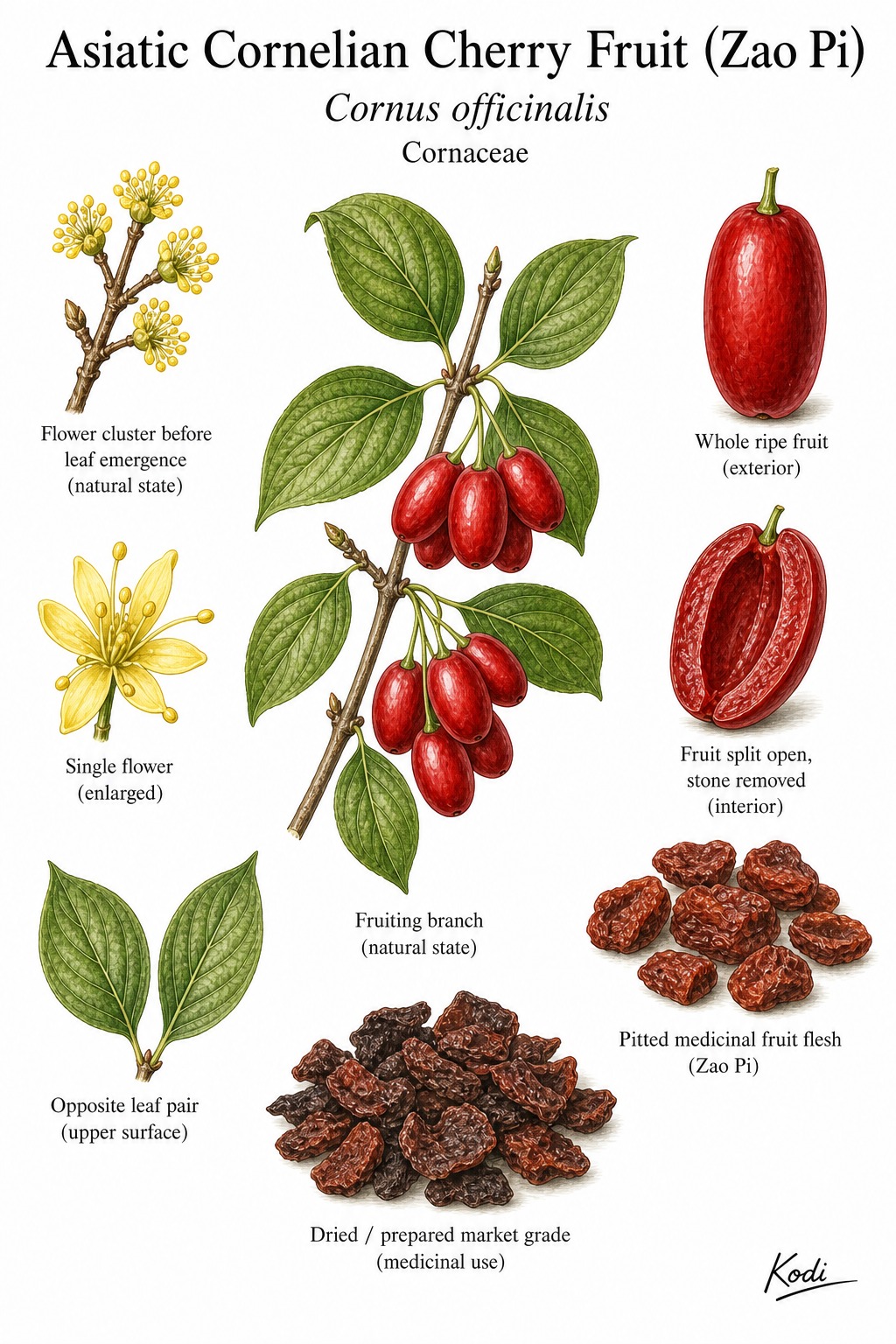
Known in TCM as Zao Pi (枣皮), this sour, warm herb enters the Liver and Kidney. Traditionally, it tonifies the Liver and Kidney and preserves essence, most often applied for frequent urination, tinnitus, and uterine bleeding. Modern research has identified Iridoid among its active constituents.
Part used: Fruit
Also Known As
Latin: Fructus Corni | Pinyin: Zao Pi | Chinese: 枣皮
TCM Properties
- Taste
- sour
- Temperature
- warm
- Channels
- Liver, Kidney
Traditional Use
Primary Actions
- Tonifies the Liver and Kidney and preserves essence … used for dizziness, tinnitus, sore lower back, weak knees, and chronic Liver-Kidney deficiency patterns
- Astringes and secures leakage … stops seminal emission, frequent urination, enuresis, and excessive sweating from deficient Kidney restraint
- Rescues collapse by restraining the outward loss of Qi and Yin … classical high-dose use for profuse sweating, faint pulse, and devastated Yang or Yin collapse
- Astringes to stop uterine bleeding … used when Chong and Ren instability from Liver-Kidney deficiency causes prolonged or excessive bleeding
Secondary Actions
- Supports Xiao Ke / wasting-thirst patterns with excessive urination rooted in Kidney deficiency
- Wine-processed form is favored for chronic tonic formulas, while raw form is used when stronger astringent rescue action is desired
Classic Formulas
- Liu Wei Di Huang Wan (六味地黄丸) … foundational Kidney Yin formula in which Shan Zhu Yu helps tonify the Liver and Kidney while securing the essence
- Zuo Gui Wan (左归丸) … enriches Kidney Yin and essence; Shan Zhu Yu helps prevent leakage while the richer tonics replenish
- Lai Fu Tang (来复汤) … rescue formula using high-dose Shan Zhu Yu with Long Gu and Mu Li for collapse with profuse sweating and scattered Qi and Yin
Classical References
- SYNONYM NOTE: Zao Pi (枣皮) is a regional or folk synonym for Shan Zhu Yu (山茱萸, herb #112). Both refer to Fructus Corni / Cornus officinalis fruit. The source XLSX imported them as separate records; this entry is retained as a separate file, but the therapeutic, research, and safety profile are shared with herb #112.
- Xiao Er Yao Zheng Zhi Jue (Song dynasty) … Liu Wei Di Huang Wan uses Shan Zhu Yu as one of the three tonifying fruits to enrich Kidney Yin while retaining essence.
- Zhang Xichun medical case tradition (late Qing / early Republic) … high-dose Shan Zhu Yu / Zao Pi use in Lai Fu Tang emphasized the fruit's ability to gather scattered Qi and Yin during collapse.
Modern Research
Active Compounds
- Iridoid glycosides (loganin, morroniside, sweroside)
- Cornuside
- Ursolic acid
- Gallic acid and related tannins
- Organic acids
- Polysaccharides
Studied Effects
- Antidiabetic and nephroprotective … Cornus officinalis and its iridoids show glucose-lowering, renal-protective, and anti-fibrotic relevance in diabetic nephropathy research (PMID 37475719)
- Anti-inflammatory, antioxidant, and neuroprotective … review literature identifies broad multi-system pharmacology consistent with traditional Liver-Kidney tonic use (PMID 33912050)
- Anti-hepatic-fibrosis … processed Cornus officinalis enhanced anti-fibrotic effects through the SIRT3-AMPK axis in experimental models (PMID 38646453)
PubMed References
- Research progress on Cornus officinalis and its active compounds in the treatment of diabetic nephropathy (2023)
- Active Components and Pharmacological Effects of Cornus officinalis: Literature Review (2021)
- Cornus officinalis with high pressure wine steaming enhanced anti-hepatic fibrosis: Possible through SIRT3-AMPK axis (2024)
Safety & Interactions
Contraindications
- Damp-Heat stranguria or painful difficult urination … the astringent nature may trap pathogenic Damp-Heat
- Exterior pathogenic disorders not yet resolved … sour astringent action may retain the pathogen
- Exuberant ministerial fire or marked Liver Yang rising … warming tonification may aggravate excess patterns
Cautions
- The seed must be removed before use; classical physicians warned that the pit opposes the medicinal action of the flesh
- High-dose rescue use should only be undertaken under experienced practitioner supervision
- MSK page not found … drug interaction data not available from Memorial Sloan Kettering integrative medicine database
Conditions
- Frequent Urination Traditional ★★★★☆ JSON
- Tinnitus Traditional ★★★☆☆ JSON
- Uterine Bleeding Traditional ★★★☆☆ JSON
- Diabetes Research ★★★☆☆ JSON
Frequently Asked Questions
What is Asiatic Cornelian Cherry Fruit (Zao Pi) used for?
Asiatic Cornelian Cherry Fruit (Zao Pi) is traditionally used to Tonifies the Liver and Kidney and preserves essence … used for dizziness, tinnitus, sore lower back, weak knees, and chronic Liver-Kidney deficiency patterns, Astringes and secures leakage … stops seminal emission, frequent urination, enuresis, and excessive sweating from deficient Kidney restraint, Rescues collapse by restraining the outward loss of Qi and Yin … classical high-dose use for profuse sweating, faint pulse, and devastated Yang or Yin collapse, Astringes to stop uterine bleeding … used when Chong and Ren instability from Liver-Kidney deficiency causes prolonged or excessive bleeding. Research has investigated its effects on: Antidiabetic and nephroprotective … Cornus officinalis and its iridoids show glucose-lowering, renal-protective, and anti-fibrotic relevance in diabetic nephropathy research (PMID 37475719); Anti-inflammatory, antioxidant, and neuroprotective … review literature identifies broad multi-system pharmacology consistent with traditional Liver-Kidney tonic use (PMID 33912050).
What are other names for Asiatic Cornelian Cherry Fruit (Zao Pi)?
Asiatic Cornelian Cherry Fruit (Zao Pi) is also known as Corni. In TCM: 枣皮 (Zao Pi); Fructus Corni.
Is Asiatic Cornelian Cherry Fruit (Zao Pi) safe during pregnancy?
Asiatic Cornelian Cherry Fruit (Zao Pi) is generally considered safe during pregnancy in normal amounts. Therapeutic or concentrated doses should be discussed with a qualified healthcare provider before use.
What are the contraindications for Asiatic Cornelian Cherry Fruit (Zao Pi)?
Asiatic Cornelian Cherry Fruit (Zao Pi) should not be used in: Damp-Heat stranguria or painful difficult urination … the astringent nature may trap pathogenic Damp-Heat; Exterior pathogenic disorders not yet resolved … sour astringent action may retain the pathogen; Exuberant ministerial fire or marked Liver Yang rising … warming tonification may aggravate excess patterns. Consult a qualified healthcare provider before use.