Arnebia Root / Gromwell Root
- Chinese
- 紫草
- Pinyin
- Zi Cao
- Latin
- Radix Arnebiae Seu Lithospermi
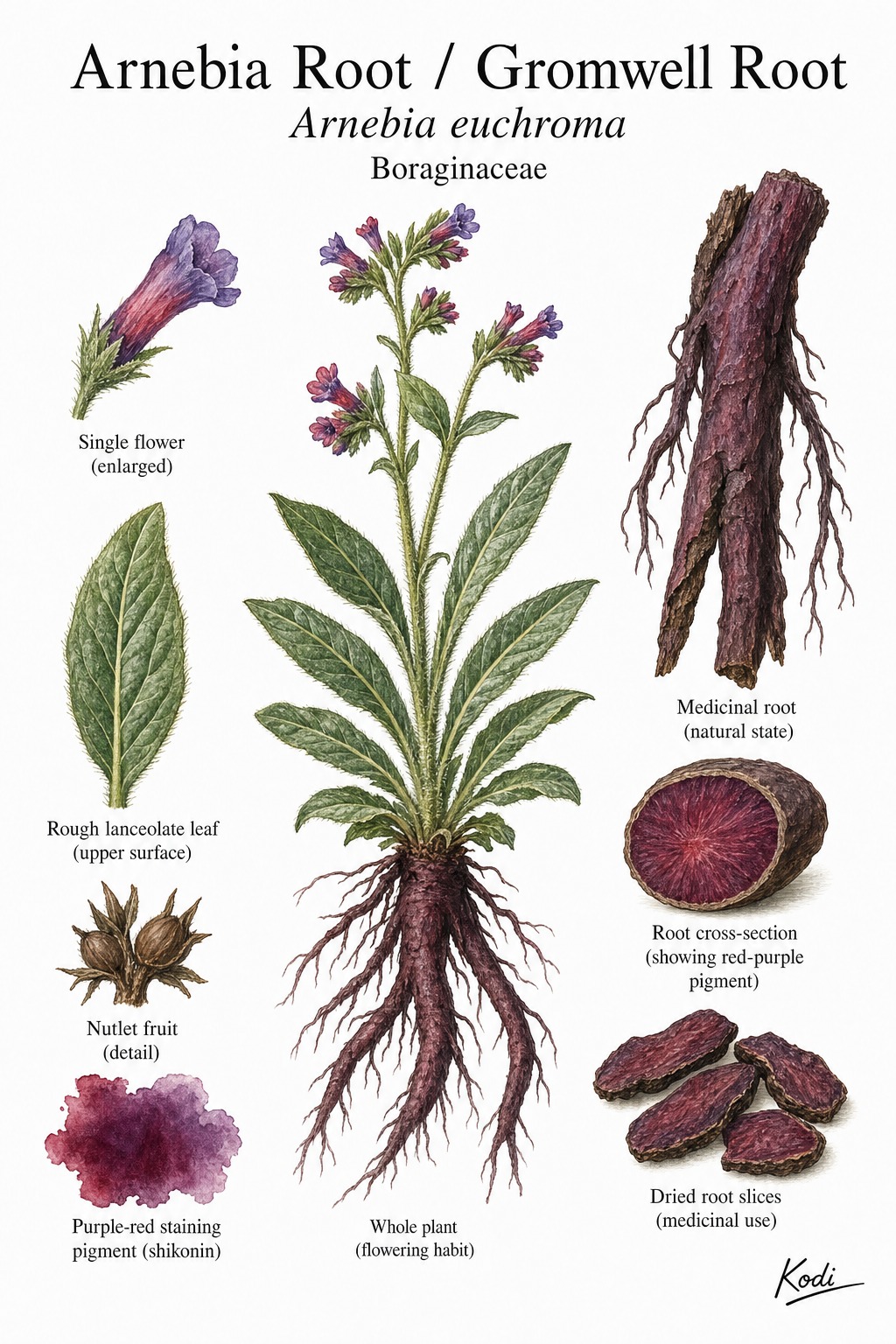
Known in TCM as Zi Cao (紫草), this sweet, cold herb enters the Heart and Liver. Traditionally, it clears Heat, cools Blood, and resolves Toxicity, most often applied for eczema, carbuncle, and fever. Modern research has identified Shikonin and acetylshikonin (hydroxynaphthoquinones) among its active constituents.
Part used: Root
Also Known As
Latin: Radix Arnebiae Seu Lithospermi | Pinyin: Zi Cao | Chinese: 紫草
TCM Properties
- Taste
- sweet
- Temperature
- cold
- Channels
- Heart, Liver
Traditional Use
Primary Actions
- Clears Heat, cools Blood, and resolves Toxicity … Blood-level Heat with skin rashes, erythema, and purpura where the rash has not fully erupted; the cold nature cools Heat in the Blood and the sweet taste enters the Liver Blood; classic indication for measles, scarlet fever, and maculopapular rashes from Heat toxin; combined with Da Qing Ye, Lian Qiao, and Gan Cao
- Promotes the eruption of rashes and measles … facilitates incomplete measles eruption by venting Heat toxin to the skin surface; combined with Chan Tui, Niu Bang Zi, and Bo He; the purple color of the herb root and its skin-level action are the TCM observational basis for this use
- Resolves Toxicity for skin lesions … topical and internal use for burns, eczema, boils, carbuncles, and infected sores; the cooling action reduces Heat swelling and promotes tissue healing; considered the foremost TCM herb for fire burns (火伤) in classical surgery texts
Secondary Actions
- Clears Damp-Heat in the lower Jiao … jaundice and urinary dysfunction with Damp-Heat etiology; less common use compared to the Blood-cooling and skin-rash indications
- Topical anti-inflammatory for dermatological conditions … eczema, psoriasis, and contact dermatitis; the purple shikonin pigment is incorporated into oil-based topical preparations (Zi Cao oil) with sesame oil or petroleum jelly carrier
Classic Formulas
- Zi Cao Hua Zhi Gao (紫草化治膏) … classical topical formula for burns, eczema, and infected skin ulcers; Zi Cao steeped in sesame oil alongside Dang Gui, Bai Zhi, and other herbs; still used in Chinese dermatology and the foundation of many modern TCM topical skin preparations
- Zi Cao San (紫草散) … for measles and rash that fails to erupt fully; Zi Cao combined with Niu Bang Zi, Chan Tui, Bo He, and Gan Cao; targets Blood-Heat obstruction that delays rash eruption
- Xiao Er Hua Ban Tang … pediatric formula for Heat rash with Blood-level involvement; Zi Cao as the primary Blood-cooling agent combined with fever-clearing herbs
Classical References
- Shen Nong Ben Cao Jing (middle class): 'Zi Cao (紫草) … bitter, cold; enters Heart channel; clears Heart Fire, cools Blood, resolves Toxicity for sores; the purple root color indicates its Blood-level action; used for skin diseases of Heat-toxic origin'
- Ben Cao Gang Mu (Li Shizhen): 'Zi Cao enters the Blood … sweet, cold; Heart governs Blood, Liver stores Blood; this herb enters both; the purple color reflects its action on Blood level; for maculae, erythema, measles rash; both internal and topical applications documented'
Modern Research
Active Compounds
- Shikonin and acetylshikonin (hydroxynaphthoquinones) … the principal purple-red pigments and major bioactive compounds; naphthoquinone class; responsible for the intense red-violet root color; anti-inflammatory, anticancer, antimicrobial, and wound-healing activity
- Alkanin … the enantiomer of shikonin found in Arnebia euchroma; similar pharmacological profile to shikonin; the two naphthoquinones together account for the majority of bioactivity
- β-acetylshikonin, β-hydroxyisovalerylshikonin, isobutyrylshikonin (shikonin ester derivatives) … multiple naphthoquinone esters with varying bioactivity profiles isolated from root extracts
- Pyrrolizidine alkaloids (low level) … present in trace amounts in Arnebia euchroma and Lithospermum erythrorhizon; substantially lower concentrations than hepatotoxic PA-containing plants such as Symphytum (comfrey); primary safety consideration for internal use
- β-sitosterol and stigmasterol (phytosterols) … anti-inflammatory contribution
- Rosmarinic acid and caffeic acid derivatives … antioxidant, anti-inflammatory polyphenols
Studied Effects
- Anti-inflammatory: shikonin inhibits NF-κB nuclear translocation, suppresses COX-2 and PGE2 production, and reduces TNF-α and IL-6 in macrophage models; validates classical Heat-clearing and Toxicity-resolving actions in skin inflammation and burns
- Anticancer: shikonin induces apoptosis via the mitochondrial pathway (caspase-3 activation, PARP cleavage) and inhibits topoisomerase II; demonstrated cytotoxicity against multiple cancer cell lines (hepatoma, breast, lung, colon); shikonin-based topical preparations are approved in China for certain skin tumors
- Wound healing and burns: topical Zi Cao preparations (shikonin in oil base) accelerate wound re-epithelialization, reduce scar formation, and inhibit bacterial colonization in burn wounds; multiple Chinese clinical trials validate the traditional burn-treatment indication
- Antiviral: shikonin demonstrates inhibitory activity against influenza A, HSV-1, and enterovirus; inhibits viral replication at multiple stages
- Pyrrolizidine alkaloid safety: PA content in properly prepared Arnebia/Lithospermum root is substantially lower than in Symphytum species; hepatotoxicity risk is considered low at standard doses (3–9 g) in short-term use, but long-term high-dose internal use warrants liver enzyme monitoring
Safety & Interactions
Contraindications
- Pregnancy … cold nature, Blood-cooling action, and pyrrolizidine alkaloid exposure; avoid internal use in all trimesters
- Spleen-Stomach Cold Deficiency … cold nature injures digestive Yang; caution in patients with chronic diarrhea, weak digestion, or Cold-pattern disorders
- Internal use at high doses or long-term … pyrrolizidine alkaloid content, although low, warrants caution; standard doses (3–9 g) for short courses are considered safe; do not exceed 2–3 week continuous internal use without monitoring
Cautions
- Pyrrolizidine alkaloids: Arnebia euchroma and Lithospermum erythrorhizon contain low-level PAs; do not use internally above 9 g/day or for extended periods; topical use has no PA-related restriction
- Two official source plants: Radix Arnebiae (Ruan Zi Cao 软紫草, from Arnebia euchroma) and Radix Lithospermi (Ying Zi Cao 硬紫草, from Lithospermum erythrorhizon) … both are Pharmacopoeia-approved; Arnebia euchroma is the primary modern source and has higher shikonin content
- Staining: shikonin imparts an intense red-purple color to formulations and skin; inform patients that topical preparations will temporarily stain skin and clothing purple-red
- Cold-pattern skin conditions: for sores or rashes without Heat (Cold-type skin disorders), Zi Cao may worsen the condition; confirm Heat pattern before prescribing
Drug Interactions
- Anticoagulants (warfarin, heparin): theoretical additive antiplatelet effect via COX-2 inhibition and reduced platelet aggregation; monitor INR if combined with anticoagulant therapy
Conditions
Frequently Asked Questions
What is Arnebia Root / Gromwell Root used for?
Arnebia Root / Gromwell Root is traditionally used to Clears Heat, cools Blood, and resolves Toxicity … Blood-level Heat with skin rashes, erythema, and purpura where the rash has not fully erupted; the cold nature cools Heat in the Blood and the sweet taste enters the Liver Blood; classic indication for measles, scarlet fever, and maculopapular rashes from Heat toxin; combined with Da Qing Ye, Lian Qiao, and Gan Cao, Promotes the eruption of rashes and measles … facilitates incomplete measles eruption by venting Heat toxin to the skin surface; combined with Chan Tui, Niu Bang Zi, and Bo He; the purple color of the herb root and its skin-level action are the TCM observational basis for this use, Resolves Toxicity for skin lesions … topical and internal use for burns, eczema, boils, carbuncles, and infected sores; the cooling action reduces Heat swelling and promotes tissue healing; considered the foremost TCM herb for fire burns (火伤) in classical surgery texts. Research has investigated its effects on: Anti-inflammatory: shikonin inhibits NF-κB nuclear translocation, suppresses COX-2 and PGE2 production, and reduces TNF-α and IL-6 in macrophage models; validates classical Heat-clearing and Toxicity-resolving actions in skin inflammation and burns; Anticancer: shikonin induces apoptosis via the mitochondrial pathway (caspase-3 activation, PARP cleavage) and inhibits topoisomerase II; demonstrated cytotoxicity against multiple cancer cell lines (hepatoma, breast, lung, colon); shikonin-based topical preparations are approved in China for certain skin tumors.
What are other names for Arnebia Root / Gromwell Root?
Arnebia Root / Gromwell Root is also known as Arnebia. In TCM: 紫草 (Zi Cao); Radix Arnebiae Seu Lithospermi.
Is Arnebia Root / Gromwell Root safe during pregnancy?
Arnebia Root / Gromwell Root is not recommended during pregnancy.
What are the contraindications for Arnebia Root / Gromwell Root?
Arnebia Root / Gromwell Root should not be used in: Pregnancy … cold nature, Blood-cooling action, and pyrrolizidine alkaloid exposure; avoid internal use in all trimesters; Spleen-Stomach Cold Deficiency … cold nature injures digestive Yang; caution in patients with chronic diarrhea, weak digestion, or Cold-pattern disorders; Internal use at high doses or long-term … pyrrolizidine alkaloid content, although low, warrants caution; standard doses (3–9 g) for short courses are considered safe; do not exceed 2–3 week continuous internal use without monitoring. Consult a qualified healthcare provider before use.
Does Arnebia Root / Gromwell Root interact with any medications?
Arnebia Root / Gromwell Root may interact with: Anticoagulants (warfarin, heparin): theoretical additive antiplatelet effect via COX-2 inhibition and reduced platelet aggregation; monitor INR if combined with anticoagulant therapy. Always inform your healthcare provider of any herbal supplements you are taking.