Areca Seed
- Chinese
- 槟榔
- Pinyin
- Bing Lang
- Latin
- Semen Arecae
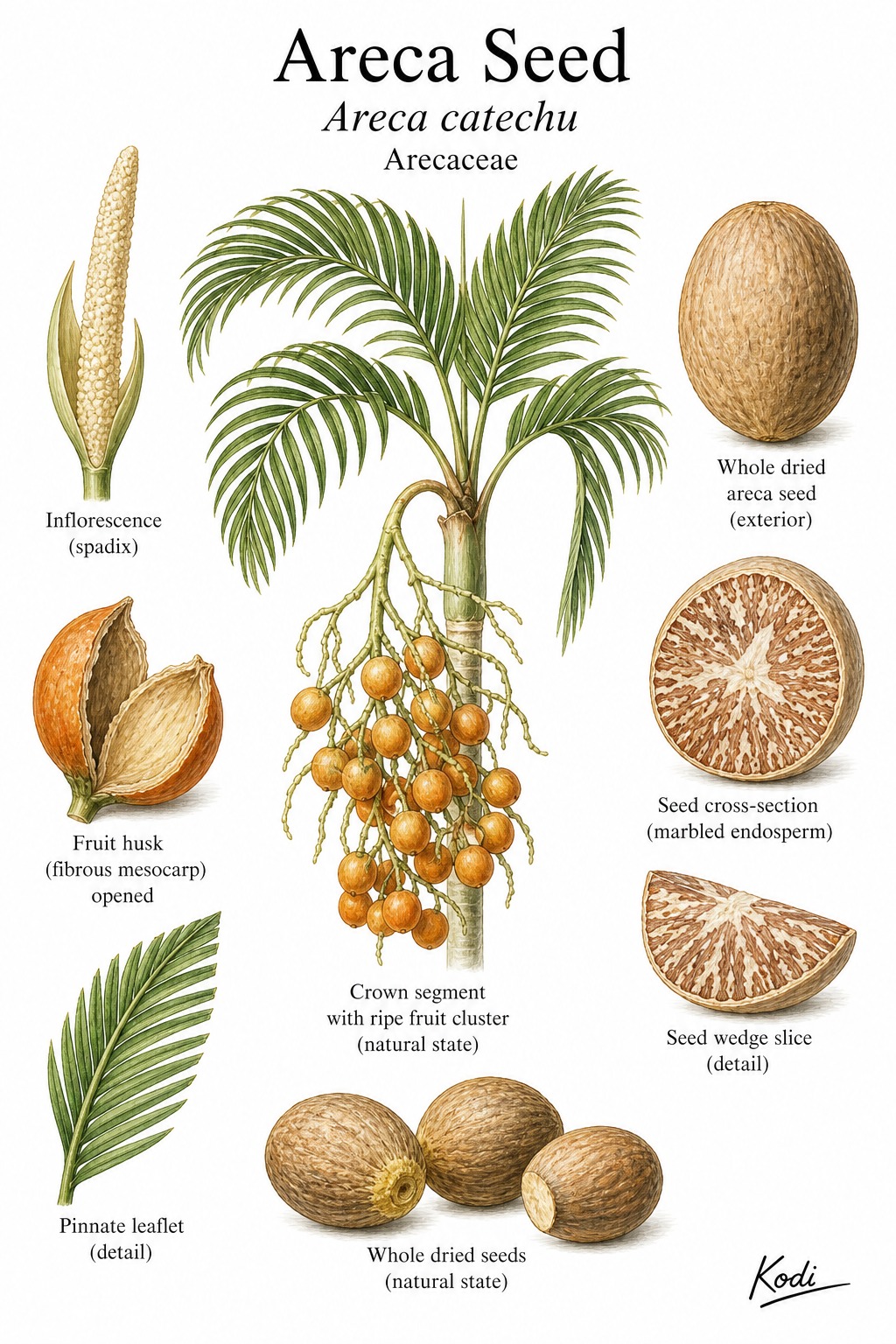
Known in TCM as Bing Lang (槟榔), this bitter and pungent, warm herb enters the Large Intestine and Stomach. Traditionally, it kills parasites and expels worms, most often applied for intestinal parasites, constipation, and abdominal pain. Modern research has identified Arecoline (principal alkaloid, ~0.5% dry weight) among its active constituents.
Part used: Seed
Also Known As
Latin: Semen Arecae | Pinyin: Bing Lang | Chinese: 槟榔
TCM Properties
- Taste
- bitter, pungent
- Temperature
- warm
- Channels
- Large Intestine, Stomach
Traditional Use
Primary Actions
- Kills parasites and expels worms … the most potent antiparasitic herb in the TCM pharmacopoeia; effective against tapeworms (Taenia solium, T. saginata), roundworms (Ascaris), pinworms (Enterobius), and liver flukes (Clonorchis); combined with Nan Gua Zi (pumpkin seeds) for tapeworm, which first immobilises the worm, then Bing Lang expels it
- Moves Qi and reduces food stagnation … abdominal distension, food stagnation, and constipation from Qi stagnation and accumulation; 'breaks Qi' (po qi) action destroys abdominal Qi blockage more forcefully than typical Qi-regulating herbs
- Promotes urination and reduces edema … water retention and edema from Qi stagnation obstructing the Triple Jiao water metabolism; combined with Mu Tong and Ze Xie
- Disperses malarial patterns … classical component of malaria-specific formulas (Jie Nue San / anti-malarial protocols); bitter-warm dispersing action on malarial Shao Yang patterns
Secondary Actions
- Descends Qi and relieves bloating … belching, fullness, and oppression in the chest-epigastric area from stagnant Qi accumulation
- Mildly laxative … bitter-warm purgation at higher doses; used in some constipation formulas
Classic Formulas
- Mu Xiang Bing Lang Wan (木香槟榔丸) … for food stagnation and Qi stagnation with abdominal pain, constipation, and dysentery; Bing Lang combined with Mu Xiang, Da Huang, Qing Pi, Chen Pi, Qian Niu Zi, and Hong Hua; classical combination formula still used for functional constipation and intestinal Qi stagnation
- Hua Chong Wan (化虫丸) … classical antiparasitic formula; Bing Lang combined with Ku Lian Pi (Melia bark), He Shi, Wu Yi, and Lei Wan; used for multiple intestinal parasites including roundworm and tapeworm
- Nan Gua Zi Bing Lang Tang (南瓜子槟榔汤) … two-herb protocol for tapeworm; pumpkin seeds (Nan Gua Zi) taken first to paralise worm, followed by Bing Lang decoction to expel; most widely used clinical tapeworm treatment in TCM before pharmaceutical anthelminthics
Classical References
- Shen Nong Ben Cao Jing: records Bing Lang (槟榔) for 'Gu (parasites), Qi stagnation, and water retention; opens the channels and eliminates Qi accumulation'
- Ben Cao Gang Mu (Li Shizhen): 'Bing Lang (槟榔) … bitter-pungent, warm; Large Intestine and Stomach; kills the 'six parasites', moves downward like an axe through Qi stagnation, reduces food accumulation, disperses water; the most powerful herb against tapeworm (Gan Tao Chong); used throughout south China and southeast Asia as a daily stimulant … this habitual use is medically separate from therapeutic TCM dosing'
- CARCINOGENICITY NOTE: Habitual betel nut chewing (Bing Lang used as a recreational stimulant … raw nut, calcium hydroxide, and often tobacco wrapped in betel leaf) is classified by IARC as a Group 1 carcinogen for oral cavity cancer and oropharyngeal cancer. This carcinogenicity applies specifically to the habitual chewing practice prevalent in Taiwan, Southeast Asia, and South/Central Asia … where 600 million people chew daily. The mechanism is arecoline-induced reactive oxygen species damage and oral submucous fibrosis. TCM therapeutic use in water decoction at standard doses (6–15 g) for short-course parasite treatment or Qi stagnation has fundamentally different pharmacokinetics (no direct mucosal contact, arecoline rapidly hydrolysed in solution) and a substantially different risk profile. Current evidence does not establish the same carcinogenicity risk for occasional therapeutic decoction use; however, long-term therapeutic use should be minimised.
Modern Research
Active Compounds
- Arecoline (principal alkaloid, ~0.5% dry weight) … muscarinic and nicotinic agonist; antiparasitic (immobilises worm musculature); CNS stimulant; basis for habitual use
- Arecaidine and guvacoline (minor pyridine alkaloids) … antiparasitic
- Tannins and condensed proanthocyanidins … antifungal, anti-inflammatory; contribute to astringent taste
- Arecatannin (hydrolysable tannin complex) … antimicrobial
- Fixed oils and fatty acids (lauric acid, myristic acid)
Studied Effects
- Antiparasitic: arecoline paralyses tapeworm and roundworm neuromuscular junctions by nicotinic acetylcholine receptor agonism causing sustained muscle contracture; in clinical trials, Nan Gua Zi + Bing Lang combination achieves 80–95% tapeworm expulsion rate; validates the principal classical antiparasitic indication; modern pharmaceutical anthelminthics (praziquantel, albendazole) have largely replaced this regimen in clinical practice
- Prokinetic and digestive: arecoline stimulates muscarinic M3 receptors in intestinal smooth muscle, increasing peristalsis and reducing transit time; validates the Qi-moving, food stagnation-dispersing classical action; arecoline is structurally related to bethanechol (pharmaceutical cholinergic prokinetic)
- Cognitive stimulant: arecoline activates CNS muscarinic M1 receptors; improves attention and working memory in preliminary human studies; basis for recreational chewing as stimulant; explains the classical 'opens the orifices' folk use for alertness
Safety & Interactions
Contraindications
- Spleen-Stomach Deficiency without Stagnation … the strongly moving, downward-driving action depletes Qi in deficiency patients without pathological accumulation
- Qi Deficiency with prolapse … rectal prolapse, uterine prolapse, and hernia are worsened by the downward-driving Qi-breaking action
Cautions
- Standard dose: 6–15 g in decoction; up to 60–120 g for tapeworm treatment (high-dose single-use); short-term only
- Cholinergic effects at high doses: excessive secretions (salivation, lacrimation, diaphoresis), bradycardia, nausea, vomiting, and bronchoconstriction from muscarinic overstimulation; high-dose tapeworm protocols require supervised administration
- IARC Group 1 (betel nut chewing): the carcinogenicity classification applies to habitual mucosal chewing, not therapeutic decoction; minimise duration of therapeutic use; do not recommend for non-therapeutic purposes
- Distinct from chewing preparations: commercial betel nut preparations (especially lime-treated and tobacco-added forms) are categorically different from TCM decoctions; patients should not self-medicate using commercial recreational betel nut products as substitutes for TCM Bing Lang decoctions
Drug Interactions
- Cholinergic drugs (physostigmine, neostigmine, pyridostigmine, donepezil, galantamine, rivastigmine) … additive muscarinic effects: bradycardia, excessive secretions, bronchospasm, seizure risk
- Anticholinergic drugs (atropine, scopolamine, hyoscine, tricyclic antidepressants, antihistamines) … pharmacodynamic antagonism; reduces efficacy of both drugs
- Beta-blockers (propranolol, metoprolol, atenolol) … arecoline muscarinic M2 agonism causes bradycardia; additive with beta-blocker AV node depression; risk of symptomatic bradycardia or heart block
- Fluphenazine and typical antipsychotics … case reports of extrapyramidal dystonia with concurrent betel nut and antipsychotic use
Classic formulas that use Areca Seed
Herbs are rarely taken alone in Chinese medicine. These formula pages show what this herb does inside a classic prescription and which pattern that prescription is chosen for.
Conditions
- Intestinal Parasites Research ★★★★★ JSON
- Constipation Traditional ★★★☆☆ JSON
- Abdominal Pain Traditional ★★☆☆☆ JSON
- Malaria Traditional ★★☆☆☆ JSON
- Dysentery Traditional ★★☆☆☆ JSON
Frequently Asked Questions
What is Areca Seed used for?
Areca Seed is traditionally used to Kills parasites and expels worms … the most potent antiparasitic herb in the TCM pharmacopoeia; effective against tapeworms (Taenia solium, T. saginata), roundworms (Ascaris), pinworms (Enterobius), and liver flukes (Clonorchis); combined with Nan Gua Zi (pumpkin seeds) for tapeworm, which first immobilises the worm, then Bing Lang expels it, Moves Qi and reduces food stagnation … abdominal distension, food stagnation, and constipation from Qi stagnation and accumulation; 'breaks Qi' (po qi) action destroys abdominal Qi blockage more forcefully than typical Qi-regulating herbs, Promotes urination and reduces edema … water retention and edema from Qi stagnation obstructing the Triple Jiao water metabolism; combined with Mu Tong and Ze Xie, Disperses malarial patterns … classical component of malaria-specific formulas (Jie Nue San / anti-malarial protocols); bitter-warm dispersing action on malarial Shao Yang patterns. Research has investigated its effects on: Antiparasitic: arecoline paralyses tapeworm and roundworm neuromuscular junctions by nicotinic acetylcholine receptor agonism causing sustained muscle contracture; in clinical trials, Nan Gua Zi + Bing Lang combination achieves 80–95% tapeworm expulsion rate; validates the principal classical antiparasitic indication; modern pharmaceutical anthelminthics (praziquantel, albendazole) have largely replaced this regimen in clinical practice; Prokinetic and digestive: arecoline stimulates muscarinic M3 receptors in intestinal smooth muscle, increasing peristalsis and reducing transit time; validates the Qi-moving, food stagnation-dispersing classical action; arecoline is structurally related to bethanechol (pharmaceutical cholinergic prokinetic).
What are other names for Areca Seed?
Areca Seed is also known as Areca. In TCM: 槟榔 (Bing Lang); Semen Arecae.
Is Areca Seed safe during pregnancy?
The safety of Areca Seed during pregnancy has not been established. Consult a qualified healthcare provider before use.
What are the contraindications for Areca Seed?
Areca Seed should not be used in: Spleen-Stomach Deficiency without Stagnation … the strongly moving, downward-driving action depletes Qi in deficiency patients without pathological accumulation; Qi Deficiency with prolapse … rectal prolapse, uterine prolapse, and hernia are worsened by the downward-driving Qi-breaking action. Consult a qualified healthcare provider before use.
Does Areca Seed interact with any medications?
Areca Seed may interact with: Cholinergic drugs (physostigmine, neostigmine, pyridostigmine, donepezil, galantamine, rivastigmine) … additive muscarinic effects: bradycardia, excessive secretions, bronchospasm, seizure risk; Anticholinergic drugs (atropine, scopolamine, hyoscine, tricyclic antidepressants, antihistamines) … pharmacodynamic antagonism; reduces efficacy of both drugs; Beta-blockers (propranolol, metoprolol, atenolol) … arecoline muscarinic M2 agonism causes bradycardia; additive with beta-blocker AV node depression; risk of symptomatic bradycardia or heart block; Fluphenazine and typical antipsychotics … case reports of extrapyramidal dystonia with concurrent betel nut and antipsychotic use. Always inform your healthcare provider of any herbal supplements you are taking.