Ark Shell
- Chinese
- 瓦楞子
- Pinyin
- Wa Leng Zi
- Latin
- Concha Arcae
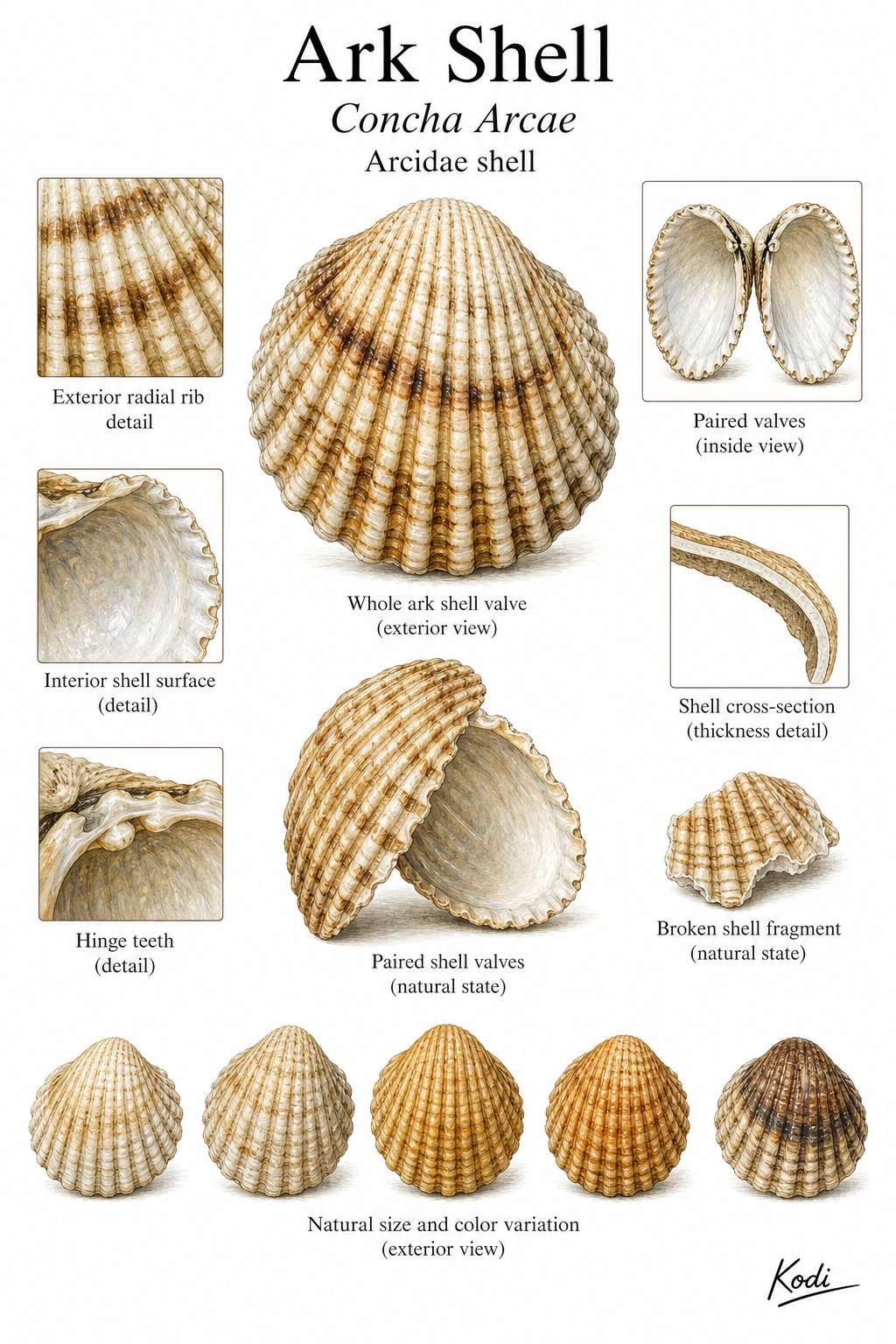
Known in TCM as Wa Leng Zi (瓦楞子), this salty, neutral herb enters the Liver, Spleen, and Stomach. Traditionally, it softens hardness and disperses nodules, most often applied for gastric ulcer, acid reflux, and thyroid nodule. Modern research has identified Calcium carbonate (CaCO₃) among its active constituents.
Part used: Shell
Also Known As
Latin: Concha Arcae | Pinyin: Wa Leng Zi | Chinese: 瓦楞子
TCM Properties
- Taste
- salty
- Temperature
- neutral
- Channels
- Liver, Spleen, Stomach
Traditional Use
Primary Actions
- Softens hardness and disperses nodules … the classic salty-taste 'ruan jian san jie' (softens the hard, disperses nodules) action; scrofula, thyroid nodules, masses from Phlegm-Blood Stasis accumulation; combined with other nodule-dispersing herbs for benign masses
- Dissolves Phlegm and resolves Blood Stasis … enlarged liver, enlarged spleen, and abdominal Zheng Jia masses from combined Phlegm-Blood Stasis; combined with San Leng, E Zhu, and Bie Jia
- Neutralises stomach acid and relieves epigastric pain … gastric hyperacidity, peptic ulcer pain, acid reflux, and heartburn; the calcined shell calcium carbonate directly neutralises gastric acid; one of the most pharmacologically validated TCM stomach acid treatments
- Stops bleeding … haematemesis and haematochezia from gastric ulceration; calcined Wa Leng Zi (Dan Wa Leng Zi) powder has astringent haemostatic action on gastric mucosal bleeding
Secondary Actions
- Reduces Pain from Liver Qi invading Stomach … epigastric and hypochondrial pain with acid regurgitation; combined with Yan Hu Suo and Wu Bei Zi for acid-pain syndrome
- Disperses swelling and reduces edema … mild edema from Qi stagnation; salty nature promotes water metabolism
Classic Formulas
- Wa Leng Zi San (瓦楞子散) … for gastric hyperacidity with epigastric pain and acid regurgitation; calcined Wa Leng Zi combined with Yan Hu Suo and Wu Bei Zi; ground to powder and taken 3–5 g before meals; classical gastric ulcer formula validated by calcium carbonate antacid mechanism
- Mass-dispersing formula combinations … Wa Leng Zi combined with Bie Jia (turtle plastron), San Leng (burreed rhizome), E Zhu (zedoary), and Mu Li (oyster shell) for abdominal masses and enlarged organs from Phlegm-Blood Stasis; salty drugs collectively 'soften the hard'
Classical References
- Ben Cao Gang Mu (Li Shizhen): 'Wa Leng Zi (瓦楞子, tile-ridged seed … named for the ribbed/ridged shell surface) … salty, neutral; enters Stomach and Spleen; calcined and powdered, dissolves Phlegm, disperses Blood Stasis, stops acid stomach pain; the ribbed shells of Arca subcrenata or Tegillarca granosa are collected from tidal flats; the ridged shell surface gives the drug its name; calcined (Dan Wa Leng Zi) increases the antacid and haemostatic actions'
- MINERAL NOTE: Wa Leng Zi is the calcified shell (calcium carbonate matrix with trace minerals) of ark clams (Arca subcrenata Lischke, Arca granosa L., or Tegillarca granosa L.) … an inorganic mineral-shell drug. The primary medicinal action of calcined Wa Leng Zi has been validated by modern pharmacology as simple calcium carbonate antacid activity, making it one of the most directly understandable TCM-to-Western medicine mechanistic translations. Raw Wa Leng Zi retains more organic matrix protein and is used for Blood Stasis mass dissolution; calcined form (Dan) is used for acid neutralisation and haemostasis.
Modern Research
Active Compounds
- Calcium carbonate (CaCO₃) … dominant component (>90% of calcined shell); validated antacid mechanism; direct pH neutralisation of gastric acid
- Organic matrix proteins and glycoproteins (raw shell fraction) … calcium-binding proteins; role in anti-proliferative and anti-Stasis activity
- Trace minerals: zinc, iron, manganese, strontium … minor constituents
- Phospholipids and fatty acids (organic residue of raw shell) … anti-inflammatory
Studied Effects
- Antacid: calcined Wa Leng Zi (Dan Wa Leng Zi) raises gastric pH from ~2 to neutral in vitro within 5 minutes at standard 3–5 g doses; in vivo studies confirm gastric acid buffering equivalent to pharmaceutical calcium carbonate antacids; the classical stomach acid-neutralising indication has direct pharmacological validation … one of the clearest TCM mechanism confirmations
- Anti-tumor: aqueous extracts of Concha Arcae protein fractions inhibit proliferation of HepG2 (liver cancer), MCF-7 (breast cancer), and HeLa (cervical cancer) cell lines in vitro; mechanism may involve lectin-type protein-carbohydrate interactions modulating cancer cell surface receptors; validates classical anti-mass indication at cellular level
- Anti-Helicobacter pylori: calcium-rich extracts from ark shell demonstrate mild bacteriostatic activity against H. pylori in vitro; synergistic with standard triple therapy in animal models; the TCM use for chronic stomach pain from acid may partly address H. pylori-associated gastritis
Safety & Interactions
Contraindications
- Spleen-Stomach Deficiency Cold with no acid … neutral-salty nature; antacid action inappropriate in hypochlorhydria (insufficient gastric acid); may impair digestion in cold-deficient patients
- Absence of Phlegm-Stasis accumulation … mass-softening action requires a pathological target; do not use as a general tonic
Cautions
- Standard dose: 9–15 g raw shell in decoction (decocted first 30 min); 1–3 g calcined powder (Dan Wa Leng Zi) for antacid and haemostatic use; taken before meals for gastric acid conditions
- Calcium-containing antacids: concurrent use with other calcium carbonate antacids (Tums, chalk) may cause milk-alkali syndrome at high doses; do not combine with multiple calcium sources long-term
- Drug separation from absorption-sensitive medications: calcium carbonate chelates fluoroquinolone antibiotics, tetracyclines, and bisphosphonates … administer Wa Leng Zi 2 hours apart from these drugs
- Thyroid hormone absorption: calcium carbonate reduces levothyroxine absorption; separate administration by ≥4 hours
Drug Interactions
- Fluoroquinolone antibiotics (ciprofloxacin, levofloxacin) … calcium chelation reduces antibiotic bioavailability by 50–70%; take antibiotic 2 hours before or 6 hours after Wa Leng Zi
- Tetracycline antibiotics … calcium chelation; same separation protocol as fluoroquinolones
- Levothyroxine … calcium impairs thyroid hormone absorption; separate by ≥4 hours
- Iron supplements … calcium inhibits non-haem iron absorption; separate administration
Conditions
- Gastric Ulcer Research ★★★★☆ JSON
- Acid Reflux Research ★★★☆☆ JSON
- Thyroid Nodule Traditional ★★★☆☆ JSON
- Uterine Bleeding Traditional ★★☆☆☆ JSON
- Abdominal Pain Traditional ★★☆☆☆ JSON
Frequently Asked Questions
What is Ark Shell used for?
Ark Shell is traditionally used to Softens hardness and disperses nodules … the classic salty-taste 'ruan jian san jie' (softens the hard, disperses nodules) action; scrofula, thyroid nodules, masses from Phlegm-Blood Stasis accumulation; combined with other nodule-dispersing herbs for benign masses, Dissolves Phlegm and resolves Blood Stasis … enlarged liver, enlarged spleen, and abdominal Zheng Jia masses from combined Phlegm-Blood Stasis; combined with San Leng, E Zhu, and Bie Jia, Neutralises stomach acid and relieves epigastric pain … gastric hyperacidity, peptic ulcer pain, acid reflux, and heartburn; the calcined shell calcium carbonate directly neutralises gastric acid; one of the most pharmacologically validated TCM stomach acid treatments, Stops bleeding … haematemesis and haematochezia from gastric ulceration; calcined Wa Leng Zi (Dan Wa Leng Zi) powder has astringent haemostatic action on gastric mucosal bleeding. Research has investigated its effects on: Antacid: calcined Wa Leng Zi (Dan Wa Leng Zi) raises gastric pH from ~2 to neutral in vitro within 5 minutes at standard 3–5 g doses; in vivo studies confirm gastric acid buffering equivalent to pharmaceutical calcium carbonate antacids; the classical stomach acid-neutralising indication has direct pharmacological validation … one of the clearest TCM mechanism confirmations; Anti-tumor: aqueous extracts of Concha Arcae protein fractions inhibit proliferation of HepG2 (liver cancer), MCF-7 (breast cancer), and HeLa (cervical cancer) cell lines in vitro; mechanism may involve lectin-type protein-carbohydrate interactions modulating cancer cell surface receptors; validates classical anti-mass indication at cellular level.
What are other names for Ark Shell?
Ark Shell is also known as Arca. In TCM: 瓦楞子 (Wa Leng Zi); Concha Arcae.
Is Ark Shell safe during pregnancy?
The safety of Ark Shell during pregnancy has not been established. Consult a qualified healthcare provider before use.
What are the contraindications for Ark Shell?
Ark Shell should not be used in: Spleen-Stomach Deficiency Cold with no acid … neutral-salty nature; antacid action inappropriate in hypochlorhydria (insufficient gastric acid); may impair digestion in cold-deficient patients; Absence of Phlegm-Stasis accumulation … mass-softening action requires a pathological target; do not use as a general tonic. Consult a qualified healthcare provider before use.
Does Ark Shell interact with any medications?
Ark Shell may interact with: Fluoroquinolone antibiotics (ciprofloxacin, levofloxacin) … calcium chelation reduces antibiotic bioavailability by 50–70%; take antibiotic 2 hours before or 6 hours after Wa Leng Zi; Tetracycline antibiotics … calcium chelation; same separation protocol as fluoroquinolones; Levothyroxine … calcium impairs thyroid hormone absorption; separate by ≥4 hours; Iron supplements … calcium inhibits non-haem iron absorption; separate administration. Always inform your healthcare provider of any herbal supplements you are taking.