American Ginseng
- Chinese
- 西洋参
- Pinyin
- Xi Yang Shen
- Latin
- Radix Panacis Quinquefolii
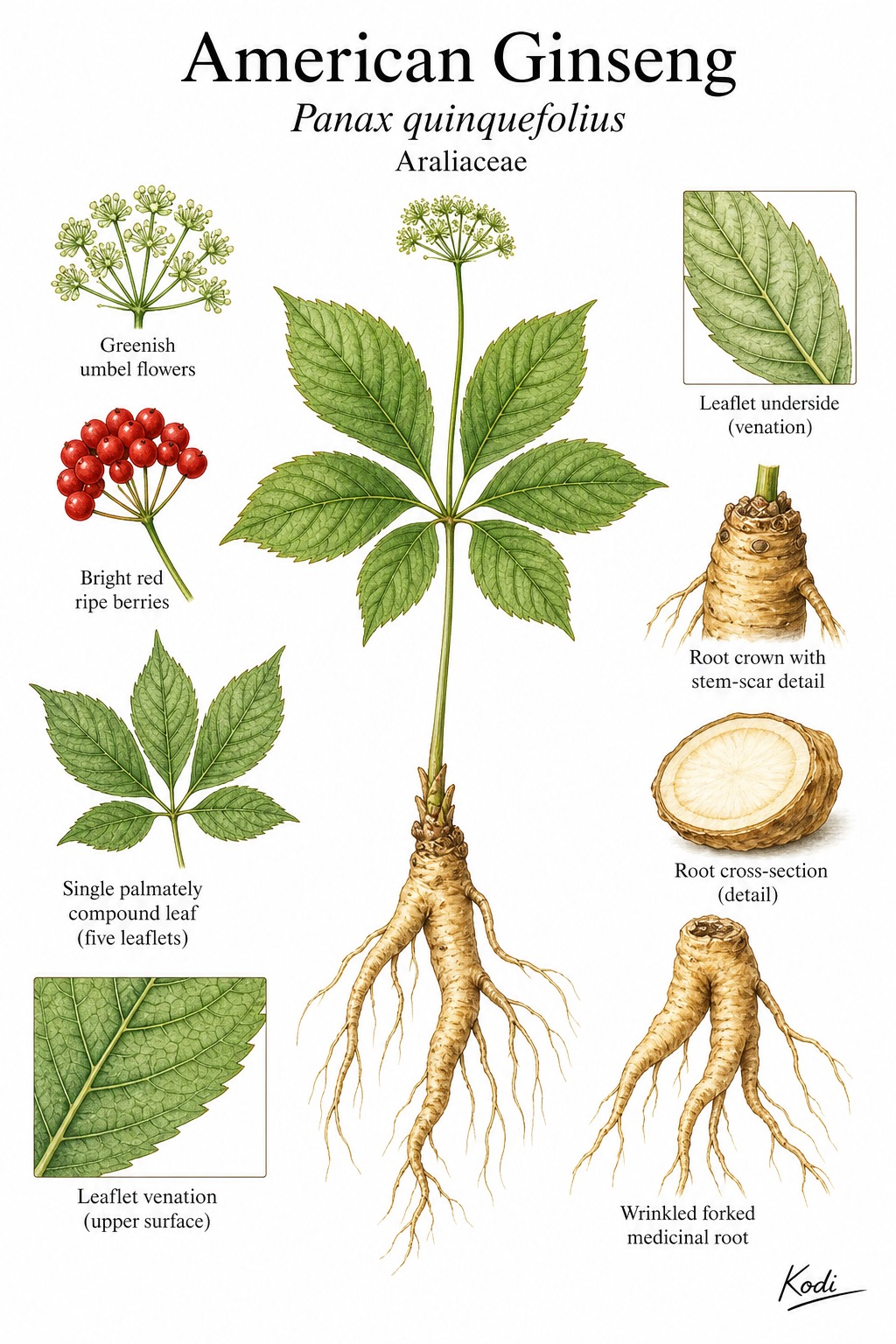
Known in TCM as Xi Yang Shen (西洋参), this sweet and slightly bitter, cool herb enters the Heart, Lung, and Kidney. Traditionally, it tonifies Qi and nourishes Yin, most often applied for diabetes, fatigue, and insomnia. Modern research has identified Ginsenosides Rb1, Rb2, Rc, Rd (protopanaxadiols) and Re, Rg1 (protopanaxatriols) among its active constituents.
Part used: Root
Also Known As
Latin: Radix Panacis Quinquefolii | Pinyin: Xi Yang Shen | Chinese: 西洋参
TCM Properties
- Taste
- sweet, slightly bitter
- Temperature
- cool
- Channels
- Heart, Lung, Kidney
Traditional Use
Primary Actions
- Tonifies Qi and nourishes Yin … combined Qi and Yin tonic for Lung and Kidney Qi-Yin Deficiency; characteristic cool temperature distinguishes Xi Yang Shen from the warm-tonifying Asian ginseng (Ren Shen); the 'cool tonifying ginseng' appropriate for deficiency patients with Heat signs who cannot tolerate the warming action of Ren Shen
- Clears Deficiency Fire … Yin Deficiency generating Heat; hot flashes, night sweats, afternoon fever, thirst with red tongue, and deficiency insomnia; the cool-tonifying action simultaneously replenishes Yin and clears the secondary Fire
- Generates Fluids and quenches thirst … Lung Qi and Yin Deficiency with chronic dry cough, dry mouth, and post-febrile fluid depletion; Wasting and Thirsting Disorder (Xiao Ke / diabetes); classical treatment for summer Heat Qi depletion with thirst
- Benefits the Lung … Lung Qi and Yin Deficiency with chronic dry cough, hemoptysis, and hoarse voice; tonifies without causing Lung Dryness (unlike warm tonics)
Secondary Actions
- Calms the Heart and quiets the Spirit … palpitations, anxiety, and insomnia from Heart Qi and Yin Deficiency; combined cardiac tonic and sedative action
- Post-illness recovery … Qi and fluid depletion after prolonged febrile illness; the cool tonifying property replenishes without creating further Heat burden … preferable to Ren Shen in post-fever recovery
Classic Formulas
- Sheng Mai San (生脉散) with Xi Yang Shen … classical Qi + Yin + Fluid tonic formula (Ren Shen/Xi Yang Shen, Mai Men Dong, Wu Wei Zi); Xi Yang Shen substituted for Ren Shen when the patient has heat signs; widely used for cardiac Qi-Yin Deficiency, heart failure support, and post-illness recovery; one of the most commonly used cardiotonic formulas in contemporary TCM
- Qing Shu Yi Qi Tang (清暑益气汤) variant … summer Heat Qi and Yin Depletion formula; Xi Yang Shen the principal Qi tonic for summer depletion patterns with thirst, fatigue, and fever; Wang Mengying's version uses Xi Yang Shen (cooler) rather than Ren Shen (warmer) for summer use
Classical References
- Ben Cao Cong Xin (Wu Yiluo, 1757 CE): 'Xi Yang Shen (Western Ocean Ginseng) arrives from North America via Canton trade … sweet and slightly bitter, cool; tonifies Qi without causing Fire, generates Fluids, clears deficiency Heat … superior to Ren Shen for patients with Qi deficiency who have Fire from Deficiency; appropriate where Ren Shen would be too warming'
- Ben Cao Bei Yao Supplement: 'Xi Yang Shen tonifies Lung Qi and Yin, clears Fire, generates Fluids; it does not cause heat as does Ren Shen … it entered Chinese medicine in the early Qing dynasty as a valuable import herb and was quickly recognised as a distinct and useful Qi tonic for heat-type presentations'
- BOTANICAL NOTE: Xi Yang Shen (西洋参) is Panax quinquefolius L. (Araliaceae) … American ginseng native to eastern North America (Appalachian forests, Wisconsin, Ontario); introduced to Chinese medicine in the late 17th–early 18th century via Canton Jesuit traders; now widely cultivated in Wisconsin (USA), Ontario (Canada), and increasingly in China (Zhejiang, Shandong); wild-harvested American ginseng is CITES Appendix II listed (trade regulated); cultivated sources dominate the market.
Modern Research
Active Compounds
- Ginsenosides Rb1, Rb2, Rc, Rd (protopanaxadiols) and Re, Rg1 (protopanaxatriols) … same class as Asian ginseng; Rb1/Rg1 ratio higher in P. quinquefolius, contributing to cooler energetic profile (Rb1 more sedating, Rg1 more stimulating)
- Quinquefolans A, B, C (polysaccharides) … antidiabetic; enhance insulin sensitivity
- Panaxynol and panaxydol (polyacetylenes) … anti-inflammatory, antiproliferative
- Phytosterols (β-sitosterol, stigmasterol) … cardiovascular protective
- Vitamin C, B vitamins, and minerals (Mn, Fe, Ca)
Studied Effects
- Antidiabetic: RCT by Vuksan et al. (JAMA 2000) demonstrated that 3 g American ginseng taken 40 minutes before a glucose challenge significantly reduced postprandial blood glucose in both type 2 diabetic and non-diabetic subjects; mechanism involves quinquefolan polysaccharide stimulation of insulin secretion and ginsenoside improvement of peripheral insulin sensitivity; validates the classical Xiao Ke (wasting-thirst/diabetes) indication
- Adaptogenic and cognitive: systematic review of P. quinquefolius trials shows consistent improvement in sustained attention and working memory in healthy volunteers and mild cognitive impairment; ginsenoside-mediated neuroprotection via NGF upregulation, antioxidant, and anti-inflammatory pathways; adaptogenic HPA-axis modulation reduces cortisol response to psychological stress
- Cardiovascular: Sheng Mai San with Xi Yang Shen clinical studies in CHF patients show improved cardiac contractility (ejection fraction), reduced NT-proBNP, and improved exercise tolerance; ginsenosides improve coronary endothelial function and reduce LDL oxidation in multiple RCTs; validates traditional Heart Qi-Yin tonifying indication
Safety & Interactions
Contraindications
- Excess Heat or Fire patterns without Yin Deficiency … though cooler than Asian ginseng, Xi Yang Shen is still a powerful tonic; avoid in acute excess Fire conditions
- Spleen-Stomach Deficiency Cold … the slightly cold temperature injures digestive Yang in Cold-Deficiency patterns; cold limbs, loose stools, and poor appetite worsen with prolonged use
- Concurrent warfarin therapy (relative contraindication) … American ginseng reduces warfarin efficacy; see drug interactions
Cautions
- Standard dose: 3–6 g as slice decoction or powder; 1–3 g as separate infusion (separately decocted from other herbs to preserve delicate Qi); consumed with meals to reduce gastric irritation
- Caution with prolonged high-dose use: may cause insomnia, palpitations, or Qi stagnation (ginseng abuse syndrome) if used at supratherapeutic doses
- Quality and adulteration: genuine Xi Yang Shen has a characteristic odour and cross-sectional starch pattern; widely adulterated with Ren Shen (Asian ginseng) … the two have different pharmacological profiles; verify by ginsenoside HPLC ratio testing in clinical contexts
Drug Interactions
- Warfarin … CLINICAL ALERT: American ginseng significantly reduces warfarin INR; double-blind RCT (Yuan et al., JAMA 2004) showed 0.6 points lower peak INR and reduced AUC with concurrent Xi Yang Shen at 1 g three times daily; mechanism unclear (possible CYP2C9 induction); CONTRAINDICATED or requires intensive INR monitoring
- Antidiabetic medications (insulin, metformin, sulfonylureas) … additive glucose-lowering effect; risk of hypoglycaemia; monitor blood glucose
- Immunosuppressants (cyclosporine, tacrolimus) … ginsenosides stimulate NK cell and T-lymphocyte activity; theoretical antagonism; monitor levels in transplant patients
- MAOIs … rare case reports of serotonergic agitation; theoretical pharmacodynamic interaction; avoid concurrent use
- CNS stimulants and sedatives … bidirectional CNS ginsenoside effects; monitor when combining with psychoactive medications
Classic formulas that use American Ginseng
Herbs are rarely taken alone in Chinese medicine. These formula pages show what this herb does inside a classic prescription and which pattern that prescription is chosen for.
Conditions
Frequently Asked Questions
What is American Ginseng used for?
American Ginseng is traditionally used to Tonifies Qi and nourishes Yin … combined Qi and Yin tonic for Lung and Kidney Qi-Yin Deficiency; characteristic cool temperature distinguishes Xi Yang Shen from the warm-tonifying Asian ginseng (Ren Shen); the 'cool tonifying ginseng' appropriate for deficiency patients with Heat signs who cannot tolerate the warming action of Ren Shen, Clears Deficiency Fire … Yin Deficiency generating Heat; hot flashes, night sweats, afternoon fever, thirst with red tongue, and deficiency insomnia; the cool-tonifying action simultaneously replenishes Yin and clears the secondary Fire, Generates Fluids and quenches thirst … Lung Qi and Yin Deficiency with chronic dry cough, dry mouth, and post-febrile fluid depletion; Wasting and Thirsting Disorder (Xiao Ke / diabetes); classical treatment for summer Heat Qi depletion with thirst, Benefits the Lung … Lung Qi and Yin Deficiency with chronic dry cough, hemoptysis, and hoarse voice; tonifies without causing Lung Dryness (unlike warm tonics). Research has investigated its effects on: Antidiabetic: RCT by Vuksan et al. (JAMA 2000) demonstrated that 3 g American ginseng taken 40 minutes before a glucose challenge significantly reduced postprandial blood glucose in both type 2 diabetic and non-diabetic subjects; mechanism involves quinquefolan polysaccharide stimulation of insulin secretion and ginsenoside improvement of peripheral insulin sensitivity; validates the classical Xiao Ke (wasting-thirst/diabetes) indication; Adaptogenic and cognitive: systematic review of P. quinquefolius trials shows consistent improvement in sustained attention and working memory in healthy volunteers and mild cognitive impairment; ginsenoside-mediated neuroprotection via NGF upregulation, antioxidant, and anti-inflammatory pathways; adaptogenic HPA-axis modulation reduces cortisol response to psychological stress.
What are other names for American Ginseng?
American Ginseng is also known as Panacis. In TCM: 西洋参 (Xi Yang Shen); Radix Panacis Quinquefolii.
Is American Ginseng safe during pregnancy?
The safety of American Ginseng during pregnancy has not been established. Consult a qualified healthcare provider before use.
What are the contraindications for American Ginseng?
American Ginseng should not be used in: Excess Heat or Fire patterns without Yin Deficiency … though cooler than Asian ginseng, Xi Yang Shen is still a powerful tonic; avoid in acute excess Fire conditions; Spleen-Stomach Deficiency Cold … the slightly cold temperature injures digestive Yang in Cold-Deficiency patterns; cold limbs, loose stools, and poor appetite worsen with prolonged use; Concurrent warfarin therapy (relative contraindication) … American ginseng reduces warfarin efficacy; see drug interactions. Consult a qualified healthcare provider before use.
Does American Ginseng interact with any medications?
American Ginseng may interact with: Warfarin … CLINICAL ALERT: American ginseng significantly reduces warfarin INR; double-blind RCT (Yuan et al., JAMA 2004) showed 0.6 points lower peak INR and reduced AUC with concurrent Xi Yang Shen at 1 g three times daily; mechanism unclear (possible CYP2C9 induction); CONTRAINDICATED or requires intensive INR monitoring; Antidiabetic medications (insulin, metformin, sulfonylureas) … additive glucose-lowering effect; risk of hypoglycaemia; monitor blood glucose; Immunosuppressants (cyclosporine, tacrolimus) … ginsenosides stimulate NK cell and T-lymphocyte activity; theoretical antagonism; monitor levels in transplant patients; MAOIs … rare case reports of serotonergic agitation; theoretical pharmacodynamic interaction; avoid concurrent use. Always inform your healthcare provider of any herbal supplements you are taking.