Baltic Amber
- Chinese
- 西琥珀
- Pinyin
- Xi Hu Po
- Latin
- Succinus
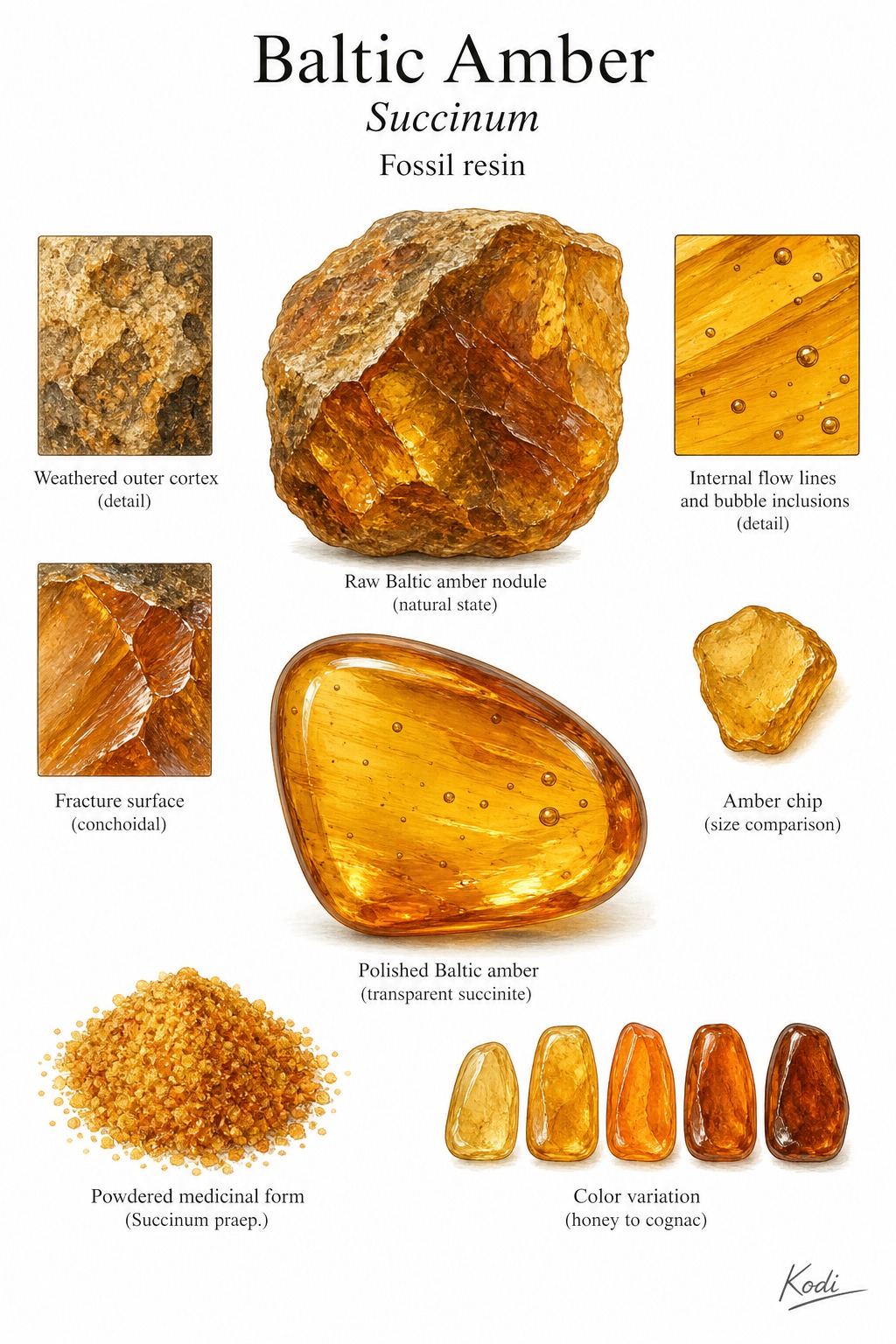
Known in TCM as Xi Hu Po (西琥珀), this sweet, neutral herb enters the Heart, Liver, and Urinary Bladder. Traditionally, it quiets the Spirit and calms the Heart (An Shen), most often applied for insomnia, anxiety, and palpitations. Modern research has identified Succinic acid (amber acid) among its active constituents.
Part used: Amber
TCM Properties
- Taste
- sweet
- Temperature
- neutral
- Channels
- Heart, Liver, Urinary Bladder
Traditional Use
Primary Actions
- Quiets the Spirit and calms the Heart (An Shen) … palpitations, anxiety, insomnia, and nightmares from Heart Shen disturbance; Xi Hu Po (Western/Baltic amber) was historically regarded as the highest-quality grade of amber in Chinese TCM, imported via Silk Road trade; same principal Spirit-calming actions as domestic Hu Po (herb #98)
- Activates Blood and dissolves Blood Stasis … amenorrhea, dysmenorrhea, and Blood Stasis in the Liver channel; descending Blood-moving action reaches the lower jiao
- Promotes urination and dissolves Bladder Stagnation … dysuria, haematuria, and urinary Lin strangury; classical use for Blood Lin and Stone Lin patterns
Secondary Actions
- Higher-grade Spirit-calming tonic … Xi (西, Western/Occidental) designates Baltic amber imported via Central Asia or Canton trade routes; Chinese physicians regarded imported Baltic amber as superior in medicinal potency to domestic amber from Yunnan or Liaoning; the same TCM indications apply but quality-conscious formulators preferred Xi Hu Po for severe or refractory Shen disturbances
- Topical wound-healing … dusted as powder onto chronic non-healing ulcers and infected wounds; same external application as Hu Po
Classic Formulas
- Xi Hu Po An Shen Wan variant … high-grade insomnia and palpitation formula specifying Xi Hu Po rather than generic Hu Po; combined with Suan Zao Ren, Long Yan Rou, Ren Shen, and Fu Ling; in contemporary practice the Xi/domestic distinction is rarely made as authentic Baltic amber of historical quality is difficult to source
- Hu Po San (琥珀散) … urinary strangury formula; Xi Hu Po used interchangeably with Hu Po in this formula; see herb #98 for formula details
Classical References
- Ben Cao Gang Mu (Li Shizhen): distinguishes several grades of Hu Po … 'Xi Hu Po (western amber) is imported from the Western Ocean via Guangdong; golden-yellow, transparent, and of larger crystal size; regarded as the best medicinal grade … the same properties as domestic Hu Po but greater potency; domestic amber from Yunnan and Guangxi is of lower grade'
- PROVENANCE NOTE: Xi Hu Po (西琥珀, 'Western amber') designates Baltic or Middle Eastern amber imported into China via Silk Road trade routes, historically arriving through Central Asia or via Canton (Guangzhou) maritime trade; Baltic amber (succinite, from the Baltic Sea region of northern Europe) has a higher succinic acid content (3–8%) and different resin acid profile than Southeast Asian and Chinese domestic ambers; the XLSX source filed two entries for Succinus … Hu Po (#98, domestic) and Xi Hu Po (#99, Western/imported grade); in modern TCM pharmacy the distinction is rarely observed in clinical dispensing.
Modern Research
Active Compounds
- Succinic acid (amber acid) … higher concentration in Baltic amber (succinite) vs some domestic amber varieties; 3–8% content in authentic Baltic succinite
- Abietic acid, communic acid, and agathic acid (diterpenoid resin acids) … characteristic of Baltic succinite; anti-inflammatory
- Phenolic antioxidants … minor fraction; antioxidant activity
Studied Effects
- Baltic amber succinic acid: succinic acid content has been better characterised in Baltic amber than in many domestic Chinese amber sources; anti-inflammatory and neuroprotective effects of succinic acid are documented in cell models; the higher succinic acid content of Baltic succinite may partially explain the historical TCM preference for Xi Hu Po over domestic amber for Shen-calming applications
- Identical pharmacological profile to Hu Po (#98): same drug substance (Succinus), same active compound classes, same studied effects … see herb #98 for complete research summary
Safety & Interactions
Contraindications
- Yin Deficiency with hyperactive Fire … Blood-activating properties may aggravate restlessness
- No Blood Stasis present … Blood-moving drugs inappropriate in pure deficiency patterns without stagnation
Cautions
- Standard dose: 1.5–3 g powder taken with decoction; NOT decocted … heat degrades amber; always chong fu (add to finished liquid)
- Adulteration is severe: Xi Hu Po labelling is particularly prone to fraud given the premium price; copal, synthetic amber, and ordinary domestic amber are frequently sold as Xi Hu Po; verify by hot-needle test (pine-resin aroma), density test (floats in saturated brine ~1.05–1.10 g/cm³), and UV fluorescence (Baltic amber fluoresces blue under UV; copal fluoresces differently)
- See Hu Po (herb #98) for full safety profile … identical drug substance
Conditions
- Insomnia Traditional ★★★★☆ JSON
- Anxiety Traditional ★★★☆☆ JSON
- Palpitations Traditional ★★★☆☆ JSON
- Dysmenorrhea Traditional ★★☆☆☆ JSON
- Urinary Tract Infection Traditional ★★☆☆☆ JSON
Frequently Asked Questions
What is Baltic Amber used for?
Baltic Amber is traditionally used to Quiets the Spirit and calms the Heart (An Shen) … palpitations, anxiety, insomnia, and nightmares from Heart Shen disturbance; Xi Hu Po (Western/Baltic amber) was historically regarded as the highest-quality grade of amber in Chinese TCM, imported via Silk Road trade; same principal Spirit-calming actions as domestic Hu Po (herb #98), Activates Blood and dissolves Blood Stasis … amenorrhea, dysmenorrhea, and Blood Stasis in the Liver channel; descending Blood-moving action reaches the lower jiao, Promotes urination and dissolves Bladder Stagnation … dysuria, haematuria, and urinary Lin strangury; classical use for Blood Lin and Stone Lin patterns. Research has investigated its effects on: Baltic amber succinic acid: succinic acid content has been better characterised in Baltic amber than in many domestic Chinese amber sources; anti-inflammatory and neuroprotective effects of succinic acid are documented in cell models; the higher succinic acid content of Baltic succinite may partially explain the historical TCM preference for Xi Hu Po over domestic amber for Shen-calming applications; Identical pharmacological profile to Hu Po (#98): same drug substance (Succinus), same active compound classes, same studied effects … see herb #98 for complete research summary.
Is Baltic Amber safe during pregnancy?
The safety of Baltic Amber during pregnancy has not been established. Consult a qualified healthcare provider before use.
What are the contraindications for Baltic Amber?
Baltic Amber should not be used in: Yin Deficiency with hyperactive Fire … Blood-activating properties may aggravate restlessness; No Blood Stasis present … Blood-moving drugs inappropriate in pure deficiency patterns without stagnation. Consult a qualified healthcare provider before use.