Aloe
- Chinese
- 芦荟
- Pinyin
- Lu Hui
- Latin
- Aloe
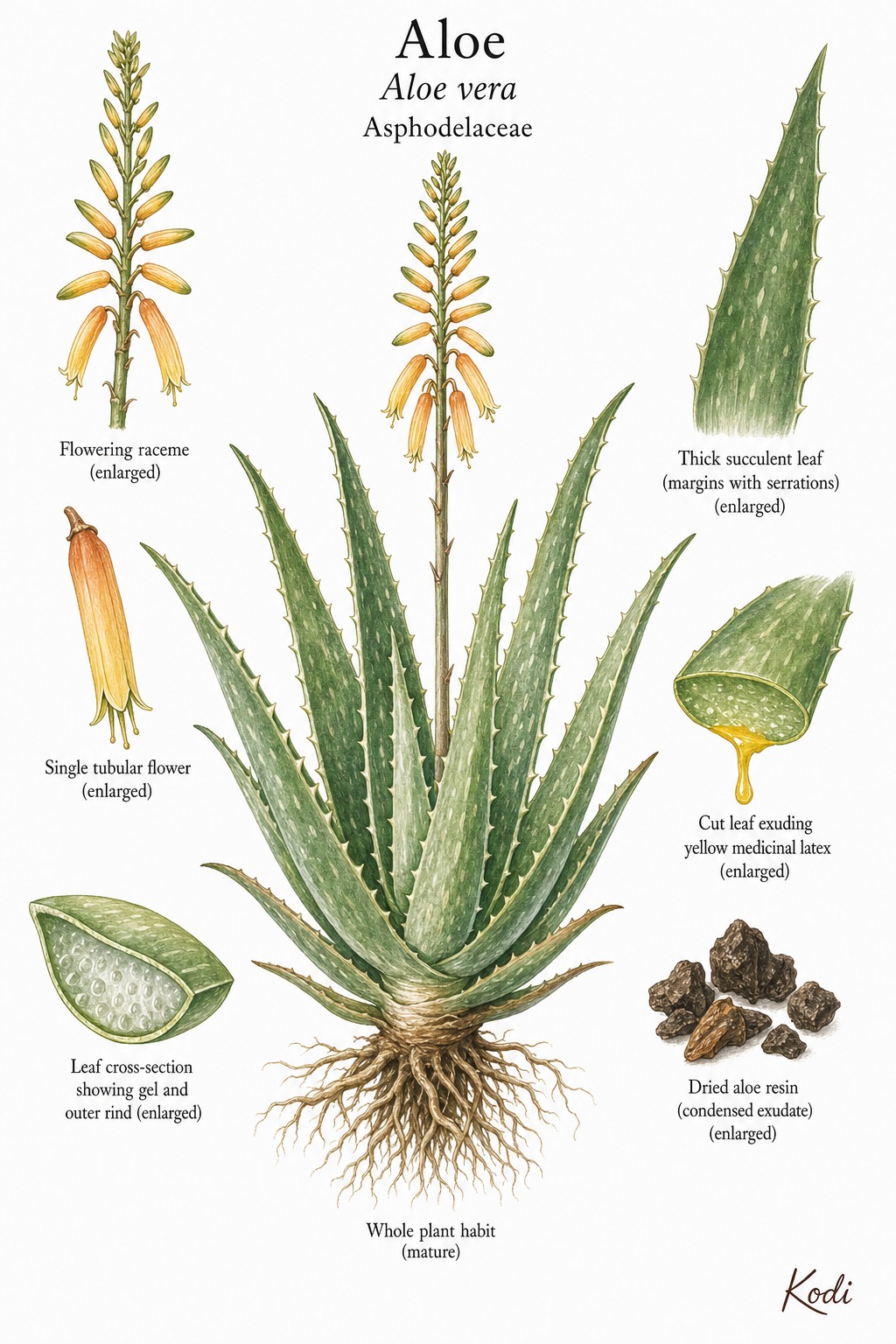
Known in TCM as Lu Hui (芦荟), this bitter, cold herb enters the Liver, Large Intestine, and Stomach. Traditionally, it drains Fire and purges the bowels, most often applied for constipation, headache, and skin burns. Modern research has identified Aloin A and B (barbaloin) among its active constituents.
TCM Properties
- Taste
- bitter
- Temperature
- cold
- Channels
- Liver, Large Intestine, Stomach
Traditional Use
Primary Actions
- Drains Fire and purges the bowels … strong purgative for constipation from Heat accumulation in the Large Intestine; Heat-Dryness type constipation with dry stools, burning sensation, and dark urine; one of the most reliable cold-purgative herbs in the TCM pharmacopoeia
- Clears Liver Fire … ascending Liver Fire with headache, dizziness, tinnitus, red eyes, irritability, and insomnia; bitter-cold nature directly drains excess Heat from the Liver channel
- Kills intestinal parasites … roundworm (Ascaris) and pinworm infestation; classical antiparasitic application combined with purgative action to expel worms
- Clears Heat and resolves toxicity externally … fresh gel or dried powder applied topically to burns, scalds, infected wounds, skin rashes, and herpetic lesions
Secondary Actions
- Promotes menstruation … amenorrhea from Heat constraint in the Blood; bitter-cold descending action opens the Chong channel; used cautiously for excess patterns only
- External topical use … raw Aloe vera leaf gel widely applied in folk practice for burns, sunburn, eczema, and infected sores; the gel (inner clear fraction) is distinct from the dried latex (TCM drug)
Classic Formulas
- Dang Gui Long Hui Wan (当归龙荟丸) … major formula for Liver-Gallbladder Fire excess; Lu Hui combined with Dang Gui, Long Dan Cao, Huang Lian, Huang Qin, Huang Bai, Zhi Zi, Mu Xiang, and Da Huang; indications: severe insomnia, agitation, constipation, dizziness, and tinnitus from raging Liver-Gallbladder Fire; one of the classical formulas where Lu Hui is the principal Fire-draining herb
- Geng Yi Wan (更衣丸) … classical two-herb pill for Liver Fire constipation; Lu Hui combined with Zhu Sha (cinnabar); purges Liver Fire and opens the bowels; modern use rare due to Zhu Sha mercury toxicity; Lu Hui alone used as a substitute in current practice
Classical References
- Ben Cao Jing Ji Zhu (Tao Hongjing, 500 CE): 'Lu Hui is bitter and cold … it purges Fire, kills worms, and clears the bowels; useful when Heat has accumulated and the bowels are blocked'
- Ben Cao Gang Mu (Li Shizhen): 'Lu Hui (芦荟) clears Liver Fire, purges Heat accumulation, kills intestinal insects … it is extremely bitter and cold; do not use in Spleen-Cold or Stomach-Cold patterns; injures the digestive Yang if used inappropriately; the name Lu Hui (芦, reed + 荟, congregate) refers to the exuded juice that dries into the drug'
- DRUG NOTE: The TCM drug Lu Hui is the dried condensed exudate (aloe latex/juice) from the cut leaves of Aloe vera L. Burm.f. (Curacao aloe) or Aloe ferox Mill. (Cape aloe) … NOT the clear inner gel. The dried exudate concentrates anthraquinone glycosides (aloin). The clear inner gel fraction used in cosmetics has negligible aloin content and does NOT share the purgative, uterotonic, or anthraquinone-related contraindications of the TCM drug.
Modern Research
Active Compounds
- Aloin A and B (barbaloin) … anthraquinone C-glycosides; principal purgative compounds; stimulate ENS and colonic secretory prostaglandins
- Aloe-emodin … anthraquinone aglycone; purgative, antiparasitic, anti-inflammatory; IARC Group 2B (possibly carcinogenic; rodent data only)
- Emodin … anthraquinone; anti-inflammatory, anticancer in vitro (BCL-2 modulation, HER2 inhibition)
- Acemannan … high-MW polysaccharide (inner gel fraction); immunostimulatory, wound-healing, antiviral; distinct from anthraquinone fraction
- Aloesin and aloeresin A (chromones) … anti-inflammatory, antioxidant, tyrosinase inhibition (topical depigmentation)
- Anthraquinone glycoside complex … collective purgative mechanism: colon-specific hydrolysis to free anthraquinones by gut bacteria
Studied Effects
- Stimulant laxative: aloin A undergoes bacterial hydrolysis in the colon to form aloe-emodin anthrone, which inhibits colonic water/electrolyte absorption and stimulates secretory PGE2, increasing intestinal motility; clinical studies confirm dose-dependent purgative efficacy within 6–12 hours; validates the classical Heat-type constipation application
- Wound healing and anti-inflammatory (topical gel): acemannan from the inner gel fraction promotes fibroblast proliferation, collagen synthesis, and re-epithelialisation in burn and wound models; reduces pro-inflammatory cytokines (IL-1β, TNF-α) at wound sites; clinical evidence supports topical aloe gel for minor burns and radiation dermatitis
- Antidiabetic: aloe vera gel extracts reduce fasting blood glucose and improve HbA1c in clinical trials involving type 2 diabetic patients; mechanism involves α-glucosidase inhibition and improved insulin sensitivity; five RCTs included in a 2016 meta-analysis (pooled FBG reduction ~46 mg/dL); relevant caution for additive effects with antidiabetic drugs
Safety & Interactions
Contraindications
- Pregnancy … absolutely contraindicated; aloin is a potent uterotonic causing uterine smooth muscle contractions; significant risk of miscarriage or premature labour at therapeutic doses; one of the most consistent pregnancy contraindications across all TCM and Western herbalism sources
- Spleen-Stomach Deficiency Cold … bitter-cold nature severely injures digestive Yang; one of the primary traditional contraindications: fatigue, loose stools, cold limbs, and poor appetite all worsen with Lu Hui
- Intestinal Cold patterns … Cold-type constipation and abdominal cold-pain; purgative warming strategy required, not cold draining
- Inflammatory bowel disease (Crohn's disease, ulcerative colitis) … stimulant purgation exacerbates intestinal inflammation; anthraquinone irritant action contraindicated in active IBD
- Children under 12 … stimulant anthraquinone laxatives not recommended in paediatric practice
Cautions
- Standard dose: 0.6–1.5 g dried aloe powder in pill or powder form; 1–2 g maximum per dose; do NOT use as decoction (aloin is poorly extracted and bitter taste intolerable); short-term use only
- Long-term use risk: chronic use >10 days causes electrolyte imbalance (hypokalemia), melanosis coli (brown pigment deposition in colonic mucosa … benign but a marker of chronic irritant laxative use), and potential laxative dependency
- IARC classification: aloe-emodin and aloin are classified IARC Group 2B (possibly carcinogenic to humans) based on rodent bioassays at high doses; no confirmed human carcinogenicity; use short-term only at therapeutic doses
- Distinguish TCM Lu Hui (dried latex exudate, anthraquinone-rich) from cosmetic aloe vera gel (inner clear gel, acemannan-rich, minimal aloin) … the purgative and uterotonic contraindications apply to the dried latex/TCM drug, not the gel
Drug Interactions
- Cardiac glycosides (digoxin, digitoxin) … CONTRAINDICATED: aloin-induced purgation causes hypokalemia, which dramatically potentiates cardiac glycoside toxicity and arrhythmia risk; do not use Lu Hui in any patient on cardiac glycosides
- Loop diuretics (furosemide, bumetanide) and thiazide diuretics … additive hypokalemia risk; combination accelerates potassium depletion; monitor electrolytes if concurrent use unavoidable
- Antidiabetic medications (insulin, metformin, sulfonylureas) … additive glucose-lowering effect from aloe gel fraction; risk of hypoglycaemia in medicated diabetics; monitor blood glucose
- Anticoagulants (warfarin) … emodin and aloe-emodin have mild anticoagulant activity in vitro; potential to enhance anticoagulant effect; monitor INR
Conditions
- Constipation Research ★★★★☆ JSON
- Headache Traditional ★★★☆☆ JSON
- Skin Burns Research ★★★☆☆ JSON
- Intestinal Parasites Traditional ★★☆☆☆ JSON
- Amenorrhea Traditional ★★☆☆☆ JSON
Frequently Asked Questions
What is Aloe used for?
Aloe is traditionally used to Drains Fire and purges the bowels … strong purgative for constipation from Heat accumulation in the Large Intestine; Heat-Dryness type constipation with dry stools, burning sensation, and dark urine; one of the most reliable cold-purgative herbs in the TCM pharmacopoeia, Clears Liver Fire … ascending Liver Fire with headache, dizziness, tinnitus, red eyes, irritability, and insomnia; bitter-cold nature directly drains excess Heat from the Liver channel, Kills intestinal parasites … roundworm (Ascaris) and pinworm infestation; classical antiparasitic application combined with purgative action to expel worms, Clears Heat and resolves toxicity externally … fresh gel or dried powder applied topically to burns, scalds, infected wounds, skin rashes, and herpetic lesions. Research has investigated its effects on: Stimulant laxative: aloin A undergoes bacterial hydrolysis in the colon to form aloe-emodin anthrone, which inhibits colonic water/electrolyte absorption and stimulates secretory PGE2, increasing intestinal motility; clinical studies confirm dose-dependent purgative efficacy within 6–12 hours; validates the classical Heat-type constipation application; Wound healing and anti-inflammatory (topical gel): acemannan from the inner gel fraction promotes fibroblast proliferation, collagen synthesis, and re-epithelialisation in burn and wound models; reduces pro-inflammatory cytokines (IL-1β, TNF-α) at wound sites; clinical evidence supports topical aloe gel for minor burns and radiation dermatitis.
Is Aloe safe during pregnancy?
Aloe is not recommended during pregnancy.
What are the contraindications for Aloe?
Aloe should not be used in: Pregnancy … absolutely contraindicated; aloin is a potent uterotonic causing uterine smooth muscle contractions; significant risk of miscarriage or premature labour at therapeutic doses; one of the most consistent pregnancy contraindications across all TCM and Western herbalism sources; Spleen-Stomach Deficiency Cold … bitter-cold nature severely injures digestive Yang; one of the primary traditional contraindications: fatigue, loose stools, cold limbs, and poor appetite all worsen with Lu Hui; Intestinal Cold patterns … Cold-type constipation and abdominal cold-pain; purgative warming strategy required, not cold draining; Inflammatory bowel disease (Crohn's disease, ulcerative colitis) … stimulant purgation exacerbates intestinal inflammation; anthraquinone irritant action contraindicated in active IBD; Children under 12 … stimulant anthraquinone laxatives not recommended in paediatric practice. Consult a qualified healthcare provider before use.
Does Aloe interact with any medications?
Aloe may interact with: Cardiac glycosides (digoxin, digitoxin) … CONTRAINDICATED: aloin-induced purgation causes hypokalemia, which dramatically potentiates cardiac glycoside toxicity and arrhythmia risk; do not use Lu Hui in any patient on cardiac glycosides; Loop diuretics (furosemide, bumetanide) and thiazide diuretics … additive hypokalemia risk; combination accelerates potassium depletion; monitor electrolytes if concurrent use unavoidable; Antidiabetic medications (insulin, metformin, sulfonylureas) … additive glucose-lowering effect from aloe gel fraction; risk of hypoglycaemia in medicated diabetics; monitor blood glucose; Anticoagulants (warfarin) … emodin and aloe-emodin have mild anticoagulant activity in vitro; potential to enhance anticoagulant effect; monitor INR. Always inform your healthcare provider of any herbal supplements you are taking.