Green Onion
- Chinese
- 葱
- Pinyin
- Cong
- Latin
- Bulbus Allii Fistulosi
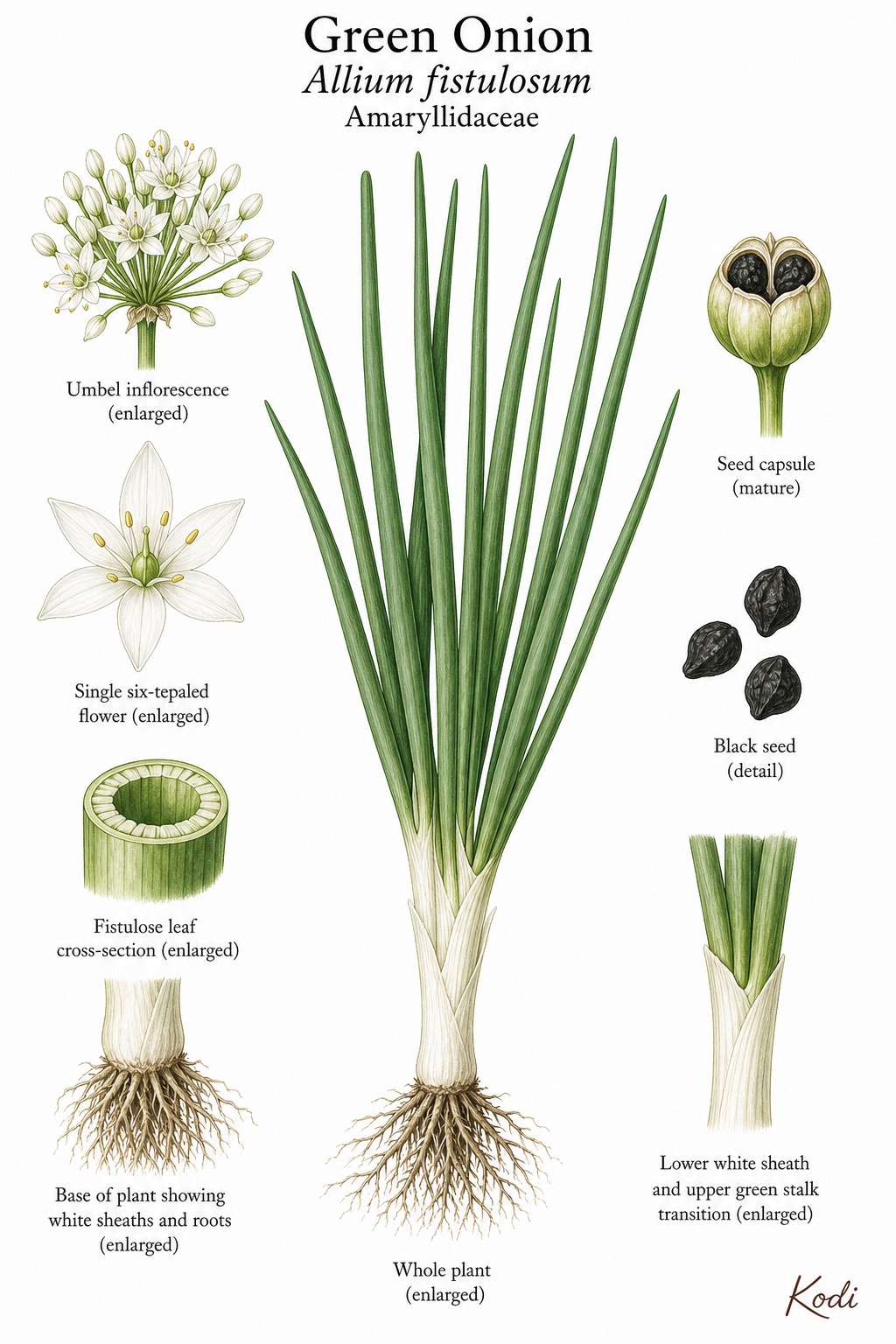
Known in TCM as Cong (葱), this pungent, warm herb enters the Lung and Stomach. Traditionally, it releases exterior and dispels Wind-Cold, most often applied for common cold, abdominal pain, and carbuncle. Modern research has identified Allicin among its active constituents.
Part used: Bulb
Also Known As
Latin: Bulbus Allii Fistulosi | Pinyin: Cong | Chinese: 葱
TCM Properties
- Taste
- pungent
- Temperature
- warm
- Channels
- Lung, Stomach
Traditional Use
Primary Actions
- Releases exterior and dispels Wind-Cold … whole green onion (including green stalk and white base) used for early wind-cold colds; slightly broader dispersing action than Cong Bai (white base only)
- Invigorates Yang and disperses Cold … abdominal cold-pain, cold extremities, and nausea from Cold accumulation in the Middle Jiao
- Resolves toxicity … carbuncles, mastitis, and insect bites; applied fresh externally
Secondary Actions
- Condiment-medicine … the most universally consumed aromatic kitchen herb in Chinese cuisine; used daily as both food and medicine in Chinese households
- Promotes sweating … mild diaphoretic for early febrile illness; less potent than stronger exterior-releasing herbs
Classic Formulas
- Cong Chi Tang (葱豉汤) variant … whole Cong (green onion including green parts) combined with Dan Dou Chi for early wind-cold cold; the green stalk adds aromatic Lung-opening properties to complement the Yang-invigorating white base
Classical References
- SPECIES NOTE: Herb #93 (Cong, 葱) represents the whole Allium fistulosum plant as used in Chinese food and folk medicine; shares the Latin Bulbus Allii Fistulosi with herb #92 (Cong Bai, 葱白 … white base only) and herb #94 (Si Ji Cong Tou, 四季葱头 … four-season onion bulb); the XLSX source filed three separate entries for this species, likely representing the whole plant, white base, and a specific cultivar variant; in TCM practice, Cong Bai (white base) is the standard drug; the whole plant 'Cong' is primarily a food item with medicinal properties
- Ben Cao Gang Mu (Li Shizhen): 'Cong (green onion) is pungent and warm, stimulates the Lung Qi, disperses Wind-Cold from the surface, warms the Middle Jiao, relieves abdominal pain, and kills insects … it has been used as a food herb for five thousand years'
Modern Research
Active Compounds
- Allicin and diallyl disulfide (organosulfur; antimicrobial, anti-inflammatory)
- Quercetin and kaempferol (flavonoids; anti-inflammatory, antioxidant, cardioprotective)
- Fructo-oligosaccharides (prebiotic fibre; gut microbiome support)
- Chlorogenic acid (phenolic acid; antioxidant, antidiabetic)
- Vitamin C, folate, vitamin K1 (micronutrients)
Studied Effects
- Antimicrobial: allicin and organosulfur compounds from A. fistulosum inhibit Staphylococcus aureus, E. coli, and H. pylori; consistent with the Heat-resolving, cold-dispersing antimicrobial indications
- Prebiotic and gut health: fructo-oligosaccharides from Welsh onion selectively promote beneficial Bifidobacterium and Lactobacillus species in the colon, consistent with Middle Jiao harmonising traditional use
- Cardiovascular protective: quercetin reduces LDL oxidation and platelet aggregation at dietary doses … whole-diet protective effect consistent with daily culinary use as a kitchen medicine
Safety & Interactions
Contraindications
- Wind-Heat exterior patterns … pungent-warm herb inappropriate for heat-type colds
- Excess sweating … diaphoretic action would further deplete fluids
Cautions
- Standard dose: 3–5 stalks whole plant; widely consumed daily as food without adverse effects
- Anticoagulants: quercetin has mild antiplatelet activity; not clinically significant at culinary doses
- Considered safe at culinary and folk-medicine doses; classified as shi yao (food-medicine)
Conditions
- Common Cold Traditional ★★★☆☆ JSON
- Abdominal Pain Traditional ★★☆☆☆ JSON
- Carbuncle Traditional ★★☆☆☆ JSON
Frequently Asked Questions
What is Green Onion used for?
Green Onion is traditionally used to Releases exterior and dispels Wind-Cold … whole green onion (including green stalk and white base) used for early wind-cold colds; slightly broader dispersing action than Cong Bai (white base only), Invigorates Yang and disperses Cold … abdominal cold-pain, cold extremities, and nausea from Cold accumulation in the Middle Jiao, Resolves toxicity … carbuncles, mastitis, and insect bites; applied fresh externally. Research has investigated its effects on: Antimicrobial: allicin and organosulfur compounds from A. fistulosum inhibit Staphylococcus aureus, E. coli, and H. pylori; consistent with the Heat-resolving, cold-dispersing antimicrobial indications; Prebiotic and gut health: fructo-oligosaccharides from Welsh onion selectively promote beneficial Bifidobacterium and Lactobacillus species in the colon, consistent with Middle Jiao harmonising traditional use.
What are other names for Green Onion?
Green Onion is also known as Allium. In TCM: 葱 (Cong); Bulbus Allii Fistulosi.
Is Green Onion safe during pregnancy?
Green Onion is generally considered safe during pregnancy in normal amounts. Therapeutic or concentrated doses should be discussed with a qualified healthcare provider before use.
What are the contraindications for Green Onion?
Green Onion should not be used in: Wind-Heat exterior patterns … pungent-warm herb inappropriate for heat-type colds; Excess sweating … diaphoretic action would further deplete fluids. Consult a qualified healthcare provider before use.